
Mistral released Timestral on October 15: four open-weight time-series forecasting models at 5M, 28M, 123M and 209M parameters. On X, a widely shared post said, in French, that the model had not been talked about much. On Monday, October 19, a Hacker News thread posted at 2:59 AM PDT reached the front page and passed 350 points and 59 comments by mid-morning PT. We covered the launch and its license in our news post on Timestral. This roundup covers what forecasters, developers and skeptics said once they looked at it.
The short version: people like that it runs on a CPU and that the small checkpoints are strong. The leaderboard margins are thin, only one widely shared post reproduced any of Mistral's numbers, and the weights license drew the most pushback.
What Mistral shipped
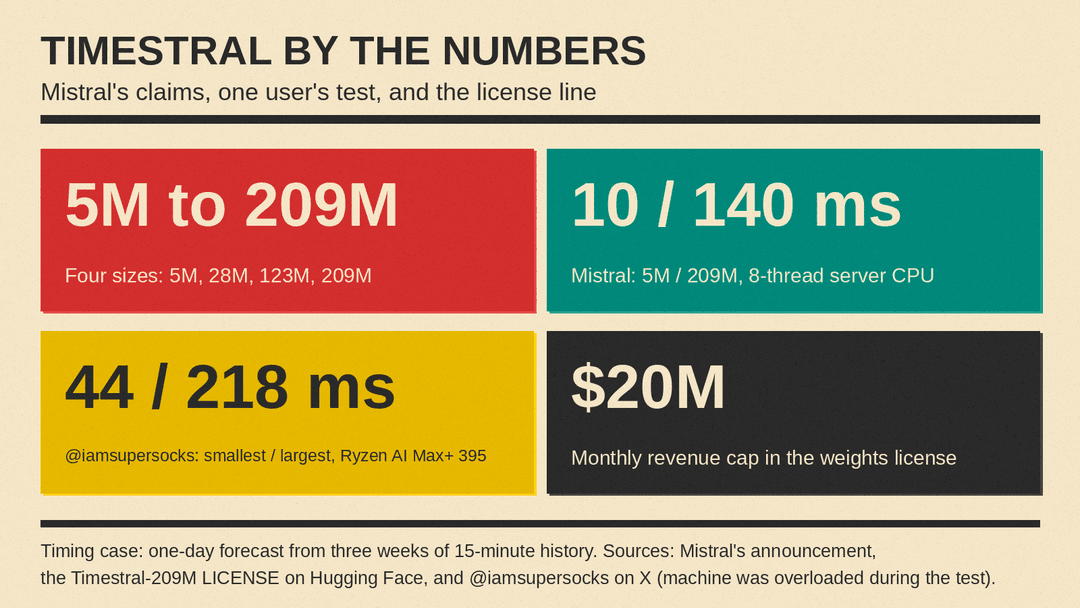
Mistral's announcement says the 209M model "ranks first on all three of the field's main public benchmarks, GIFT-Eval, TIME, and fev-bench". The models give probabilistic forecasts over 21 quantiles, take up to 32,768 time steps of context, and accept past-only and known-future covariates. Mistral says that on an 8-thread server CPU, a one-day forecast from three weeks of 15-minute history takes 10 ms with the 5M model and 140 ms with the 209M model. It also says the 28M model beats Chronos-2, "about four times larger", on GIFT-Eval and TIME. A technical report is promised but not yet published.
The inference code on GitHub is Apache 2.0. The weights on Hugging Face use a "Modified MIT License". Its second condition says you are not authorized to use the model "if the global consolidated monthly revenue of your company (or that of your employer) exceeds $20 million (or its equivalent in another currency) for the preceding month."
Praise: small, fast and no GPU
A widely shared hands-on post came from @iamsupersocks, written in French, with more than 300 likes. They ran the models on a Ryzen AI Max+ 395 machine without a GPU. In Mistral's one-day test case they measured 218 ms for the largest model and 44 ms for the smallest, a little slower than Mistral's figures, which they put down to their machine being overloaded at the time. They wrote that this was more than twice as fast as Amazon's Chronos-Bolt at a comparable size. Their favorite was the 28M checkpoint, which they said still beats Amazon's Chronos-2 and is the one they would start with for most uses.
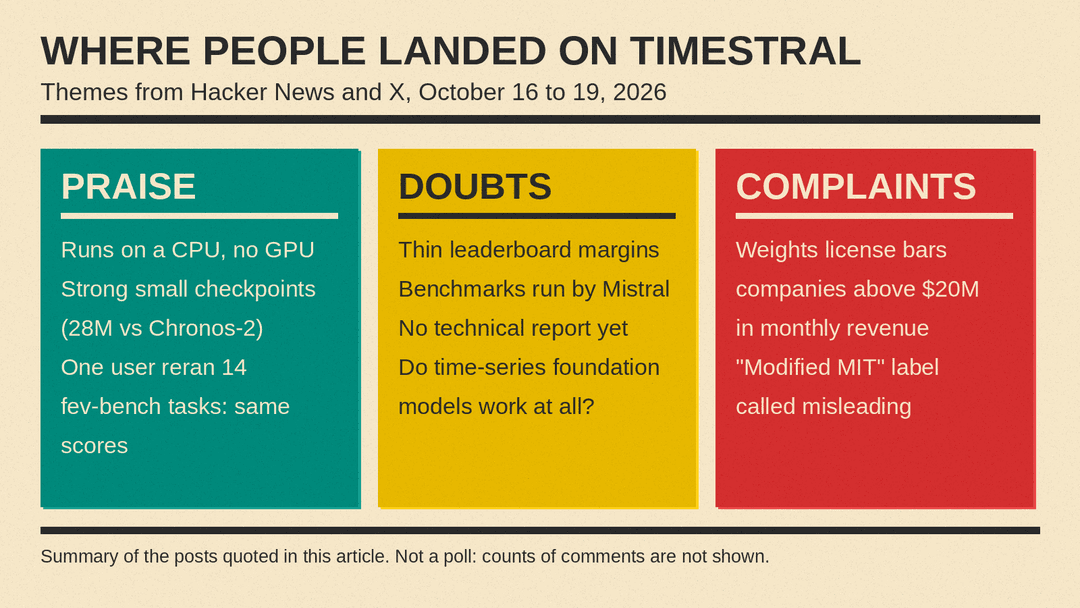
Others made the same point about the small models. @aapakari replied: "28M beating Chronos-2 is the real headline here". @threerouter called Timestral "the first thing from a major lab worth a real eval in a while" and added: "for most teams the small checkpoints matter more than the flagship."
On Hacker News, edot wrote: "It's mind-blowing to me that it used to take me months to build and deploy a forecasting model five years ago." alex7o, who said they had used Nixtla's tools before, was "happy that there is more open competition now in the space". SabriMjd posted a quick test on X: "interesting for sure compared to neural prophet, it's pretty fast too."
The benchmarks people checked
Only one widely shared post reported reproducing Mistral's numbers. @iamsupersocks said they reran 14 fev-bench tasks with the same code as the published results and got exactly the same scores. They agreed Timestral is first among models usable as-is, with a fairly small lead over the runners-up, including Google's TimesFM-3. A reply from @luisships, in French, said that rerunning benchmark tasks is the step they wait for after every announcement and that nobody does.
Everyone else pointed at the size of the lead. @threerouter quoted the GIFT-Eval figures in Mistral's model card: "on GIFT-Eval MASE it posts 0.658 vs t0-gamma 0.661 and Chronos-2 0.698. so it leads, but the gap over the runner-up is 0.003." They added: "worth keeping in mind those are mistral's own numbers and the tech report isn't out yet." On Hacker News, nelaggy wrote: "crazy how they make an improvement of 0.03 look like a 5x difference". rubenfiszel found it "quite impressive that they get performance so close to the leader t0-gamma", even though Mistral's charts put Timestral first, and called the license "unfortunate". GeoffNN, who speaks for The Forecasting Company in the thread, said its own Apache 2.0 model has "a 42% winrate vs Timestral on fevbench" and that "the winrates are tight".
@cbalarezol posted a long breakdown in Spanish. Their points: Mistral ran all the benchmarks itself, the 140 ms figure applies to one CPU, horizon and context window, the release is a Public Preview installed from GitHub rather than PyPI, and the repo does not accept pull requests. Hacker News user Trusteando suggested how to test a forecaster: "use a data-generating process with a high signal-to-noise ratio where a classical method (empirical conditional distributions, i.e., counting) can capture most of the signal. Then check whether the model captures that signal too."
Complaints: the license
The license got more comments than any benchmark. On Hacker News, when colesantiago said "Timestral is free and open weights", pquerna replied: "Timestral is not free - it has a "Modified" MIT, which requires you to buy from Mistral if your global business makes more than $20m a month. Calling it "Modified" MIT is just misleading."
@threerouter called it "a real one for self-hosters" and wrote: "so the enterprises that actually want air-gapped forecasting are often exactly the ones excluded." @cbalarezol made the same point in Spanish and noted that the Hugging Face card says only "Modified MIT", so readers have to open the LICENSE file to find the threshold. @basedpolymer argued, in French, that the model is mostly useful to large companies and that the license is restrictive enough to push them to alternatives.
Not everyone thought the cap matters. @Dys_hay replied, in French, that $20 million a month is $240 million a year, so almost nobody is affected. @cbalarezol also said most small and mid-sized companies in Latin America sit well below the line.
The bigger argument: do time-series foundation models work?
A large part of the Hacker News thread was about the whole category, not Timestral. beernet wrote that "time series data is fundamentally different from textual data" and that "Real-world usability is very limited, which is probably the reason why the blog post features an imaginary customer rather than an actual reference." saithound agreed: "These are essentially numerology models."
logancbrown disagreed and argued the case for scale: with 10,000 series to forecast, "A TSFM saves a ton of work in modeling each of these series and could potentially generalize better to produce more accurate forecasts." justincormack said many uses do not need much accuracy, such as forecasting traffic to scale a load balancer, and that the models replace "various traditional curve fitting tools."
joefourier, who works in audio and vision ML, questioned treating covariates as optional. Mistral's post says known-future covariates such as production schedules "improve forecast quality". joefourier wrote: "To me this should be the entire basis of the system, not a condition to improve forecast quality". whatever1 doubted forecasting can be judged objectively at all: "We observe just one universe."
Practical warnings from users
Several replies were about data, not the model. @invalidcmd wrote that "most demand history is lying to you. every week you were out of stock shows up as low demand," and advised: "fix your stockout flags first or you're just forecasting your own mistakes faster". @Cabecinha1984 warned that "these models want regular intervals. Fill the gaps or resample first, or the forecast learns your missing data instead of your load." @codemonk_dev put it more bluntly: "A fast forecast that ignores your calendar is still a wrong forecast."
Builders also started filling gaps. @mh91929 wrote that "there's no official fine-tuning story yet" and posted timestral-ft, a tool for full and LoRA fine-tuning with backtests. Mistral itself offers fine-tuning through its Forge service.
The thread also drifted to Mistral's language model. ritzaco said they tried Mistral Large 4, nicknamed Le Chonk, for coding and "was very disappointed", and other commenters complained that the service was slow. That is a separate model; our Mistral Large 4 explainer covers it.
What to take from it
The early verdict is cautious but mostly positive for anyone who forecasts at small scale. The CPU speed claims roughly held up in one independent test, and the 28M model is the one people keep recommending. The benchmark lead is real on Mistral's numbers but small, and outside reproduction so far is one person's 14 tasks. Before you use it at work, check your company's monthly revenue against the license. If you are under the cap, the common advice in these threads is to backtest it on your own series against what you use today.
