
Two announcements on October 18 approach one problem from opposite ends. Stripe shared figures on how much AI agents are actually buying through Link, its consumer payments wallet. World, the identity network co-founded by Sam Altman, launched a bundle for banks that includes a way for agents to prove a verified human stands behind them. One measures demand for agent-initiated payments; the other targets the trust gap that holds them back.
What the Stripe numbers say
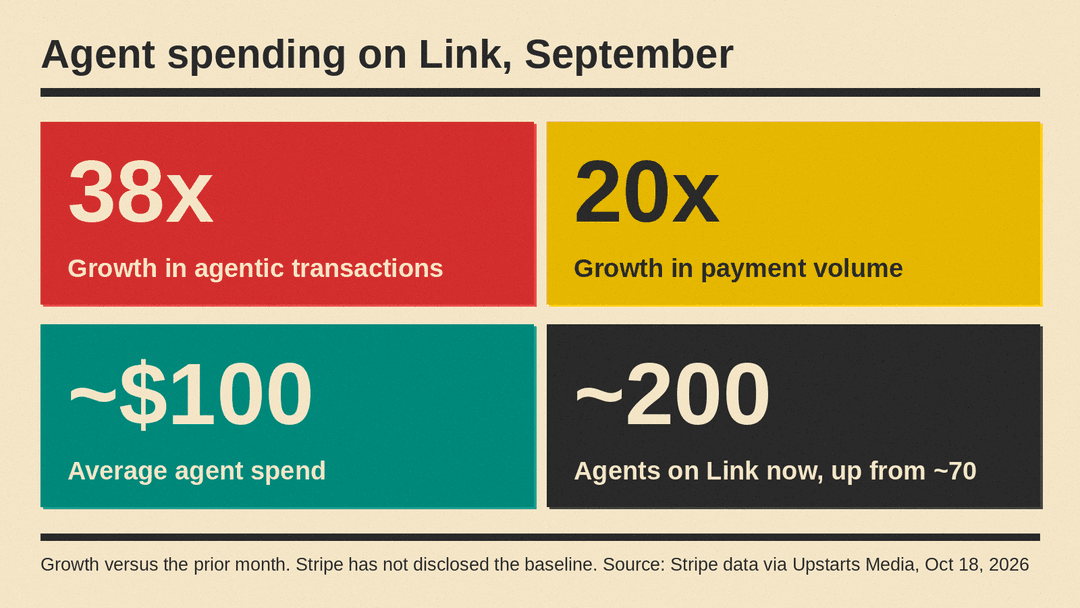
According to Upstarts Media, which received the data exclusively, agentic transactions through Link grew 38x in September while payment volume grew 20x. Retail led both measures, and the average spend was about $100, per Techmeme's summary of the report. Stripe had already disclosed the 38x figure in a September 29 product post, describing it as growth in agentic purchases over the preceding month.
The gap between the two multiples matters. If transaction count rose faster than dollar volume, the typical agent purchase got smaller, which fits consumers handing agents low-stakes retail buys. Stripe has not published the baseline, so the multiples say nothing about absolute volume, and a month that included several large agent launches may overstate the underlying trend.
Dan Hill, who leads Link consumer product at Stripe, told Upstarts that Link now powers about 200 agents, up from roughly 70 when the September numbers were computed. Link has about 300 million users overall, so agents remain a small share. Upstarts also reports that Anthropic and OpenAI use Link, but not yet for agentic commerce.
How Link handles agent checkout
Stripe's tooling explains part of the growth. When Meta integrated Link into its Muse agent in September, Stripe said Muse could check out directly at more than 1 million businesses that accept Link. At other merchants, Link issues the agent a single-use virtual card scoped to the approved purchase. The consumer approves each total in the chat interface, and the agent never sees the underlying card details.
The September 29 update added capabilities aimed at failure modes specific to agents:
- Incremental authorization, so an agent can raise an approved amount when taxes, shipping, or add-ons change the final price, instead of restarting checkout.
- Guidance on payment obstacles, such as a URL the agent can send the user to complete a 3D Secure challenge, or a prompt to choose another payment method after a decline.
- Consumer-permissioned spending insights through Financial Connections, which Stripe says covers more than 12,000 financial institutions and over 97% of US bank accounts.
- Purchase protection on eligible agent-completed purchases.
These are plumbing changes, but they map onto the main reasons agent purchases fail: prices that move mid-flow, step-up authentication designed for a human at the keyboard, and no recourse when the agent makes a mistake.
World's pitch: prove the human behind the agent
On October 18, World co-founder Alex Blania announced World ID for banking and finance at Money20/20 in Las Vegas. The offering bundles three existing products: the World ID app, World ID for Zoom, and World ID for Agents.
The app issues three kinds of cryptographic Proofs. Proof of Human is established by a one-time visit to World's Orb device. Proof of Presence is a phone-based liveness check. Proof of Attributes confirms a single fact from a government credential, such as age or nationality. World positions these for account opening, account recovery, and human-bound approvals of ACH and wire transfers.
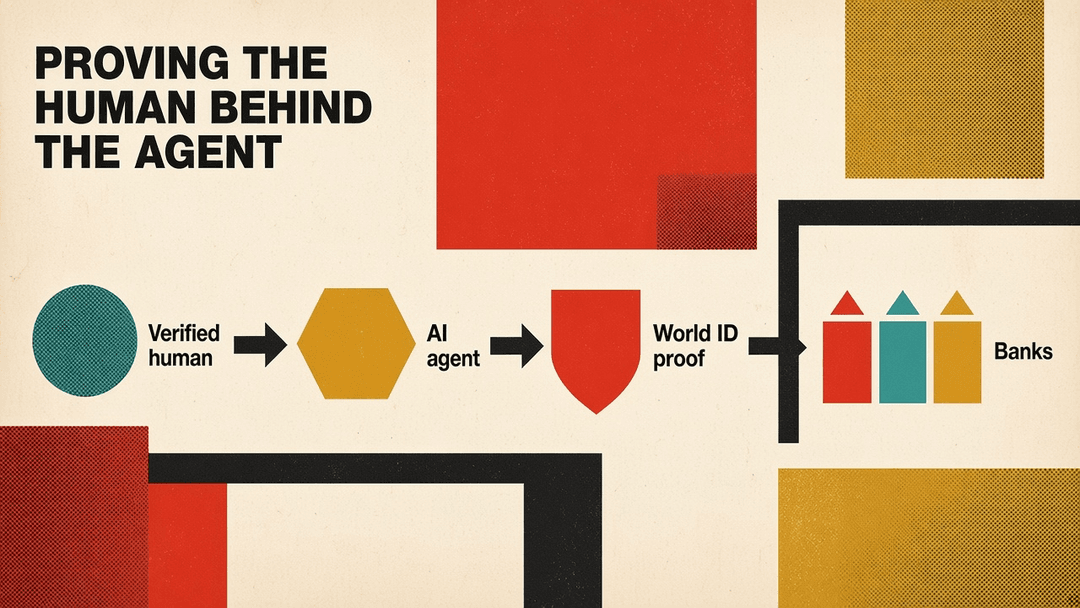
The agent piece is AgentKit, which World describes as still in beta. A person delegates selected Proofs to an agent, which can then show that it acts for a verified human without disclosing who that human is. In the open-source AgentKit repository, the flow is concrete: an agent wallet is registered using a World ID proof, a site or API that uses the x402 payment protocol challenges the agent to sign a CAIP-122 message, and the server verifies the signature, resolves the registering human, and applies its access policy.
World named Bain Capital, OpenExchange, Outtake, Pantera Capital, and VanEck Funds as design partners. The Block noted that no bank was named as a customer, and the announcement gave no pricing or rollout timeline. World says more than 18 million people hold a Proof of Human credential. World ID for Zoom, which checks a meeting participant against their Orb-verified identity, is now generally available.
Two models of agent trust
The announcements describe different trust models. Stripe's is payment-centric: scoped virtual cards, user approval of each total, and protection after the fact. World's is identity-centric: a cryptographic claim that a unique, verified human authorized the agent, with no personal data attached. A bank or merchant could reasonably want both, one to cap what an agent can spend and one to know whether any person is accountable for it.
The fraud backdrop World cites should be read as context, not measurement. Deloitte projected that generative AI could push US fraud losses to $40 billion by 2027, up from $12.3 billion in 2023. World also points to the 2024 Arup case, in which an employee transferred about $25.6 million after a video call where the other participants were deepfakes.
Three things are worth watching. First, whether Stripe's October figures hold up once September's cluster of agent launches is in the base. Second, whether any bank signs on as a named World ID customer rather than a design partner. Third, whether agent-identity schemes such as AgentKit get adopted by payment networks and large merchants, or stay opt-in for individual sites and APIs.
Sources
- Upstarts Media: Data: How AI Assistants Are Spending Real Money (October 18, 2026)
- Techmeme summary of the Upstarts report
- Stripe: Helping personal agents shop more intelligently and reliably with Link (September 29, 2026)
- Stripe: Stripe helps Muse, Meta's new personal AI agent, shop across the internet with Link (September 8, 2026)
- World: World ID for banking and finance (October 18, 2026)
- The Block: World launches World ID suite for banks (October 18, 2026)
- worldcoin/agentkit on GitHub
- Deloitte: Deepfake banking fraud risk on the rise
- CNN: Arup deepfake scam loss
