
StepFun is a Shanghai-based AI company that publishes model weights on Hugging Face and runs its own API platform. As of November 2026, its catalog spans a large flagship model released under a custom license, two Apache 2.0 "Flash" models, a 10B multimodal model, and open families for speech, video generation, image editing, 3D, OCR, GUI agents, and math proofs. This explainer covers who is behind the company, what it publishes, what the StepFun Model License actually says, and how you can run or call these models.
What is StepFun?
StepFun is a Shanghai-based AI company, according to The Wire China's June 8, 2025 profile, "What is StepFun?". The Wire China describes the company as one of China's "AI tigers". Its China API platform, platform.stepfun.com, uses the Chinese name 阶跃星辰. Its CEO is Jiang Daxin, per 36Kr.
StepFun publishes its models on Hugging Face under the stepfun-ai organization. Alongside the model work, it has shipped consumer products, and it has consolidated them over time. In June 2025, 36Kr reported that the chat product StepAsk had been renamed StepAI, and StepFun told 36Kr that the change marks a transition from a chat-type product to one with agent capabilities. 36Kr reported that the role-play app Bubble Duck stopped large-scale investment in December 2024 and that its team merged into StepAsk. StepFun told 36Kr that in 2025 it converged its products and focused on agents (36Kr's English edition is a translation of the Chinese report).
What models does StepFun make?
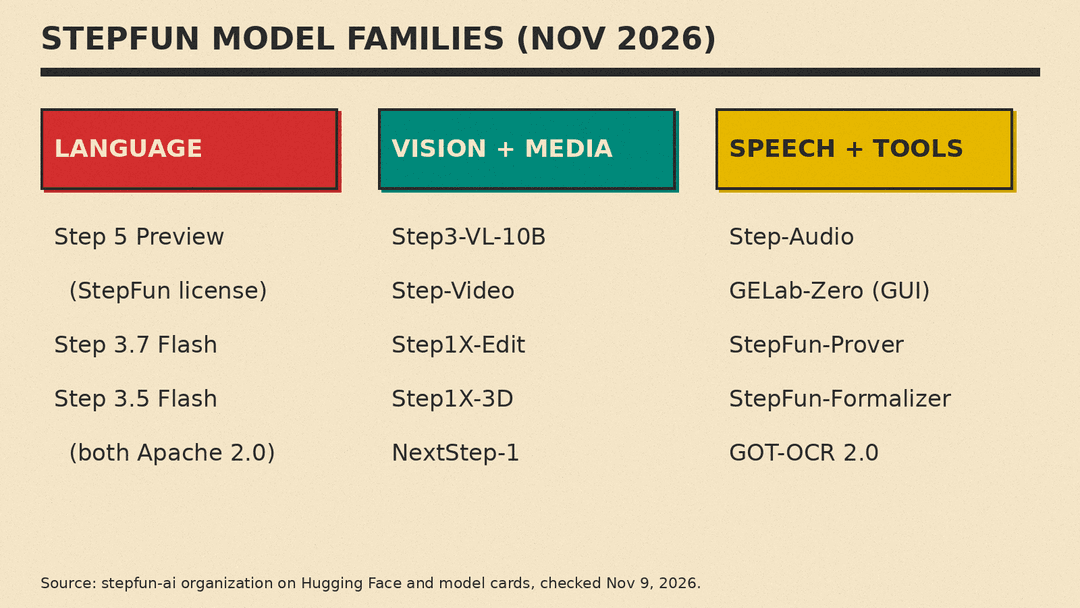
As of November 2026, the main language model releases are:
- Step 5 Preview. StepFun calls this its "flagship model for agentic work". It is a sparse Mixture-of-Experts (MoE) model with 600B total parameters, 27B active parameters, and support for up to 1M tokens of context. More on this model in the next section.
- Step 3.7 Flash. An Apache 2.0 sparse MoE vision-language model with 198B total parameters, made of a 196B language backbone plus a 1.8B vision encoder. It activates about 11B parameters per token and has a 256k context window. StepFun says throughput reaches up to 400 tokens per second. The card describes three reasoning levels: low, medium, and high.
- Step 3.5 Flash. Also Apache 2.0. A sparse MoE that activates 11B of its 196B parameters per token, with a 256K context window. StepFun reported 74.4% on SWE-bench Verified and 51.0% on Terminal-Bench 2.0 on the model card. There is a tech report on arXiv.
- Step3-VL-10B. Apache 2.0, a 10B-parameter open multimodal model with a paper on arXiv. The model card includes an apology from StepFun for inaccuracies in some Qwen3VL-8B comparison benchmarks caused by a wrong max_tokens setting.
Beyond the language models, the stepfun-ai Hugging Face page hosts several other open model families as of November 2026:
- Step-Audio: speech models, for example Step-Audio-2-mini, Step-Audio-R1.1, Step-Audio-EditX, and Step-Audio-TTS-3B.
- Step-Video: video generation, including stepvideo-t2v and stepvideo-ti2v.
- Step1X-Edit: image editing.
- Step1X-3D: 3D.
- NextStep-1: image generation.
- GELab-Zero-4B-preview: a GUI agent model.
- StepFun-Prover and StepFun-Formalizer: math proof and formalization models.
- GOT-OCR 2.0: OCR.
What is the difference between Step 3.5 Flash and Step 3.7 Flash?
Both are Apache 2.0 sparse MoE models with about 196B language parameters, roughly 11B active per token and a 256K context window, per their model cards. The main difference is vision. The Step 3.7 Flash card describes a vision-language model with a 1.8B vision encoder for native image understanding, and it adds three selectable reasoning levels.
The Step 3.5 Flash card focuses on text reasoning and agents. StepFun says it uses 3-way Multi-Token Prediction to reach 100 to 300 tokens per second in typical use, peaking at 350 for single-stream coding. It mixes three sliding window attention layers with every full attention layer to keep long context cheaper. StepFun says it runs on high-end consumer hardware such as a Mac Studio M4 Max or NVIDIA DGX Spark.
Is Step 5 Preview open source?
The weights are downloadable, but whether that counts as "open source" depends on the license. On Hugging Face, the Step 5 Preview license field is listed as "other". That "other" is the StepFun Model License 1.0, a custom license described in the next section. The model card calls it "an Apache-2.0-Style license, with additional attribution and commercial-license conditions". The Flash models, by contrast, use Apache 2.0, a standard permissive open source license.
On capabilities, the model card is the primary source. Its introduction says Step 5 Preview accepts text, images, and video. However, the card's specification list says input is text and image, and output is text. The card lists both, so if multimodal input matters for your use case, check the current card and test directly.
StepFun says the model targets software engineering, long-horizon agent tasks, and professional knowledge work, and that it is "particularly strong in financial tasks". These are the vendor's own claims from the model card, not independently verified results.
What does the StepFun Model License allow?
The StepFun Model License 1.0 grants, in the license's words, a "perpetual (subject to Section 5), worldwide, non-exclusive, no-charge, royalty-free license to use, copy, distribute, and sublicense" the model. The conditions that matter most sit in Sections 2(b) and 2(c).
Section 2(b) is an attribution requirement with a size threshold. If "any commercial product or service provided by You or Your affiliates that uses or incorporates the Model or a Derivative Work has more than 100,000,000 active users or generates revenue exceeding US$20,000,000 (or the equivalent in another currency)" in any calendar month, then you must prominently display "Powered by StepFun AI" on the product's user interface, including the About page, and in its user agreement or documentation.
Section 2(c) requires a separate commercial license agreement in two situations:
- A hardware maker or brand owner of devices "(including, without limitation, phones, vehicles, smart glasses, wearables, robots, or smart-home devices)" first makes the model's capabilities commercially available as a feature of those devices.
- You use the model for any commercial purpose while operating a Model as a Service (MaaS) business, if the combined revenue of you and your affiliates "from all sources exceeds US$20,000,000 (or the equivalent in another currency) over any consecutive twelve-month period".
Three clarifications from the license text are important. Section 2(c) does not apply to internal use that does not make the model or its outputs available to any third party, or to a copy obtained through a distribution channel StepFun has certified, within the scope of that certification. And MaaS means giving a third party inference or fine-tuning access, including through an API, where the third party has meaningful control over inputs, parameters, or training data. The license says that building the model into a specific end-user feature without giving that control to a third party, or only relaying requests to another provider's model, is not MaaS.
This is a summary, not legal advice. Read the license text yourself before you build on Step 5 Preview.
How can you try StepFun models?
There are three broad routes: hosted APIs, third-party serving platforms, and self-hosting.
For the Flash models, the Step 3.7 Flash card lists availability on the StepFun Open Platform, at platform.stepfun.ai for global users and platform.stepfun.com in China, plus OpenRouter and NVIDIA NIM. Pricing as listed on the model card, checked November 9, 2026: input at $0.20 per million tokens on a cache miss, input at $0.04 per million tokens on a cache hit, and output at $1.15 per million tokens.
For self-hosting, Step 3.7 Flash is supported in vLLM, SGLang, Hugging Face Transformers, and llama.cpp. The card says it can run locally on high-memory devices such as NVIDIA DGX Station, AMD Ryzen AI Max+ 395 systems, and Mac Studio or MacBook Pro devices with at least 128GB of unified memory. Step 3.5 Flash and Step3-VL-10B are also Apache 2.0 downloads from the same Hugging Face organization, so standard open-weight tooling applies.
For Step 5 Preview, the deployment examples on its card use one B300 node with 4 GPUs (FP8) or one H200 node with 8 GPUs (FP8), using vLLM, SGLang, or Transformers.
On the consumer side, 36Kr reported in June 2025 that StepFun's chat product StepAsk had been renamed StepAI, which StepFun said reflects a shift toward agent capabilities. It is the company's own app, as opposed to raw model access.
How does StepFun compare with other Chinese AI labs?
Structurally, StepFun resembles the other labs covered in China's AI Labs Explained. Like MiniMax and Moonshot AI, the maker of Kimi, StepFun releases open weights on Hugging Face and runs its own API platform.
The difference worth noting is licensing. StepFun's newest flagship, Step 5 Preview, uses a custom license with user and revenue thresholds and a device clause, while its Flash models use Apache 2.0. The flagship license adds an attribution obligation above 100 million active users or US$20,000,000 in revenue in a calendar month, and requires separate commercial agreements for device integration and for MaaS operators whose group revenue tops US$20,000,000 over any 12 months. If your product sits near those thresholds, the license terms matter more than the parameter counts.
This is a structural comparison only, not a ranking. Which lab's models fit your workload depends on your modality needs, context length, hardware, and legal constraints.
What to watch?
Rather than predictions, here are questions you can check yourself over time:
- Has Step 5 left preview status, and if so, did the specs, modalities, or license change with the full release?
- Does the Step 5 Preview model card resolve the discrepancy between its introduction (text, images, and video input) and its specification list (text and image input, text output)?
- Has the StepFun Model License been revised, or have new thresholds appeared?
- Are the Step 3.7 Flash prices on the model card and platform.stepfun.ai still the same?
- What new families appear on the stepfun-ai Hugging Face page?
Checking the model cards and the license text directly will always beat relying on any summary, including this one.
Sources
- StepFun on Hugging Face (stepfun-ai organization)
- Step 5 Preview model card
- StepFun Model License 1.0 (Step 5 Preview)
- Step 3.7 Flash model card
- Step 3.5 Flash model card
- Step 3.5 Flash tech report (arXiv)
- Step3-VL-10B model card
- Step3-VL-10B paper (arXiv)
- The Wire China: What is StepFun? (June 8, 2025)
- 36Kr: StepFun's Bubble Duck to cease operation, focus shifts to agents (June 4, 2025)
