
Pangu is the name Huawei uses for its AI models. Huawei also makes phones and Ascend AI chips, and Pangu ties into both. It shows up in three places: as industry models sold on Huawei Cloud, as an open-source model family called openPangu, and inside Huawei's HarmonyOS phone software.
This guide explains each part in plain English, what you can download, how it ties to Huawei's chips, and why it matters. For the wider picture, see our guide to China's AI labs and who makes which model.
What is Huawei Pangu?
Pangu is a family of AI models, not a single chatbot. According to a Kuai Technology report carried by Tencent News, Pangu was built jointly by Huawei Cloud, Recurrent AI and Peng Cheng Laboratory, covers five base model types including language, computer vision and multimodal models, and was first released in April 2021.
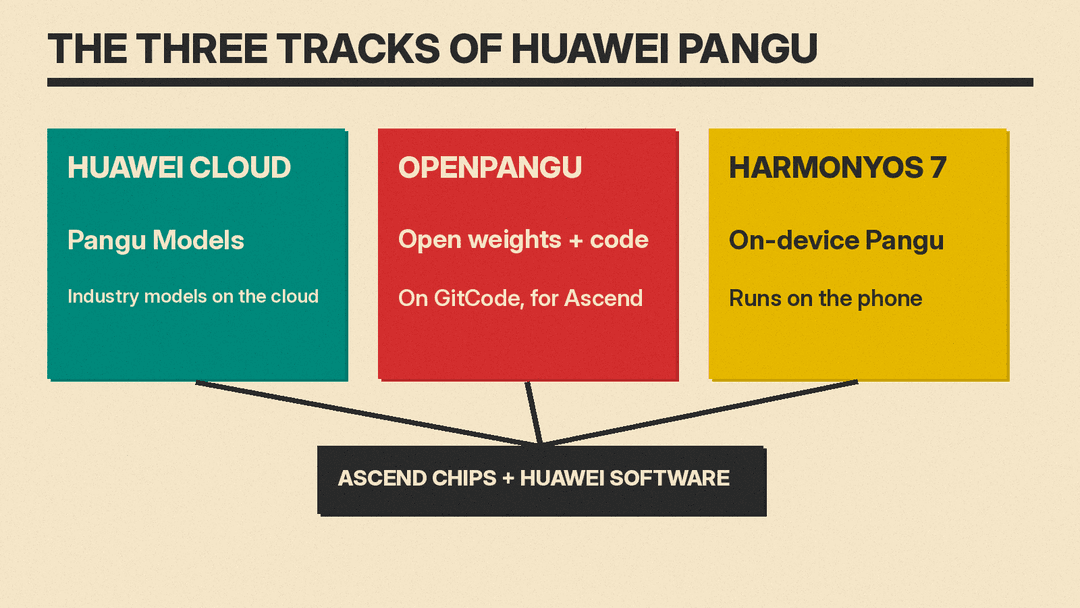
Today the name covers three tracks:
- Pangu Models on Huawei Cloud: cloud models aimed at businesses and industries.
- openPangu: Huawei's open-source model brand, built to train and run on Ascend chips.
- On-device Pangu in HarmonyOS: a model built into Huawei's phone operating system.
What are Pangu Models on Huawei Cloud?
Pangu Models are the business side. Huawei Cloud says they "focus on industry-facing applications," and its examples come from agriculture, manufacturing and scientific research rather than a consumer chat app.
The version Huawei Cloud described in most detail is Pangu Models 5.5, announced at Huawei's developer conference (HDC 2025) on June 20, 2025. According to Huawei Cloud's announcement, Huawei Cloud CEO Zhang Ping'an presented upgrades across five areas: natural language processing (NLP), computer vision (CV), multimodal, prediction and scientific computing.
Huawei Cloud gave these details for that release:
- Language model: a 718B "deep thinking" mixture-of-experts (MoE) model with 256 experts. An MoE model splits its knowledge across many expert sub-networks and uses only some of them for each request.
- Fast and slow thinking: Huawei says the model can choose quick answers for easy questions and deeper reasoning for hard ones, and claims this made overall inference eight times more efficient.
- DeepDiver: a research feature that Huawei says can complete a more than 10-step complex Q&A within 5 minutes and write survey reports of over 10,000 words.
- Prediction model: handles table data, time series data and image data in one framework, for uses such as factory process data and equipment logs.
- Vision model: 30B parameters with an MoE design, according to Huawei Cloud.
The Chinese version of the announcement lists customer examples. Huawei Cloud says the Shenzhen Meteorological Bureau upgraded its Zhiji weather model on Pangu for regional ensemble forecasts, Chongqing's meteorological bureau built a 12-hour weather model on Pangu for same-day severe weather warnings, and Shenzhen Energy uses Pangu to forecast wind and solar power output.
Huawei Cloud says the service runs on its AI Cloud Service built on CloudMatrix 384 supernodes. Huawei Cloud's model numbers above are from its June 2025 announcement; check Huawei Cloud for current versions before you buy.
What is openPangu?
openPangu is the open-source side. In its June 30, 2026 press release, Huawei describes openPangu as its open-source AI model brand. Huawei says the goal is to give the industry a best-practice reference for using Ascend chips through Ascend-native training and inference.
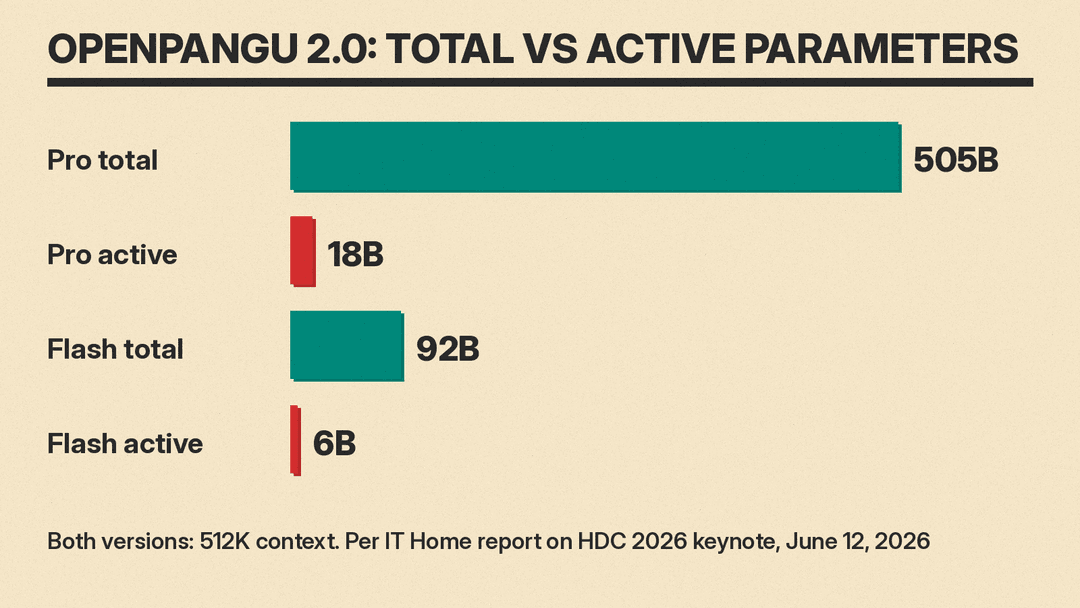
Huawei launched openPangu 2.0 at HDC 2026 on June 12, 2026. IT Home reported from the keynote by Richard Yu (Yu Chengdong), chairman of Huawei's consumer business group, that openPangu 2.0 has a 512K context window and two versions:
- openPangu 2.0 Pro: 505B total parameters, 18B active parameters
- openPangu 2.0 Flash: 92B total parameters, 6B active parameters
"Active parameters" are the part of the model used for each token. The gap between total and active parameters means only a small share of each model runs at a time, which lowers the cost of running it.
According to the same IT Home report, Huawei said openPangu 2.0 is tuned for Ascend computing, with single-card throughput up to 2 times that of other mainstream open-source models, and that it is adapted for agent tasks on HarmonyOS. Those are Huawei's claims, not independent test results.
IT Home also reported Yu's answer on why the largest model is 505B. He said much of Huawei's computing power goes to support other Chinese companies, so the amount Huawei keeps for itself is limited, and that because AI compute is costly, Huawei focuses on latency and throughput.
What can you download?
Huawei released openPangu 2.0 in steps, each with its own press release:
- June 30, 2026: openPangu-2.0-Flash weights, basic inference code, and training and inference operators.
- July 31, 2026: openPangu-2.0-Pro weights, basic inference code and a technical report.
- September 28, 2026: pretraining, supervised fine-tuning and reinforcement learning code. Huawei says the training framework targets models from tens of billions to trillions of parameters, and the RL framework is built on the VERL ecosystem for Ascend.
The files live on GitCode, a Chinese code hosting site, under the Ascend Tribe organization. As of November 11, 2026, that page lists five openPangu models: openPangu-2.0-Pro, openPangu-2.0-Flash, openPangu-R-72B-2512, openPangu-R-7B-2512 and openPangu-VL-7B, which Huawei labels a multimodal model. The openPangu-2.0-Infer, openPangu-2.0-Training and openPangu-2.0-RL code repositories are labeled Apache-2.0 on that page. Check each model repository for its own license terms before you use the weights.
What is on-device Pangu in HarmonyOS?
The third track runs on phones. At the same HDC 2026 event, Huawei unveiled HarmonyOS 7 and opened a developer beta. IT Home reported that HarmonyOS 7 embeds Pangu model 6.0 in the system so AI tasks can run locally on the device, working with Huawei's agent framework and its system assistant Xiaoyi.
Huawei's own press release lists openPangu 2.0 as one of five main HDC 2026 announcements and says the upgraded HarmonyOS agent framework 2.0 raises the success rate on complex tasks to above 90%. That figure is Huawei's.
HarmonyOS 7 is now out for users. Huawei released it on September 7, 2026, and upgrades opened to a first batch of devices from that day, according to Xinhua.
How does Pangu connect to Ascend chips?
The common thread is Huawei's own hardware. openPangu is defined by Huawei as Ascend-native: trained and served on Ascend chips, with code and operators released so others can do the same. Huawei Cloud says Pangu Models 5.5 was trained on its full Ascend cloud stack of hardware and software.
For developers and companies that use Ascend chips, this gives them a model, training code and RL code from the chip maker itself to start from, instead of porting models built for other hardware. For more on the hardware, see our posts on the Ascend 950DT SuperPoD in Wuhan and on reports that DeepSeek V5 will train on Ascend 950.
How can you try Pangu?
- openPangu weights and code: download from the Ascend Tribe page on GitCode. The code is built for Ascend hardware.
- openPangu 2.0 Pro online: Huawei's July 31 release says you can try it on Huawei Cloud's MaaS (model as a service) platform.
- openPangu-2.1-Pro: Huawei Cloud said on November 6 that this update goes live on its MaaS platform on November 15, 2026, with better ArkTS code generation for HarmonyOS apps and a closer fit with Ascend operator development.
- Pangu Models for business: through Huawei Cloud, as described in its HDC 2025 announcement.
- On-device Pangu: on Huawei devices running HarmonyOS 7, per IT Home's report.
How does Pangu compare with other Chinese AI models?
DeepSeek, Alibaba's Qwen and Baidu's ERNIE are each a named model line from one AI lab. Pangu is organized differently. It is split into cloud industry models, open-source models and an on-device model, and Huawei ties all three to its own chips and operating system. Huawei has not published head-to-head benchmark comparisons in the sources above, so this guide makes no claim about which is better.
Why it matters
Pangu is the model layer in Huawei's own AI stack, which runs from chips and clusters to phone software. For developers, openPangu offers open code and weights designed for Ascend. For businesses, Huawei Cloud sells Pangu as industry tools for areas such as weather and energy. For phone users, Pangu now sits inside HarmonyOS. How well each part performs against rivals is something to check with independent tests as they appear.
FAQ
Is Pangu a chatbot like ChatGPT? Not mainly. Pangu is a family of models. Huawei Cloud sells it to businesses, openPangu is released for developers, and an on-device version runs in HarmonyOS 7.
What is the difference between Pangu Models and openPangu? Pangu Models are Huawei Cloud's industry models, offered as a cloud service. openPangu is Huawei's open-source model brand, with weights and code on GitCode.
What hardware does openPangu need? Huawei builds openPangu for its Ascend AI chips and calls it Ascend-native.
Who makes Pangu? Huawei. Huawei Cloud runs the cloud models, and Richard Yu of Huawei's consumer business group launched openPangu 2.0 at HDC 2026.
Sources
- Huawei Cloud: Pangu Models 5.5 announcement (June 20, 2025)
- Huawei Cloud: Pangu Models 5.5 announcement, Chinese (June 20, 2025)
- IT Home: Huawei launches openPangu 2.0 (June 12, 2026)
- IT Home: HarmonyOS 7 launch (June 12, 2026)
- Xinhua: Huawei releases HarmonyOS 7 (September 7, 2026)
- Huawei: HarmonyOS 7 developer beta and HDC 2026 announcements (June 12, 2026)
- Kuai Technology via Tencent News: Richard Yu on Pangu (June 12, 2026)
- Huawei: openPangu-2.0-Flash open-sourced (June 30, 2026)
- Huawei: openPangu-2.0-Pro and technical report (July 31, 2026)
- Huawei: openPangu-2.0 training and RL code (September 28, 2026)
- Huawei Cloud: openPangu-2.1-Pro on MaaS from November 15 (November 6, 2026)
- Ascend Tribe on GitCode
