
Kimi is an AI assistant and a family of large language models made by Moonshot AI, a startup based in Beijing. You can chat with Kimi on the web or in a phone app, use it as a desktop work assistant or a coding agent, or call its models through an API. Since July 2025, Moonshot has also published the weights of its main Kimi models, so anyone can download them and run them on their own hardware.
This guide explains who makes it, what the products do, how the model family grew, what "open weights" means in Kimi's case, and the disputes around it. Model names and dates were checked on October 29, 2026. The K3.1 Pro weights and license were rechecked on November 4, 2026.
The short answer
- What it is: a chatbot and agent product line (Kimi) plus the models behind it (Kimi K2, K3 and later versions).
- Who makes it: Moonshot AI (月之暗面, "Dark Side of the Moon"), founded in Beijing in March 2023.
- Where to use it: kimi.com or kimi.ai, the Kimi mobile apps, the Kimi Work desktop app, the Kimi Code coding agent and the Kimi API.
- What makes it different: an early focus on very long inputs, and large models whose weights Moonshot releases for download.
Who makes Kimi: Moonshot AI
Moonshot AI was founded in March 2023 by Yang Zhilin, Zhou Xinyu and Wu Yuxin, according to TechCrunch. The company launched on the 50th anniversary of Pink Floyd's The Dark Side of the Moon, Yang's favorite album and the source of the company's name.
Yang is the best-known of the three. CNN reports that he studied at Tsinghua University under Tang Jie, who later founded Z.ai, the lab behind the GLM models. He then earned a computer science PhD at Carnegie Mellon University under Ruslan Salakhutdinov. TechCrunch adds that he worked at Google Brain and Meta AI and was a key author of Transformer-XL, a research model that helped language models handle text beyond a fixed length. Long context became the company's first big bet.
The chatbot is named after Yang's English name, Kimi, according to CNN.
Moonshot is privately held. Alibaba led a funding round of about $1 billion in early 2024 that valued the company at $2.5 billion, TechCrunch reported, citing Chinese media and Bloomberg. Tencent later joined as an investor, and Wikipedia's summary of later reporting lists a round that closed at a $35 billion valuation in July 2026, citing Bloomberg. For how Moonshot fits among DeepSeek, Alibaba's Qwen team, Zhipu, MiniMax, ByteDance and Baidu, see our guide to China's AI labs.
Where Kimi started: very long inputs
Kimi's first version launched in China in October 2023. Moonshot said it could handle 200,000 Chinese characters in one conversation, TechCrunch reported. TechCrunch noted Moonshot's claim that this was eight times what OpenAI's GPT-4-32K could handle. In practice this meant you could paste a long contract, a book chapter or a stack of financial reports and ask questions about all of it at once.
Long context is still part of the pitch. Moonshot says its current flagship models accept up to 1 million tokens, in the Kimi K3 and Kimi K3.1 Pro announcements. A token is a chunk of text, often a short word or part of a word.
The Kimi products
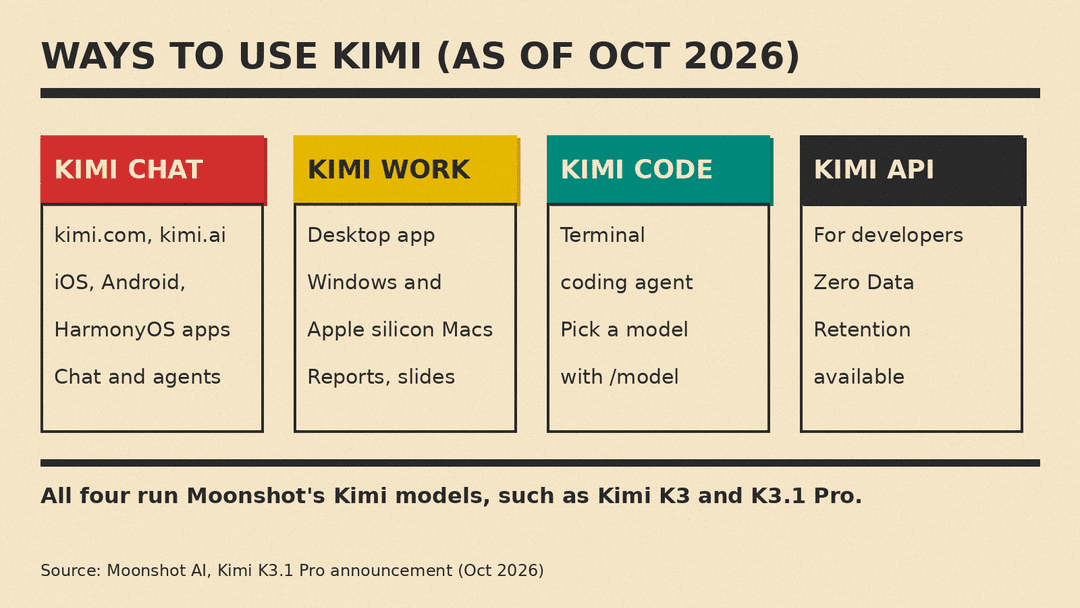
Kimi is not one app. As of October 2026, Moonshot's K3.1 Pro announcement lists these ways to use its models:
- Kimi chat and agents: the website (kimi.com and kimi.ai) and mobile apps for iOS, Android and Huawei's HarmonyOS. This is the everyday chatbot, which can also run multi-step agent tasks.
- Kimi Work: a desktop agent for Windows and Apple silicon Macs that works with files on your computer. Its product page says it can turn research into PowerPoint decks or Excel sheets. The K3 announcement describes Widgets and a Dashboard inside Kimi Work that keep interactive results in one view.
- Kimi Code: a coding agent with a command-line version, a VS Code extension and a desktop app, per Moonshot's Kimi Code page. You pick the model with a
/modelcommand. - Kimi API: for developers who want to build Kimi models into their own apps. Moonshot says Zero Data Retention is available for API customers.
- Kimi for organizations: a business plan with member management and separate personal and work accounts.
Moonshot has also added features on top of the models. One is "Agent Swarm," in which one model directs many sub-agents at once. The FrontierDot release timeline notes that Moonshot described up to 100 sub-agents when it launched Kimi K2.5 in January 2026. Another is 3D Make, which the K3.1 Pro post says lets users preview and edit 3D models on kimi.ai and download them for 3D printing.
The Kimi model family, in order
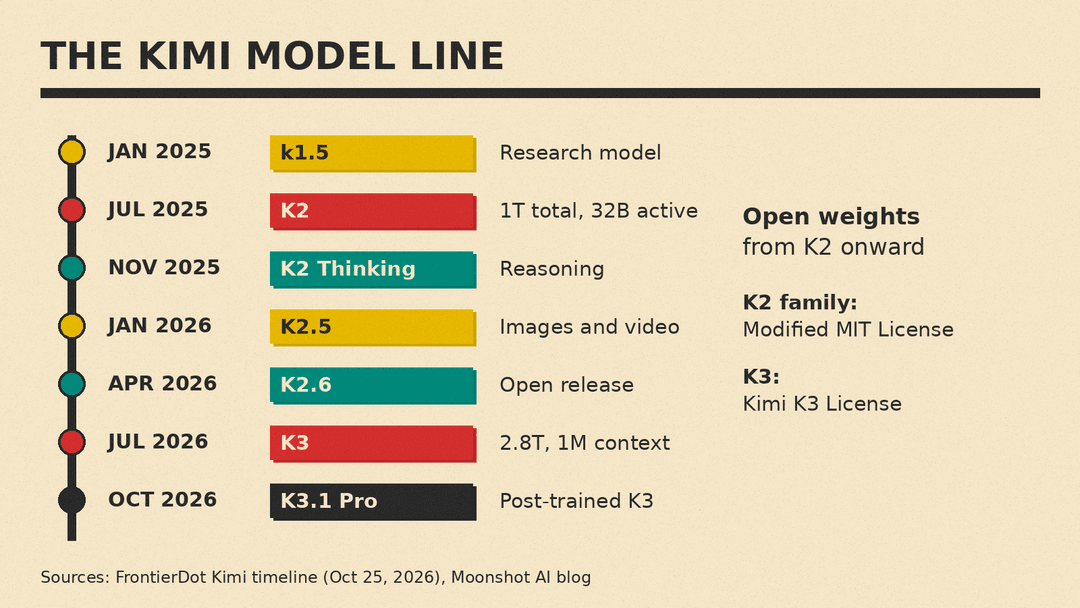
Moonshot names its models with a K and a version number. The FrontierDot timeline, which dates each release from Moonshot's own blog index and model cards, gives this sequence:
- Kimi k1.5 (January 2025): a research model on scaling reinforcement learning, described in a technical paper. FrontierDot found no statement that its weights were released.
- Kimi K2 (July 2025): the first open-weight release, a mixture-of-experts model with 1 trillion total parameters and 32 billion active at a time, trained on 15.5 trillion tokens according to its GitHub README.
- Kimi K2 Thinking (November 2025): a reasoning version that Moonshot says can make 200 to 300 tool calls in a row.
- Kimi K2.5 (January 2026): added native image and video understanding, plus the Agent Swarm feature.
- Kimi K2.6 (April 2026): another open release across the Kimi apps, API and Kimi Code.
- Kimi K3 (July 2026): a 2.8 trillion parameter model with a 1 million token context and native vision.
- Kimi K3.1 Pro (October 2026): a post-trained version of K3, with a Highspeed variant that Moonshot says runs two to three times faster.
Two terms in that list need a word of explanation.
A parameter is one of the numbers a model learns in training; more parameters means a bigger model that needs more computing power to run. A mixture-of-experts model splits its parameters into many "experts" and uses only a few for each piece of text. That is why K2 has 1 trillion parameters but uses only 32 billion at a time. Moonshot says K3 activates 16 of its 896 experts.
Moonshot claims K3 was "the world's first open 3T-class model." The K3 post also says its overall performance "still trails" the strongest closed models from Anthropic and OpenAI at the time, Claude Fable 5 and GPT 5.6 Sol.
Older models do get retired from the API. FrontierDot reports that Moonshot's platform models page set October 31, 2026 as the day the K2 series closed to new API sign-ups (already registered users were not affected), with all K2 models due to retire by the end of December 2026. Weights you have already downloaded keep working; it is the hosted API names that go away.
What "open weights" means for Kimi
Most leading American models are proprietary, CNN notes: you use them through the company's app or API. Moonshot instead publishes the weights of its main models on Hugging Face and GitHub. The weights are the trained numbers that make up the model. Our guide to open-weight vs closed AI models explains the trade-offs. With them, a company can run Kimi on its own servers, keep its data in-house, or fine-tune the model for its own tasks.
CNN quotes Morningstar analyst Chelsey Tam on why this matters to buyers: "Many organisations value the ability to self-host open models, allowing them to retain the weight and control over sensitive data instead of relying solely on closed-model providers."
Open weights is not the same as "do anything you like." Each release has a license, and the terms differ by generation. According to FrontierDot:
- The K2 family (K2, K2 Thinking, K2.5, K2.6) uses a Modified MIT License.
- K3 uses a separate Kimi K3 License, which is not the Modified MIT text.
- For K3.1 Pro, Moonshot's announcement said on October 24 that "the full model weights will be released by Nov 4," 2026. Moonshot has since published them. When we rechecked on November 4, 2026, the K3.1 Pro page on Hugging Face listed the weights under a separate Kimi K3.1-Pro License. The license lets you use, modify and distribute the model, with conditions. A company that runs a "Model as a Service" business, meaning it gives outside parties access to model inference or fine-tuning, and has more than $20 million in revenue over 12 months needs a separate agreement with Moonshot. A product with more than 100 million monthly active users, or more than $20 million in monthly revenue, must show "Kimi K3.1-Pro" in its interface. Internal use is exempt from both rules. Read the license text for the exact terms.
Two practical points. First, the largest Kimi models need data center hardware: Moonshot recommends deploying K3 on supernode setups with 64 or more accelerators. Second, read the license before you build a product on it, especially if your service is large.
How good is Kimi?
It depends on the task. Each Kimi launch post includes benchmark tables, but those are Moonshot's own tests, run with settings it chose. Treat them as claims, not independent results.
Outside views vary. In July 2026, CNN quoted Counterpoint Research analyst Wei Sun as saying the general gap between Chinese and American models had narrowed to three to six months, though it varies by task. The same article quoted Morningstar's Malik Ahmed Khan as cautious about calling K3 near-equal to top US models in real-world work, noting that many open model developers have in the past tuned for benchmarks.
Moonshot is open about some weak points. The K3 post lists limitations: the model can become unstable if an app does not pass back its earlier reasoning, it can act too much on its own when instructions are unclear, and it "exhibits a noticeable gap in user experience" compared with the top closed models.
For safety, the K3.1 Pro post says that, for the open-weight release, Moonshot removed cyber-related data from two stages of training to reduce its hacking ability. Moonshot says the model's offensive cyber skill remains behind that of leading closed models that have been public for at least three months. Those are Moonshot's own tests.
The disputes around Kimi
Kimi's rise has come with accusations from US companies and officials. All of them concern "distillation," which means training a model on the answers of another model.
- In February 2026, Anthropic said in a blog post that Moonshot, DeepSeek and MiniMax used about 24,000 fraudulent accounts to generate more than 16 million exchanges with Claude to improve their own models, as The New York Times reported.
- In July 2026, after K3 launched, White House science adviser Michael Kratsios wrote on X that the US had information that Moonshot distilled Anthropic's Fable model, CNN reported. Moonshot's head of enterprise business, Huang Zhenxin, denied the accusations in an interview with Chinese state media, according to CNN. Most analysts CNN cited found the accusation unlikely.
- On September 30, 2026, OpenAI said people linked to Moonshot had run a campaign in July to extract the hidden reasoning behind its models' answers, The Next Web reported.
- On October 28, 2026, The Information reported that Moonshot relied heavily on OpenAI's GPT-6 Astra to train Kimi K3.1 Pro, citing people with knowledge of the matter, per The Next Web. TNW said it had not verified the report.
These are allegations, and Moonshot has disputed at least some of them. They matter to users for a simple reason: they shape how US companies and governments treat Chinese models, from procurement rules to export policy. Our explainer on US AI chip export controls covers the policy side.
How to try Kimi
- Just to chat: go to kimi.com or kimi.ai, or install the Kimi app.
- For office work: download Kimi Work for Windows or an Apple silicon Mac.
- For coding: install Kimi Code and choose a model with
/model. - To build an app: sign up on the Kimi API platform.
- To self-host: find the model on Hugging Face under moonshotai, read the license, and check the hardware it needs.
As with any chatbot, do not paste in information you would not want stored by the provider. Read the privacy terms for the version you use.
Frequently asked questions
Is Kimi Chinese? Yes. Kimi is made by Moonshot AI, a company based in Beijing.
Is Kimi the same as Moonshot? No. Moonshot AI is the company. Kimi is its product brand and model family.
Is Kimi open source? Moonshot releases the model weights of its main models under its own licenses. That lets you download and run them, but the license terms still apply.
What is the newest Kimi model? When we checked on October 29, 2026, it was Kimi K3.1 Pro, dated October 24, 2026 on Moonshot's blog. Our Kimi K3.1 Pro explainer covers it in detail. Moonshot releases new versions often, so check its blog.
Why is it called Kimi? It is Yang Zhilin's English name, according to CNN.
Sources
- TechCrunch: Moonshot AI raises $1B at a $2.5B valuation (Feb 2024)
- CNN: What is China's Kimi K3 and why is the US so rattled by it? (Jul 2026)
- Moonshot AI: Kimi K3, Open Frontier Intelligence
- Moonshot AI: Introducing Kimi K3.1 Pro
- Hugging Face: moonshotai/Kimi-K3.1-Pro model card and license
- Anthropic: Detecting and preventing distillation attacks (Feb 2026)
- Moonshot AI: Kimi Work product page
- Moonshot AI: Kimi Code page (Chinese)
- FrontierDot: Kimi model timeline, K1.5 to K3.1 Pro (updated Oct 25, 2026)
- Wikipedia: Moonshot AI
- The New York Times: Anthropic accuses 3 Chinese companies of harvesting its data (Feb 2026)
- The Next Web: DeepSeek and Moonshot trained new models on GPT-6 Astra, report says (Oct 2026)
- llms.blog: China's AI labs explained
- llms.blog: US AI chip export controls on China explained
