
Meituan, the Chinese delivery and local-services company, has released LongCat-2.5, a model with 1.6 trillion total parameters that it says was trained entirely on Chinese-made AI accelerators. The LongCat blog post is dated November 1, 2026. Meituan's news page says the release was on November 2, and Caixin Global reported it as unveiled on Monday, November 2. As of the check at about 10:40 PM PT on November 4, 2026, the model is available through an API and the LongCat site, and no weights are published.
What Meituan says LongCat-2.5 is
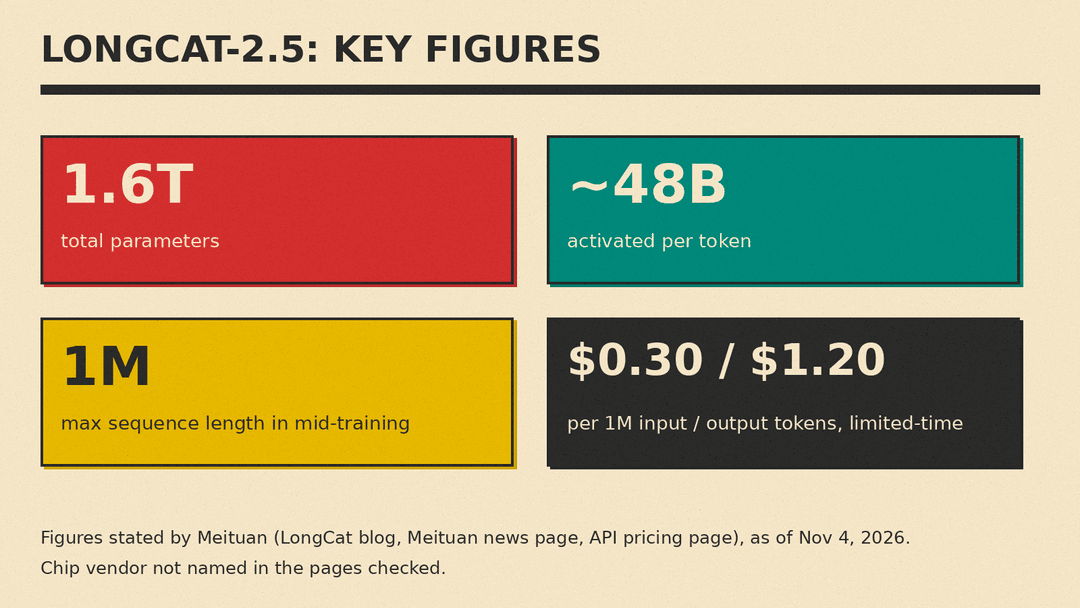
Meituan describes LongCat-2.5 as a native multimodal model for long-horizon agent tasks. The LongCat blog gives 1.6 trillion total parameters and about 48 billion activated per token. It says the model builds on LongCat-2.0 with stronger visual understanding and agentic coding.
"Native multimodal" here means the model turns visual input into tokens that it processes together with text. Meituan says this supports tasks such as interactive web pages and 3D display pages. For coding, it says the model was trained with large-scale long-horizon reinforcement learning to handle end-to-end engineering work.
The domestic-chip claim
The main claim is about hardware. Meituan's news page says the whole training run used Chinese computing power. It says LongCat-2.0, released in June, for the first time completed full-process training and inference of a trillion-parameter model on domestic computing power. That is Meituan's own statement, translated here from the page's Chinese.
The pages checked here do not name the chip vendor. Meituan's news page says only that it worked with domestic computing vendors. No chip is named here for that reason.
The LongCat blog and Meituan's page give these engineering details:
- Meituan's news page says mid-training used sequences of up to 1M tokens, for trillions of tokens in total.
- Each domestic accelerator has less than 80 GB of memory, according to the blog, so Meituan organized the work around the "supernode" design, keeping the main traffic inside the supernode's high-speed interconnect.
- On the long-context fine-tuning tasks it tested, Meituan reports 86% higher per-card training throughput than a standard distributed data parallel (DDP) baseline.
- For serving, Meituan quantizes both the expert weights and the activations to 4 bits (called W4A4). Against an 8-bit baseline (W8A8 INT8) in an online stress test, Meituan reports about 40% higher throughput, about 16% shorter time to first output, and about 20% shorter time per later token.
Meituan also says the 4-bit version performed comparably to the unquantized model on the downstream tasks it evaluated. These figures come from Meituan's own tests, and no independent measurement was found in the sources checked.
Benchmark claims
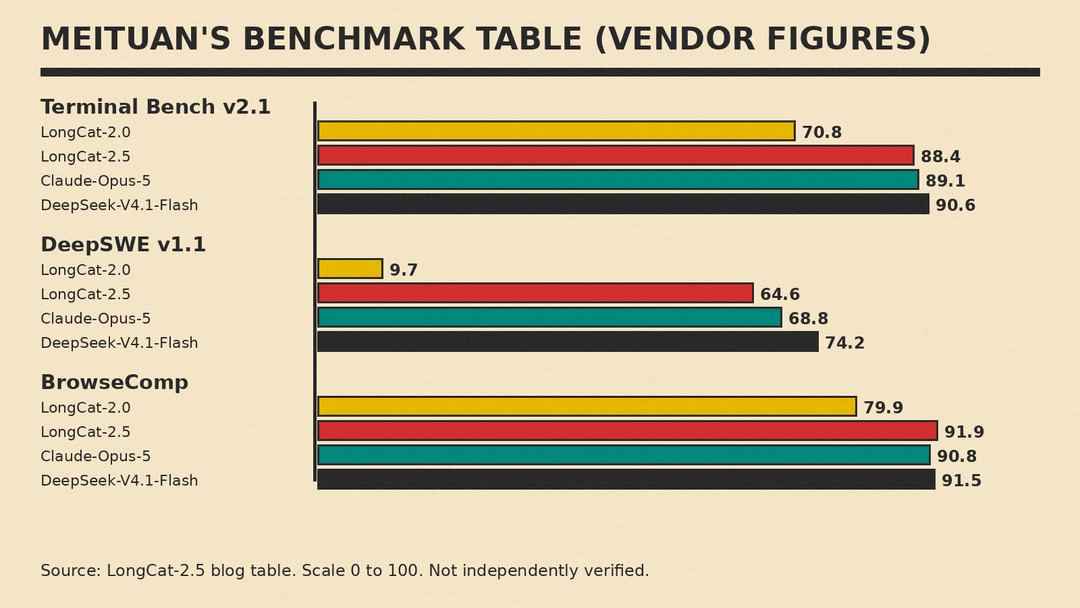
Meituan's table compares LongCat-2.5 with its predecessor and with models from Anthropic, OpenAI, Zhipu, Moonshot and DeepSeek. Meituan's news page summarizes it by saying the scores fall between Claude-Opus-4.8 and Claude-Opus-5, and exceed Claude-Opus-5 on some tests. In the LongCat blog's footnotes, Meituan says scores for other models marked with an asterisk come from public technical reports, blog posts or official leaderboards, and the other scores are its own runs. It calls all of them indicative only. Treat every number as a vendor figure.
These are a few rows from the table in the LongCat blog post, as of November 4, 2026:
- Terminal Bench v2.1: LongCat-2.5 88.4, LongCat-2.0 70.8, Claude-Opus-5 89.1, DeepSeek-V4.1-Flash 90.6.
- DeepSWE v1.1: LongCat-2.5 64.6, LongCat-2.0 9.7, Claude-Opus-5 68.8, DeepSeek-V4.1-Flash 74.2.
- BrowseComp: LongCat-2.5 91.9, LongCat-2.0 79.9, Claude-Opus-5 90.8, kimi-k3 91.2.
- Terminal Bench v4.0: LongCat-2.5 38.5, LongCat-2.0 3.0, Claude-Opus-5 53.9, GLM-5.3 41.8.
- VideoMME: LongCat-2.5 85.2, kimi-k3 90.0.
In Meituan's table, LongCat-2.5 scores above LongCat-2.0 on every row listed. On BrowseComp, 91.9 is the highest score in the row. On the other four rows, at least one listed competitor scores higher.
Price and access
The LongCat API pricing page lists the Pay-As-You-Go rates as a "Discounted Price (limited-time)": $0.30 per 1M uncached input tokens, $0.006 per 1M cached input tokens, and $1.20 per 1M output tokens. In yuan, the same page lists 2, 0.04 and 8 per 1M tokens. It adds that prices are subject to change. These are the rates as of November 4, 2026.
Weights are a separate question. At about 10:40 PM PT on November 4, 2026, the meituan-longcat organization on Hugging Face and its GitHub organization showed no LongCat-2.5 repository. The LongCat blog page also lists GitHub and Hugging Face buttons that both carry a "Coming soon" label. LongCat-2.0 does have weights, and its Hugging Face page lists the MIT license.
Why Meituan built it
Meituan's news page ties the model to its main business. It says that on the August 28 earnings call, CEO Wang Xing said Meituan will not become a token factory and will use its models to support its core business. As an example, the news page describes a brand analysis case, which it attributes to the LongCat-2.5 technical blog. In that case the model built a channel profit statement, found that payment GMV (gross merchandise value) grew 23.2% while channel profit fell 1.7%, and proposed resource changes. The blog text checked here lists a business-analysis demo in its showcase section but does not repeat these figures.
Meituan also says it built an AI operations workbench for merchants, called Miaoshou (妙手), on its LongCat models. It lists chain brands such as Guming (古茗), Xushengji (徐升记) and Yihetang (益禾堂) as users.
Caixin's report frames the launch as an example of Chinese tech companies relying more on home-grown chips, and of a focus on earning money through existing businesses instead of selling raw computing power.
Context on this site
LongCat-2.5 is one of several stories here about Chinese hardware. See the report that DeepSeek V5 may train on Huawei Ascend 950, the Huawei Ascend 950DT SuperPoD going live in Wuhan, and the explainer on US AI chip export controls. For another recent Chinese release, see Tencent Hy4.
Sources
- Introducing LongCat-2.5, LongCat blog, dated November 1, 2026
- Meituan news page, November 2, 2026 (Chinese; the page credits Economic Observer)
- LongCat-2.5 API pricing, LongCat API docs
- Meituan Unveils New AI Model Trained on Homegrown Chips, Caixin Global, November 3, 2026
- meituan-longcat/LongCat-2.0, Hugging Face
