
DeepSeek is a Chinese artificial intelligence company based in Hangzhou. The name also stands for its chatbot, its developer service and a family of AI models whose files are published for download. This guide explains each one in plain English: who is behind the company, what its main models are, what open weights means, and how people use it. Facts about current models are as of November 4, 2026 and will change as DeepSeek releases new versions.
The short answer
- The company. DeepSeek was founded in May 2023, according to The Guardian. The Guardian describes it as the passion project of Liang Wenfeng, a hedge fund entrepreneur, and says his hedge fund, High-Flyer Capital, bankrolled its research.
- The chatbot. DeepSeek's website links to DeepSeek Web, app downloads and an API platform. Its home page shows two chat options named DeepThink and Search.
- The models. DeepSeek publishes language models under names such as V3, R1, V4-Pro and V4.1-Flash. Each name points to a different model with different strengths.
- The weights. DeepSeek publishes the model files on Hugging Face under the MIT License, so people can download and run them.
Who is behind DeepSeek
The Guardian reported in January 2025 that Liang Wenfeng founded the company and that High-Flyer Capital, a fund he started in 2015, pays for its research. The same article says the company is designed as a research-focused organisation rather than a profit-driven one. It quotes an interview in which Liang said: "not to lose money, nor to make huge profits". Hugging Face's deepseek-ai organization page describes DeepSeek (深度求索) as a Chinese company founded in 2023. The Guardian places its campus in Hangzhou.
Reuters and Bloomberg reported outside funding rounds for DeepSeek in 2026. Our post on DeepSeek's 100 billion yuan round summarizes those reports and says which parts are unconfirmed.
Why DeepSeek became well known
The Guardian wrote on January 28, 2025 that DeepSeek was "being credited with a 'Sputnik moment' in the global AI development race". The reason was a claim by DeepSeek, as the Guardian reports it, that it trained a model on a par with OpenAI's ChatGPT for less than $6 million. The Guardian also says Alexandr Wang, an American AI entrepreneur, told CNBC he believed DeepSeek had a stockpile of advanced chips that it had not disclosed. Both points are claims and counter-claims from early 2025. Neither is a settled fact.
The Guardian also quotes Liang on why chips matter to the company: "Our biggest challenge has never been money, it is the embargo on high-end chips". For the rules behind that remark, see our guide to US AI chip export controls on China.
The main models, in plain English
The DeepSeek website lists its research under these names: V4.1, V4, V3.2, V3.1, R1 and V3. Two letters stand out.
- V models are the main line. The R1 card says R1 was trained on DeepSeek-V3-Base, so R1 grew out of a V model.
- R models are reasoning models. The R1 card says R1 explores chain-of-thought, a written line of reasoning, to solve complex problems.
DeepSeek-V3 and R1
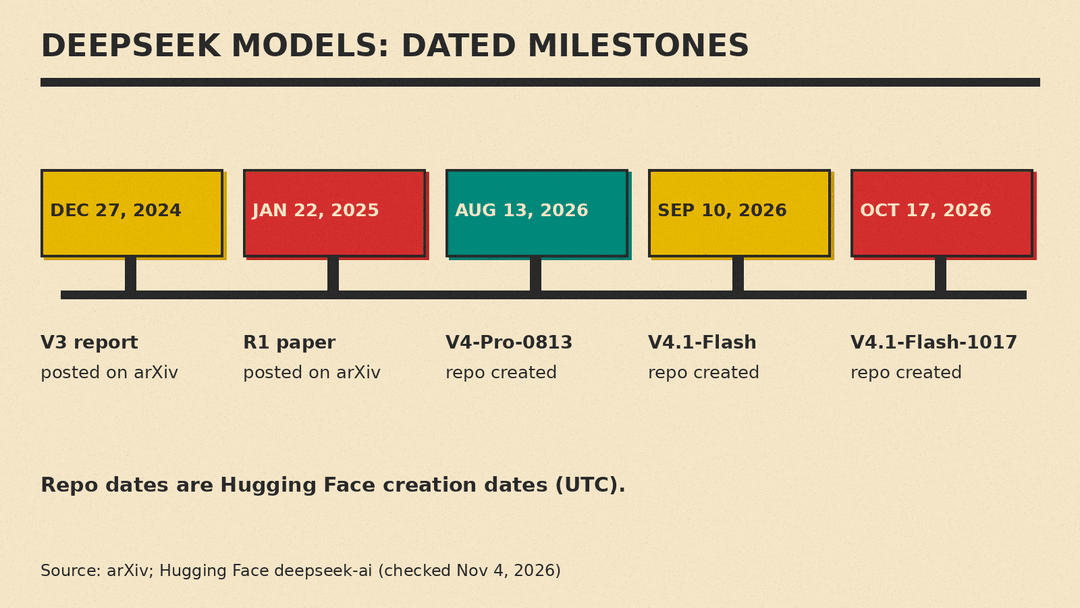
DeepSeek posted the DeepSeek-V3 technical report on arXiv on December 27, 2024. The DeepSeek-R1 paper followed on January 22, 2025, 26 days later.
According to the R1 model card, R1-Zero and R1 are "first-generation reasoning models". Each has 671 billion total parameters, of which 37 billion are active at a time, and a 128K context length. The card says they are trained on DeepSeek-V3-Base. DeepSeek says R1 "achieves performance comparable to OpenAI-o1 across math, code, and reasoning tasks". That is DeepSeek's own claim, made in its model card.
The same card says DeepSeek also released six smaller "distilled" models, with 1.5B, 7B, 8B, 14B, 32B and 70B parameters. DeepSeek made them by fine-tuning existing Qwen and Llama models on reasoning data that R1 generated. A smaller model needs less computer memory than the 671 billion parameter models.
The V4 generation (as of November 2026)
As of November 4, 2026, DeepSeek's API documentation lists two model names. The documentation says the name deepseek-flash "is now served by DeepSeek-V4.1-Flash-1017", and the other name is deepseek-v4-pro. These are the Flash tier and the Pro tier.
- DeepSeek-V4.1-Flash. Its model card calls it a "multimodal Mixture-of-Experts (MoE) model with 552B backbone parameters and support for contexts of up to one million tokens". It reads images and text and writes text. The card says it uses the MIT License.
- DeepSeek-V4-Pro. The V4-Pro-0813 card calls it "the official release of DeepSeek-V4-Pro, superseding the preview version". It also lists the MIT License. The V4.1-Flash card's table puts the V4-Pro base model at 1.6T backbone parameters with 49B active.
Two terms need a short explanation. A mixture-of-experts model has many specialist parts and uses only some of them for each token, which is a word or a piece of a word. The V4.1-Flash card says it uses 6 of its routed experts per token. That is why a model can have hundreds of billions of parameters but activate far fewer at a time. Multimodal means the model accepts more than one kind of input, here images and text.
The suffixes on some names, such as 0813 and 1017, match the month and day the repositories were created on Hugging Face: V4-Pro-0813 on August 13, 2026 and V4.1-Flash-1017 on October 17, 2026 (UTC). DeepSeek's cards do not explain the suffixes, so treat this as our observation.
The API documentation also says "DeepSeek Harness is now in developer preview for agent harness developers worldwide." Harness is DeepSeek's open-source agent software. We covered its test code in DeepSeek V5 Names in Harness Code.
As of November 4, 2026, DeepSeek has not published a V5 model card. Chinese outlets have reported plans to train a V5 model on Huawei Ascend 950 chips; see our post on DeepSeek V5 and Huawei Ascend 950 training. Treat that as reported, not confirmed.
What open weights means here
A model's weights are the learned numbers that make up the model. When a company publishes them, people with enough hardware can download the model and run it themselves.
DeepSeek's cards use the MIT License. The R1 card says the R1 series "support commercial use, allow for any modifications and derivative works". Read each card for the exact terms. The R1 card also notes that its distilled models start from other models: the Qwen-based 1.5B, 7B, 14B and 32B ones are derived from Qwen-2.5 models originally licensed under Apache 2.0, and the two Llama-based ones are derived from models under the Llama 3.1 and Llama 3.3 licenses.
Downloading weights and using DeepSeek's website or app are different things. With the website or app you use DeepSeek's service. With downloaded weights you run the model on your own hardware or a host you choose. For privacy, censorship and government restrictions on DeepSeek's apps, see our guide Is DeepSeek Safe to Use?
Three ways people use DeepSeek
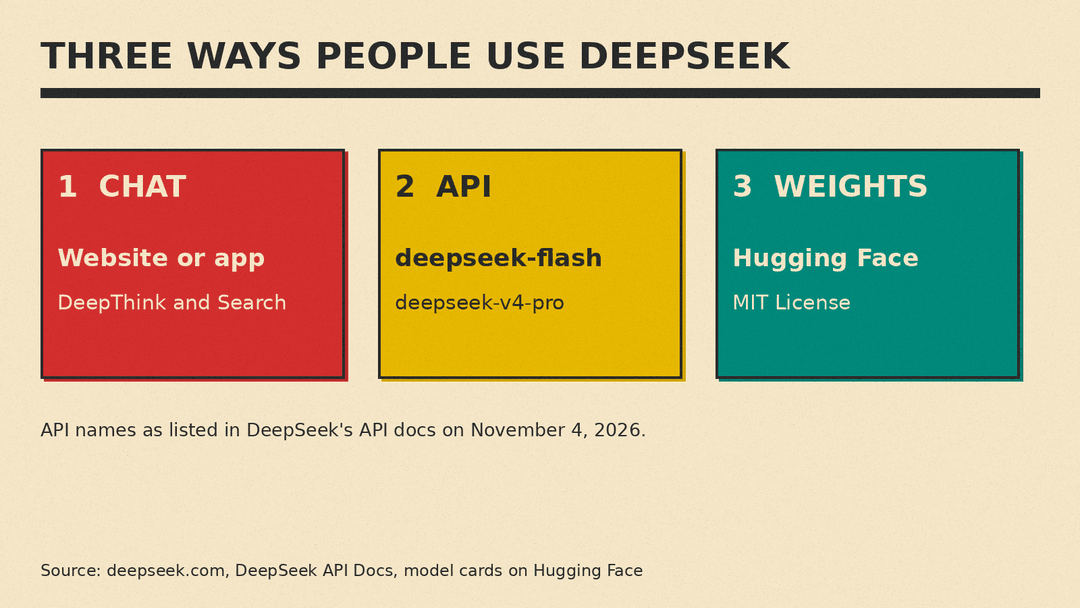
- Chat. DeepSeek's home page links to DeepSeek Web and to app downloads. It shows DeepThink and Search as chat options. The page does not say what each button changes, so check the app itself.
- API. Developers connect their own software to the API platform. The documentation says the API format is compatible with OpenAI and Anthropic formats, and shows
deepseek-flashanddeepseek-v4-proas the model names. Prices change, so check DeepSeek's API pricing page rather than a blog post. - Weights. People download the models from Hugging Face and run them on their own machines or rent servers. The V4.1-Flash page lists inference providers that host it, including Together AI, Novita, Fireworks, Featherless AI, DeepInfra and Baseten, as of November 4, 2026.
What to check on a DeepSeek model card
Each card on Hugging Face follows a similar pattern. These are the items worth reading first:
- License. The cards read for this guide list the MIT License. Distilled models can follow the license of the model they started from.
- Total and active parameters. The R1 card lists 671B total and 37B active. The V4.1-Flash card lists 552B backbone parameters.
- Context length. The R1 card lists 128K. The V4.1-Flash card says contexts of up to one million tokens.
- Who ran the tests. The benchmark tables on the cards are DeepSeek's own. Treat them as claims from the lab until someone else repeats them.
How DeepSeek fits among Chinese AI labs
DeepSeek is one of several Chinese labs that publish open models. For a side-by-side look, read China's AI Labs Explained. For a test-style comparison of a recent DeepSeek model against two rivals, see Kimi K3.1 Pro vs DeepSeek V4.1 Flash vs MiniMax M3.1 Flash.
Common questions
Is DeepSeek one model? No. It is a company with several models. V3 and R1 are older, and the V4 models are the ones the API documentation lists as of November 2026.
What does it cost? The cards list the MIT License for the weights. DeepSeek's hosted chat and API are separate services, and the site has its own API pricing page. Check it for current terms.
Is the newest version always better? Not on every test. In the table on the V4.1-Flash card, DeepSeek reports 92.4 for DS-V4-Pro and 90.9 for DS-V4.1-Flash on GPQA Diamond, and 87.9 for DS-V4-Pro and 90.6 for DS-V4.1-Flash on Terminal-Bench 2.1, at maximum reasoning effort. Those are DeepSeek's own figures from the card as of November 4, 2026. Pick a model by trying it on your task.
Where do I find the latest version? Check DeepSeek's Hugging Face page and its API documentation, which are the places that name the current releases.
Sources
- The Guardian: Who is behind DeepSeek and how did it achieve its AI 'Sputnik moment'? (Jan 28, 2025)
- DeepSeek: official website (English)
- DeepSeek API Docs: Your First API Call
- arXiv: DeepSeek-V3 Technical Report (Dec 27, 2024)
- arXiv: DeepSeek-R1 (Jan 22, 2025)
- Hugging Face: deepseek-ai/DeepSeek-R1
- Hugging Face: deepseek-ai/DeepSeek-V4-Pro-0813
- Hugging Face: deepseek-ai/DeepSeek-V4.1-Flash
- Hugging Face: deepseek-ai organization
