
AlphaFold is an AI system from Google DeepMind that predicts the 3D shape of proteins from their amino acid sequence. That sounds narrow, but it solved a problem biologists had worked on for about 50 years, and it won two of its creators a share of the 2024 Nobel Prize in Chemistry.
This guide explains what AlphaFold does, why protein shapes matter, how the versions differ, how to use it for free, and where it still gets things wrong. No biology degree needed.
The short answer
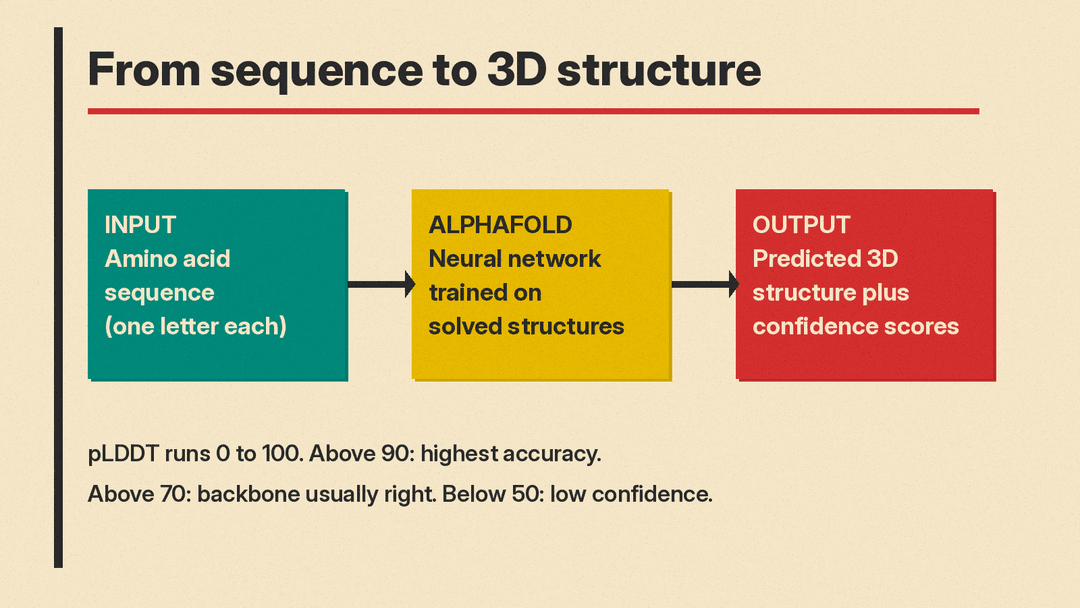
- AlphaFold takes a protein's sequence (a string of letters, one per amino acid) and predicts how that chain folds into a 3D structure.
- Google DeepMind says that figuring out just one protein structure "can take several years, and hundreds of thousands of dollars," while AlphaFold predicts structures "in minutes."
- The AlphaFold Protein Structure Database provides open access to over 260 million predicted structures, according to EMBL-EBI, and is free to browse.
- AlphaFold 3 goes further and predicts how proteins interact with other molecules, such as small molecules and metal ions. Scientists can use it free through AlphaFold Server for non-commercial research.
- It is a prediction tool, not a lab result. Each prediction comes with confidence scores, and some protein types remain hard for it.
Why protein shapes matter
Proteins do most of the work inside living things. The Nobel Prize press release puts it this way: proteins "control and drive all the chemical reactions that together are the basis of life," and they also act as "hormones, signal substances, antibodies and the building blocks of different tissues."
A protein starts as a long chain of amino acids. The Nobel committee notes that proteins "generally consist of 20 different amino acids," linked in strings that "fold up to make a three-dimensional structure, which is decisive for the protein's function." In other words, shape decides what a protein does. A drug that blocks a protein, for example, has to fit a specific pocket in that protein's shape.
Scientists can measure shapes in the lab, but it is slow and expensive. Predicting the shape from the sequence alone would skip much of that work. According to the Nobel press release, researchers had tried to do this "since the 1970s," but it "was notoriously difficult." This is what people mean by the "protein folding problem."
A short history of AlphaFold
Google DeepMind's AlphaFold page lays out the timeline. The key steps:
- 2016. After DeepMind's AlphaGo beat Go player Lee Sae Dol in March 2016, the lab set up "a small team" to work on protein structure prediction.
- 2018. The first AlphaFold placed first at CASP13, the 13th Critical Assessment of Protein Structure Prediction.
- 2020. AlphaFold2 won CASP14. DeepMind says the CASP organisers recognised it as a solution to the "protein folding problem," with predictions at a median error under 1 Angstrom, which DeepMind calls "3 times more accurate than the next best system and comparable to experimental methods."
- 2021. The method was published in Nature as "Highly accurate protein structure prediction with AlphaFold," and DeepMind released the code. A week later, with the European Bioinformatics Institute (EMBL-EBI), it launched the AlphaFold Protein Structure Database, starting with the human proteome and 20 other organisms, "over 350,000 structures in total."
- 2022. The database expanded to over 200 million structures, covering "nearly all catalogued proteins known to science."
- 2024. In May, Google DeepMind and Isomorphic Labs introduced AlphaFold 3 and launched AlphaFold Server. In October, Demis Hassabis and John Jumper were co-awarded the Nobel Prize in Chemistry.
The Nobel Prize went half to David Baker of the University of Washington "for computational protein design" and half jointly to Hassabis and Jumper of Google DeepMind "for protein structure prediction." The committee wrote that with AlphaFold2 they "have been able to predict the structure of virtually all the 200 million proteins that researchers have identified."
How AlphaFold works, in plain terms
AlphaFold is a neural network trained on protein structures that scientists had already solved in the lab and stored in the Protein Data Bank (PDB).
EMBL-EBI's free AlphaFold course explains that "only the protein parts of the PDB structures were used" to train AlphaFold2, not small molecules or nucleic acids. It also says AlphaFold2 "works by deriving relationships between protein sequences." That is why, as covered below, it does worse on proteins with few known relatives.
The course also makes an important point: AlphaFold2 "does not simply replicate known protein structures." Independent researchers have shown it can predict folds "never previously seen in the PDB."
AlphaFold 2 vs AlphaFold 3
The two main versions do different jobs.
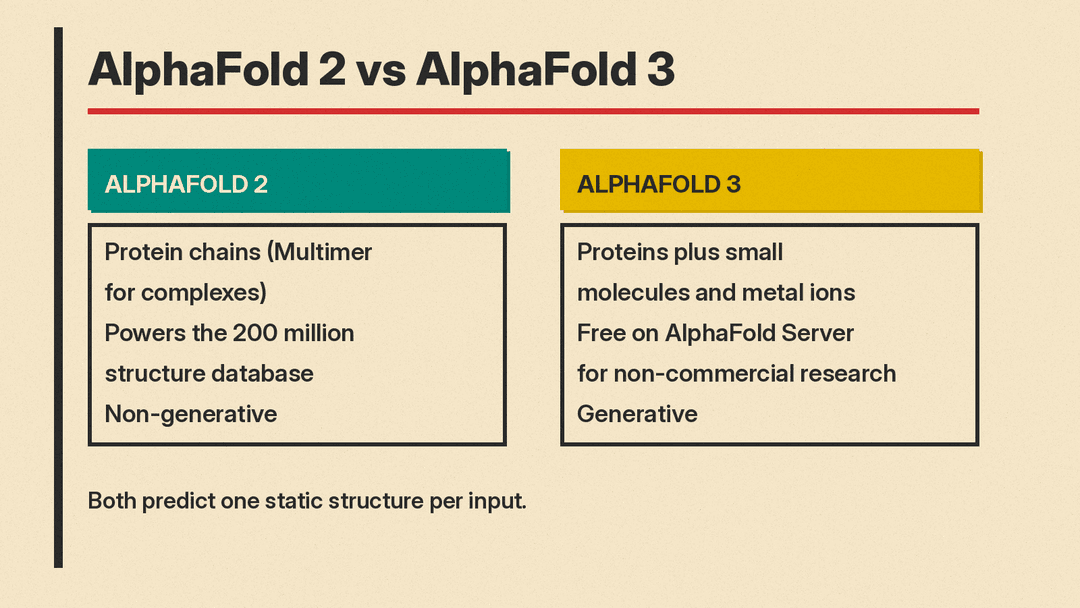
- AlphaFold 2 predicts the structure of single protein chains. An extension called AlphaFold-Multimer, according to EMBL-EBI, predicts complexes made of several protein chains. AlphaFold 2 is the model behind the database.
- AlphaFold 3, per Google DeepMind, "predicts the structure and interactions of all of life's molecules." EMBL-EBI's AlphaFold 3 section says it can model "chemically different entities like proteins, small molecules and metal ions." That matters for drug research, where the question is often how a small molecule binds to a protein.
There is also a design change. EMBL-EBI notes that "AlphaFold 3 is a generative model, whereas AlphaFold 2 was non-generative." That brings new kinds of errors, covered below.
How to use AlphaFold for free
There are three main ways in, depending on what you need.
1. Look up an existing prediction. The AlphaFold Protein Structure Database, run by EMBL-EBI with Google DeepMind, lets anyone search by protein name, gene or sequence and view the predicted 3D model in the browser. DeepMind describes it as free and open access. Since the database covers "nearly all catalogued proteins known to science," per DeepMind, a prediction often already exists and there is nothing to run.
2. Run a new prediction on AlphaFold Server. AlphaFold Server runs AlphaFold 3 in the browser. Google DeepMind says it gives scientists "free access to AF3 structure prediction capabilities for non-commercial research." Its FAQ says each user can run 30 jobs per day. You paste in sequences, and it returns a predicted structure with confidence scores. The AlphaFold 3 code page notes the server supports "a more limited set of ligands and covalent modifications" than the full model.
3. Run AlphaFold 3 yourself. The AlphaFold 3 GitHub repository has the inference code, and the README links a direct download for the model weights. It says you "may only use AlphaFold 3 model parameters if received directly from Google" and that use is subject to its terms of use. Those terms limit the weights and their output to non-commercial use by non-commercial organizations such as universities, non-profits, research institutes, and educational, journalism and government bodies. They also say you must not publish or share the weights outside your organization. Google DeepMind's AlphaFold page describes the code and weights as available "for academic use." For commercial use, the README points to Google Cloud's Gemini Enterprise Agent Platform. Running it locally needs a GPU and large sequence databases, so this route is for labs with technical staff.
How to read the confidence scores
Every AlphaFold prediction comes with scores that say how much to trust each part of it. This is the most useful thing a newcomer can learn.
The main per-residue score is pLDDT, short for predicted local distance difference test. EMBL-EBI's guide to pLDDT explains:
- It runs from 0 to 100, "with higher scores indicating higher confidence and usually a more accurate prediction."
- Above 90 is "the highest accuracy category," where "both the backbone and side chains are typically predicted with high accuracy."
- Above 70 "usually corresponds to a correct backbone prediction with misplacement of some side chains."
- Below 50 usually means one of two things: the region is "naturally highly flexible or intrinsically disordered," or AlphaFold "does not have enough information to predict it with confidence."
The score can change a lot along one protein. A well-folded core may score high while the loose linkers between sections score low. EMBL-EBI's guide shows predictions colored by pLDDT, so the weak regions stand out. It also describes a second score, PAE (predicted aligned error), as "a measure of global confidence" in a prediction.
What AlphaFold gets wrong
AlphaFold is strong, but its limits are well documented by EMBL-EBI.
AlphaFold 2 struggles with:
- Single mutations. It is "not sensitive to point mutations that change a single residue," because of a lack of data on variations and its "focus on patterns as opposed to calculating physical forces."
- Highly variable proteins such as "immune system molecules like antibodies."
- Orphan proteins, "those with few close relatives." With few related sequences to compare, it "often produces low-quality predictions with poor confidence scores."
- Disordered regions. It "cannot predict disordered or dynamic substructures," though its low pLDDT scores are a good signal that a region is disordered.
AlphaFold 3 struggles with:
- Motion. Like other models, it predicts a single static structure. EMBL-EBI notes such models "do not capture the dynamic behaviour of biomolecular systems in solution."
- The wrong shape for the situation. EMBL-EBI gives the example of a protein called cereblon, where AlphaFold 3 predicts the closed form even when, without a bound molecule, the real protein is open.
- Orphan proteins, for the same reason as AlphaFold 2.
- New error types. Because it is generative, it "sometimes predicts spurious structural order" in disordered regions. EMBL-EBI says these hallucinations are quite rare and usually carry pLDDT scores well below 50.
The takeaway: treat a prediction as a starting point, and let the confidence scores tell you which parts to trust.
Why it matters beyond biology labs
AlphaFold is one of the clearest cases of AI changing how science gets done. The Nobel press release says that among its uses, researchers "can now better understand antibiotic resistance and create images of enzymes that can decompose plastic." Google DeepMind's AlphaFold page says it is being used by "over 3 million researchers from over 190 countries" (its figure as of November 2025) on problems including "antimicrobial resistance, crop resilience and heart disease."
Google DeepMind has since applied AI to other science and health work. For examples, see our posts on DeepMind's Co-Scientist moving into lab workflows and Google's Singapore public health partnership. For a wider view, see AI in healthcare: 12 real uses today, and for the hardware Google trains models like this on, our explainer What Is a TPU?
Quick FAQ
Is AlphaFold free? The database is free and open access. AlphaFold Server is free for non-commercial research, up to 30 jobs per day per user. The AlphaFold 3 weights are free for non-commercial use by non-commercial organizations under Google's terms, and commercial use goes through Google Cloud.
Who made AlphaFold? Google DeepMind. AlphaFold 3 was introduced with Isomorphic Labs, and the database is run with EMBL-EBI.
Is an AlphaFold prediction always right? No. It gives a predicted structure with confidence scores, and EMBL-EBI documents known weak spots such as single mutations, orphan proteins and moving parts.
Can I use it without coding? Yes. The database and AlphaFold Server both run in a web browser.
Sources
- Google DeepMind: AlphaFold
- The Nobel Prize in Chemistry 2024: press release
- AlphaFold Protein Structure Database (EMBL-EBI)
- AlphaFold Server
- AlphaFold 3 on GitHub (README)
- EMBL-EBI: Strengths and limitations of AlphaFold 2
- EMBL-EBI: pLDDT, understanding local confidence
- EMBL-EBI: What AlphaFold 3 struggles with
