
Google has put Gemini Robotics ER 2, the DeepMind model that acts as the planning "brain" for a robot, into public preview on Google Cloud. The model first shipped in July through the Gemini API and Google AI Studio, but on Google's enterprise cloud it was only in private preview. On October 27, Google Cloud says developers and enterprise teams can start building with it in preview through Model Garden on its Gemini platform.
Google calls it "this same frontier embodied reasoning model," so the change is in who can use it and where. Companies that already run their data, security and machine learning work on Google Cloud can call the same robotics model from inside that setup, with Google Cloud's access controls and billing.
What Gemini Robotics ER 2 does
"ER" stands for embodied reasoning. In its July launch post, DeepMind describes ER 2 as "a high-level brain for robots." It does not move motors itself. It watches camera feeds, plans the steps of a task, and hands each step to a lower-level model or API that does the moving. DeepMind says ER 2 "hands off motor execution to any given lower level vision-language-action (VLA) model."
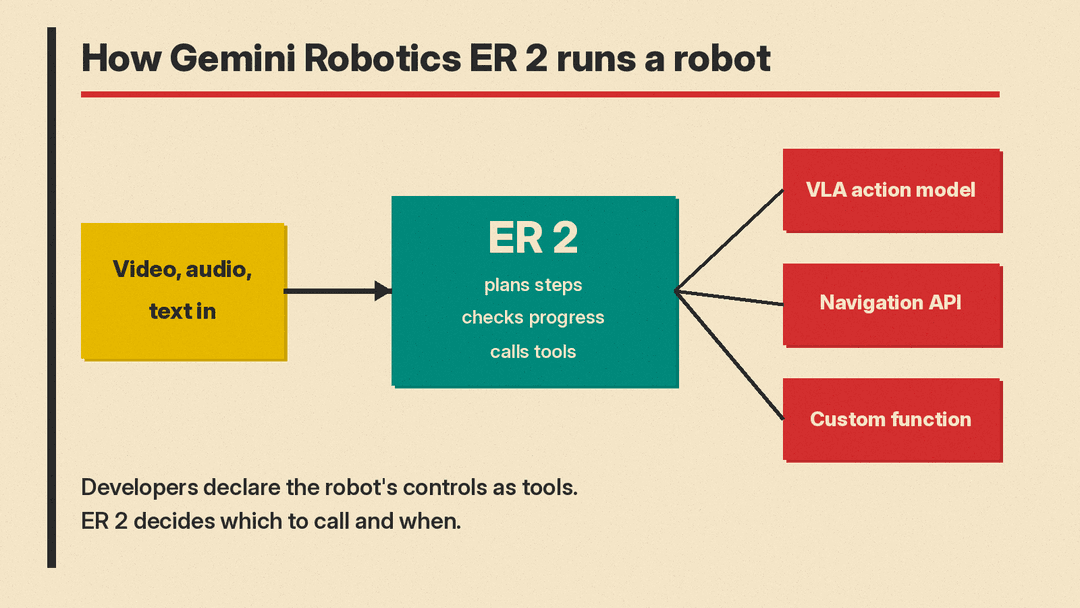
Developers set this up by declaring the robot's controls as tools, the same way a chatbot developer declares functions. According to Google's developer docs, ER 2 can then:
- read video, audio, images and text as input, and answer in text
- plan multi-step tasks and call tools, including Google Search or user-defined functions
- track how far along a task is, and spot the moment a step is done
- coordinate more than one robot in a shared space
- read instruments such as dials, digital displays, rulers and thermometers
The model card says ER 2 is based on Gemini 3.5 Flash. The developer docs list an input limit of 131,072 tokens and an output limit of 65,536 tokens. There are two versions: gemini-robotics-er-2-preview for standard calls, and gemini-robotics-er-2-streaming-preview, which runs on the Live API for low-latency robot agents that take in continuous audio and video. Google Cloud's documentation lists only gemini-robotics-er-2-preview as available in preview there.
The numbers Google gives
Google's figures come from its own evaluations, not independent tests. In the Cloud announcement, Google says ER 2 finds the exact video frame where a key event happens, such as when to stop pouring a liquid, with 91.3% accuracy and a 0.96-second mean absolute frame distance. It says the model runs at 4x the execution speed of many larger model categories at a fraction of the compute cost.
DeepMind's July post adds a progress-tracking result. In that test, each video frame is sorted into one of five progress bands (0-20% through 80-100%), and ER 2 scored 57.4% accuracy, which DeepMind says beats earlier models and "competing frontier models." DeepMind also calls ER 2 "our safest model," citing gains on its Safety Instruction Following and Human Proximity benchmarks. It says that in testing, ER 2 halted a humanoid robot when a person came near and resumed only once the area was clear. Details are in DeepMind's safety technical report, linked from that post.
What it costs
Google Cloud's pricing page lists two price levels for "Gemini ER 2.0", per 1 million tokens:
- Through December 31, 2026: $1.00 for input (text, image, video or audio), $0.10 for cached input, and $5.00 for text output
- Starting January 1, 2027: $2.00 for input, $0.20 for cached input, and $10.00 for text output
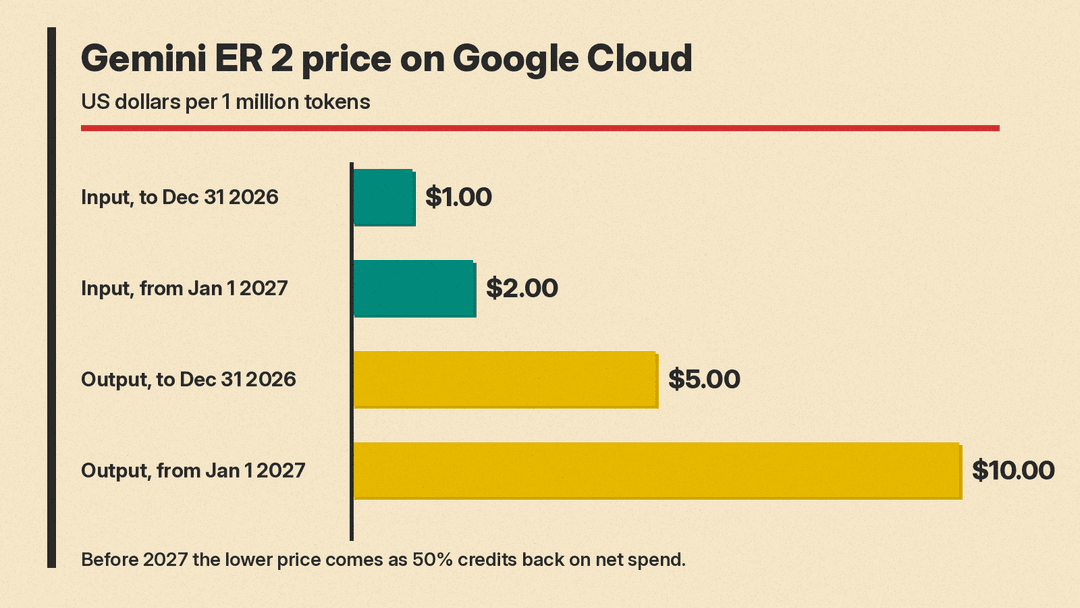
The page says the lower 2026 price is promotional, "provided through 50% credits back on net spend on select models within a given period." In other words, the lower rate shown through December 31 comes as a credit, and the page lists the higher rate starting January 1, 2027. The page labels output as "Text output (response and reasoning)," so reasoning tokens are billed as output.
What Google Cloud adds around the model
The Cloud post pitches ER 2 as one piece of a larger robotics workflow on Google's infrastructure. Google describes three stages:
- Simulate: test robot behavior in simulators such as MuJoCo-Warp and NVIDIA Isaac Sim before touching hardware.
- Train: use ER 2's pointing, moment finding and progress classification to label demonstration videos stored in Cloud Storage and BigQuery, then train custom VLA models.
- Operate: run ER 2 workflows with Google Cloud's identity and security controls, and offload latency-sensitive local work such as SLAM (simultaneous localization and mapping) and path planning to factory floors with Google Distributed Cloud.
The Cloud post quotes four early users. Boston Dynamics, whose Spot robot DeepMind used in its July demo, is represented by Marco da Silva, VP and general manager of Spot: "Video changes what an inspection can be." A*STAR's Institute of Materials Research and Engineering (IMRE) says it is using ER 2 to give its lab robots more flexibility. Its executive director, Prof. Loh Xian Jun, says: "Most lab automation today relies on rigid scripts for single, isolated tasks." DeepReach and Arm are also quoted.
What is still preview
Everything here is labeled preview. On Google Cloud, ER 2 falls under Google's Pre-GA terms, which the Cloud documentation page says means features are available "as is" and "might have limited support." The same page says customers may use the preview "for production or commercial purposes," and that for preview the endpoint is available only at the global location. The older ER 1.6 model was deprecated on August 31, 2026, per the developer docs, so anyone still on it needs to switch model names.
Why it matters
Our recent Gemini coverage has focused on chat and coding, from the Gemini 4 Argon launch to the Gemini API CLI. ER 2 on Google Cloud is a different kind of bet. Google is offering a ready-made planning layer for robots, sold by the token like any other Gemini model, inside the cloud tools its enterprise customers already use. The open question is how well Google's own benchmark numbers hold up on factory floors and in labs, which only customer deployments will show.
For more on DeepMind's longer-term research agenda, see our explainer on the DeepMind Institute.
Sources
- Google Cloud Blog: Gemini Robotics Embodied Reasoning 2 is now available on Google Cloud
- Google: Introducing Gemini Robotics ER 2 (July 30, 2026)
- Google DeepMind: Gemini Robotics ER 2 model card
- Google AI for Developers: Gemini Robotics ER overview
- Google AI for Developers: Gemini Robotics ER 2 preview model page
- Google Cloud: Gemini Enterprise Agent Platform pricing
- Google Cloud documentation: Gemini Robotics ER 2
