
Google DeepMind researchers argue that the biggest visible economic shift from AI may not come from models that get smarter on their own, but from AI agents that learn to work together well. That is the core claim of The Economics of Intelligence, an essay published on October 29, 2026 by Alex Imas, Andrew Koh and Shane Legg, and of the working paper behind it, Organizing Intelligence.
Imas, Director of AGI Economics at Google DeepMind, announced the project on X as the first in a series of projects from his group at Google DeepMind. The essay says it draws on the paper, which "presents the full economic model and derives the results formally." The essay is on the DeepMind Institute site, which says its pieces are conversation starters and "should not be read as Google's official view." The paper adds that it does not represent corporate forecasts or product roadmaps.
The puzzle they try to explain
The authors start with a gap many people have noticed. Frontier models keep passing milestones, yet, in the essay's words, "most people still go to recognizable jobs, headcounts look very similar to a few years ago, and aggregate productivity numbers have barely budged." (For one recent data point, see our report on US GDP and AI investment in Q3.)
Their answer: "the individual AI agent is the wrong economic object." Benchmarks test one model against one person. But the economy runs on organizations, and organizations combine people with uneven skills into teams that beat any single member. The essay says "a model can exceed the performance of every person one-on-one and still lose to a well-structured team."
To show that human skills are uneven, the team gave 100 people a quiz across six domains (math, verbal reasoning, science, patterns, culture and economics). Performance in one domain did not predict much about another. When participants were paired to complement each other on a task, they outperformed random pairs by 32%, according to the essay.
Competence vs coordination
The framework splits AI progress into two separate dials:
- Competence is skill at individual tasks such as coding, math or writing. The authors say gains here "smoothly shift wages, prices and the mix of humans and AI agents in a firm while leaving industry structure largely intact."
- Coordination is how well agents work together inside a firm. Once it passes a critical threshold, the essay says, it "triggers large, abrupt jumps in market concentration, employment, and wages."
Coordination matters because it sets how big a firm can get before it becomes too messy to run. The authors tie this to an old question from economist Ronald Coase: why isn't all production done by one giant firm? Human limits on attention, communication and incentives are the usual answer. The authors argue those limits "need not apply" to AI agents, which can share full working state, such as entire codebases and context windows.
They also note that today's systems "coordinate poorly in practice." The essay quotes OpenAI's Noam Brown, who said of running thousands of agents on math problems that "it's actually very difficult to get these agents to coordinate in a productive way."
A worked example with coders, writers and managers
The paper builds a small, illustrative economy of 14 people: six coders, six writers and two coordinators. Coders and writers are mirror-image specialists. Coordinators are weak at both tasks but better at helping a team work together (a coordination score of 0.97, against 3/4 for everyone else).
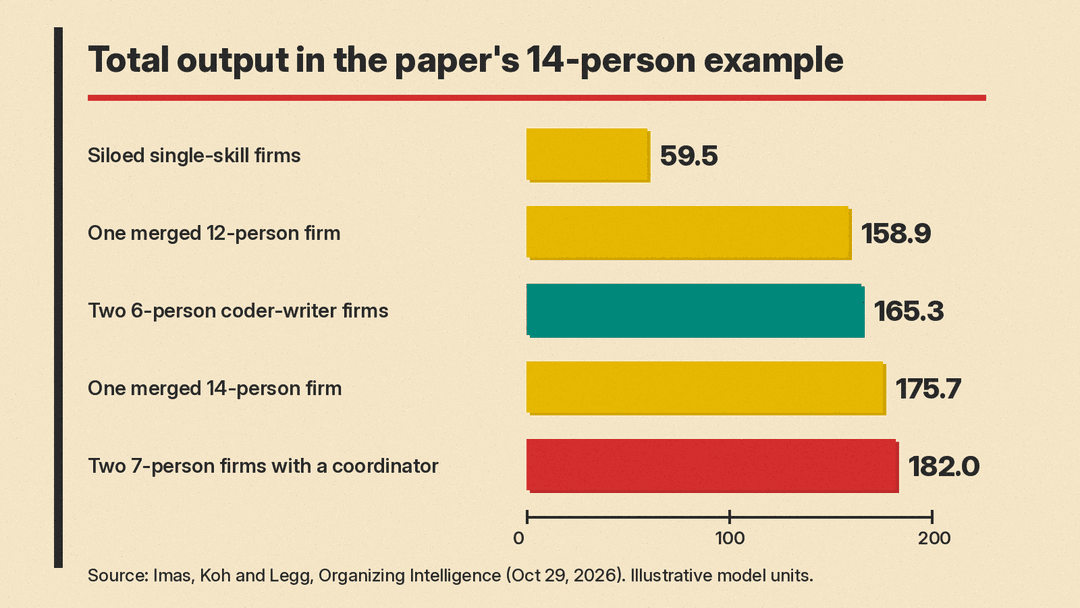
In the paper's numbers, siloed single-skill firms produce 59.5 in total. Two balanced six-person teams of coders and writers produce 165.3, beating one merged twelve-person firm at 158.9. Adding a coordinator to each team lifts total output to 182.0 across two seven-person firms, which "still outperform a single merged fourteen-person firm (175.7)."
Wages follow. Coordinators earn 2.41 "despite ranking last on standalone task tests," and specialists earn 4.15. Then the paper adds AI that matches the average human and can be copied at the cost of compute. All 14 people stay employed, but specialist wages fall from 4.15 to 2.90 and coordinator wages fall from 2.41 to 1.30. In a separate run, with AI task skills held at 4 and a higher outside wage for humans, once AI coordination rises to about 0.85, human-only firms disappear and specialist employment "drops from twelve to zero." These are model outputs, not measurements of real firms.
Four regimes of AGI
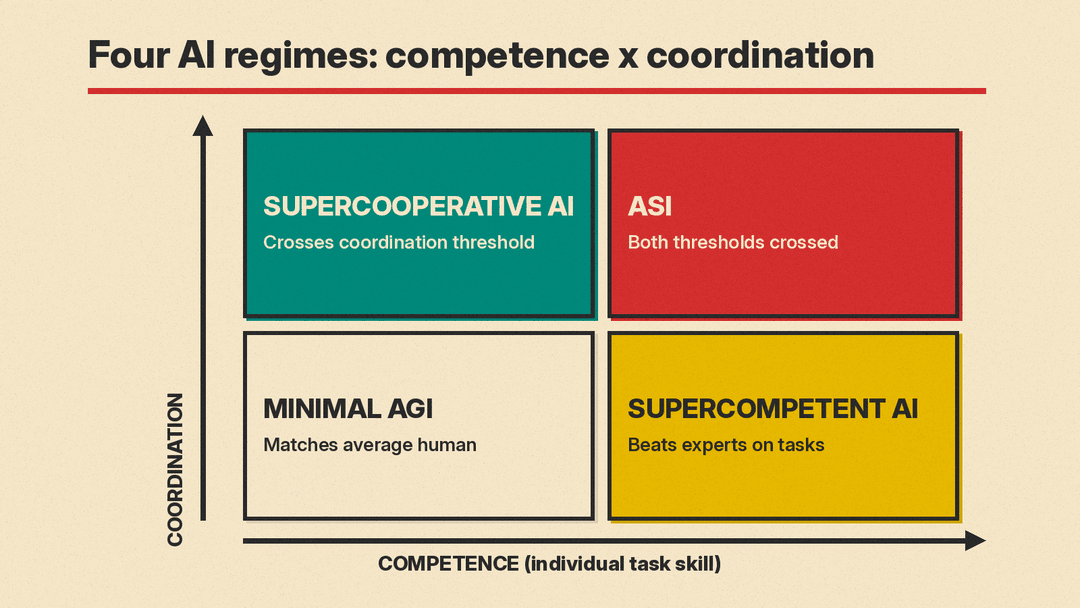
Crossing the two dials gives four regimes:
- Minimal AGI: AI matches average human ability. Little changes in structure, but wages for skills AI can match drift toward the cost of compute.
- Supercompetent AI: AI beats every expert on tasks but not on coordination. Firms get more productive but stay small or shrink. The essay calls this "abundance without concentration," while a skilled human coordinator still multiplies the output of a team of AI agents.
- Supercooperative AI: coordination crosses the threshold while competence stays at the minimal level. Large AI-only firms can suddenly outcompete small ones in big, standardized markets such as software, logistics or finance.
- Artificial superintelligence (ASI): both thresholds are crossed, and lean AI firms can serve niche markets too. The authors suggest spending may shift toward a "relational sector," such as healthcare and teaching, where human involvement is part of the value.
Why it matters
The paper gives a reason why strong benchmark scores have not yet shown up clearly in jobs data, and it names what to watch. The authors make two practical calls. First, the field needs benchmarks for "organizations of agents" that test how well multi-agent systems split up work, share context across handoffs and catch one another's mistakes. Second, they say wages and job roles, "not headline GDP or industry concentration," are the earliest signals of change. That fits debates over entry-level hiring, such as the data in our look at software engineer jobs and AI.
It also matters for the agent tools now shipping across the industry. Most of them are still judged one agent at a time. If the authors are right, the more telling test is how a team of agents performs, a point that connects to recent work on reasoning effort and cost in LLM agents.
The results depend on formal assumptions about compute cost, copying and coordination, and the paper is a working paper, not a forecast with dates.
