
What is A2A?
A2A, short for Agent2Agent, is a protocol that lets AI agents built by different companies work together. The A2A documentation calls it "an open standard for communication between AI agents." If you are new to agents, start with our guide to what an AI agent is.
A2A gives agents a common language, whatever framework or vendor built them. It uses existing web standards: HTTP, JSON-RPC and Server-Sent Events. It supports long-running tasks, including cases where agents or users are not continuously connected, through streaming and push notifications.
The key concepts page describes three actors. The user can be a human or an automated service. The A2A client is an app, service or agent acting for the user. The A2A server or remote agent is an agent that exposes an HTTP endpoint. To the client, that agent is a black box.
The A2A documentation places A2A in a larger stack. A2A connects agents to each other. MCP connects models to data and external resources. Agent frameworks such as LangGraph, CrewAI and ADK build agents. Models can be any LLM. The same page describes opaque execution: agents collaborate without exposing internal logic, memory or proprietary tools.
Why agents need a shared language
The travel example in the A2A documentation shows the scale problem. A user asks an AI assistant to plan an international trip. The assistant needs a flight booking agent, a hotel reservation agent, a local tours agent and a currency conversion agent. Without a standard, each integration becomes custom point-to-point work. The docs say that work is hard to scale and that ad hoc communication often lacks consistent security.
Developers often wrap agents as tools. The A2A documentation notes that this approach can limit what agents can do. A tool usually receives a request and returns an output. An agent may need to plan, ask follow-up questions, keep state, use several tools and complete work over multiple turns. A2A exposes agents as they are instead of reducing them to simple tool calls.
With a shared protocol, the assistant can act as an orchestrator. It can gather results from other agents and present one travel plan.
How A2A works step by step
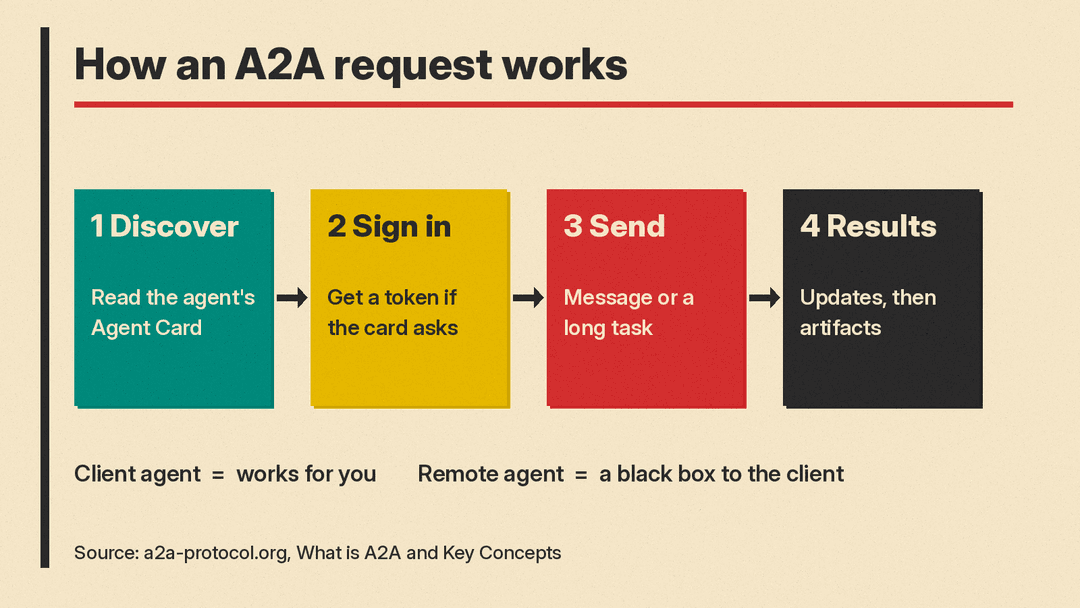
The request lifecycle begins with discovery. A client can fetch an Agent Card at a well-known URI, such as /.well-known/agent-card.json, according to the A2A documentation. The discovery page adds that clients can find cards through a well-known URI, curated registries in enterprises or marketplaces, or direct configuration. Registries can let clients search by skills or tags.
After discovery, authentication happens. The A2A documentation says the client reads security schemes in the Agent Card and obtains a token if required. Then the client sends messages either as a single request/response exchange or as a stream of task updates. Updates can include submitted, working, artifacts and completed.
The key concepts page lists interaction patterns: polling, streaming with Server-Sent Events, and push notifications to a webhook. Credentials such as OAuth tokens or API keys usually travel in HTTP headers, separate from A2A messages.
What an Agent Card is
An Agent Card is a JSON document that an agent publishes. The key concepts page calls it "a digital business card." It lists identity, endpoint, capabilities, skills and authentication requirements. The discovery page says clients can locate it through a well-known URI, registries or direct configuration.
The card tells a client how to talk to the agent. It points to the endpoint where the agent accepts requests. It can describe capabilities and skills. It can state security schemes the client must meet before sending a request. This lets a client connect to an agent it did not build.
The card is not the agent's internal logic. The A2A documentation says agents can collaborate without exposing internal logic, memory or proprietary tools. The card gives communication metadata, not a full view of internal implementation.
Tasks, messages and artifacts
A2A uses a small set of objects for work between agents. The key concepts page defines a task as a stateful unit of work with a unique ID and lifecycle. It supports long-running and multi-turn work. An agent can reply with a message for an immediate answer or with a task for longer work.
The page defines a message as one turn of communication with a role of "user" or "agent." A part is a content container that can hold text, a file or structured data. An artifact is a tangible output, such as a document, image or structured data. If a travel agent returns a trip itinerary, or if a diagnostic agent returns a repair report, the result would fit the artifact concept.
Task updates can include submitted, working, artifacts and completed, according to the A2A documentation. This stateful lifecycle lets a client follow progress instead of receiving only one final response. Streaming and push notifications support cases where agents or users are not continuously connected.
A2A vs MCP
MCP and A2A address different layers. The A2A and MCP page describes MCP as vertical. It deepens a single agent by giving it tools, resources and skills. It describes A2A as horizontal. A2A connects agents across boundaries such as another team, department or partner organization.
The page contrasts tools and agents. Tools are typically stateless with structured inputs and outputs. Examples include a calculator, a database query and a weather lookup. Agents can reason, plan, use multiple tools, keep state and hold multi-turn dialogues. The A2A documentation says wrapping agents as tools limits what agents can do.
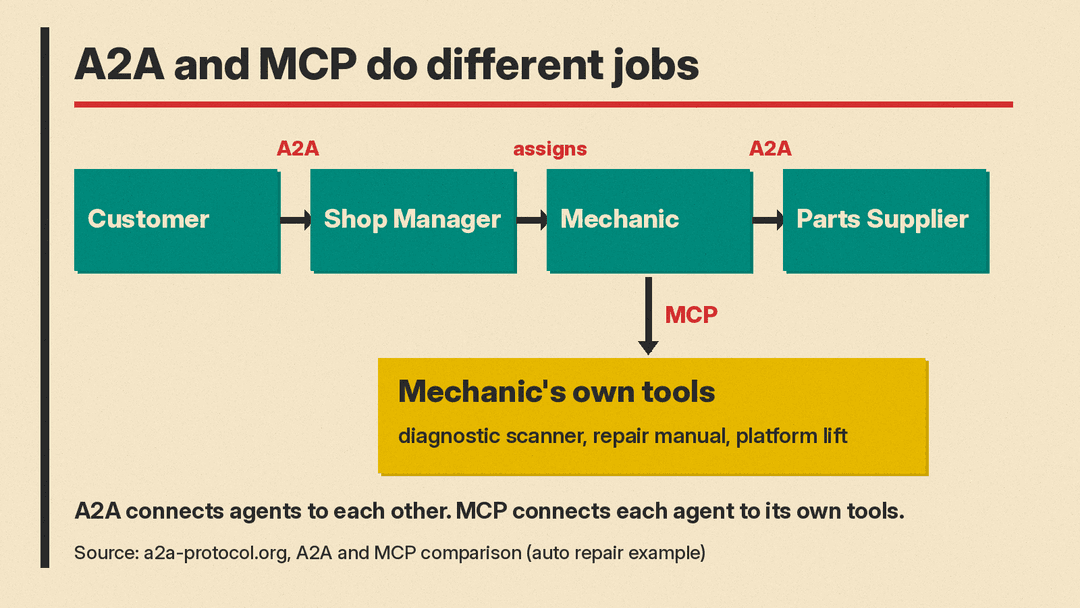
The auto repair example in the same page shows the split. A customer talks to a Shop Manager agent through A2A and says, "My car is making a rattling noise." The Manager asks follow-up questions. A Mechanic agent uses MCP to reach a diagnostic scanner, a repair manual database and a platform lift. The Mechanic then uses A2A to ask a Parts Supplier agent whether a part is in stock and to order it.
Another example is a customer service agent delegating an inquiry to a billing agent. The page summarizes the difference: "A2A connects the agents to each other; MCP connects each agent to its own tools."
Is A2A secure?
The A2A documentation says A2A uses HTTPS and follows standard web practices for authentication, authorization, security, privacy, tracing and monitoring. Clients read security schemes in the Agent Card and obtain a token if required. The key concepts page says credentials such as OAuth tokens or API keys usually travel in HTTP headers, separate from A2A messages.
Opaque execution is another listed feature. Agents collaborate without exposing internal logic, memory or proprietary tools, according to the A2A documentation. This lets one agent use another agent's endpoint without receiving its private implementation.
A protocol sets the rules for how agents talk. It does not make any single agent trustworthy. Each agent's maker still decides what it accepts and what it shares. Our explainer on agent skills covers another way agents gain new abilities.
Who is behind A2A
Google announced A2A on April 9, 2025. The Google announcement says "A2A is an open protocol that complements Anthropic's Model Context Protocol (MCP), which provides helpful tools and context to agents." For a plain guide to that other protocol, see our MCP explainer.
On June 23, 2025, the Linux Foundation announced the Agent2Agent project. The Linux Foundation press page describes A2A as "an open protocol created by Google for secure agent-to-agent communication and collaboration."
The A2A site lists Linux Foundation neutral governance, the Apache 2.0 open source license, and official SDKs in Python, Go, Java, JavaScript, C#/.NET and Rust.
On August 27, 2026, the A2A blog announced that A2A had been accepted as a Growth Stage project at the Agentic AI Foundation (AAIF). The post says A2A now operates under the Linux Foundation-directed AAIF, alongside sibling projects such as MCP, goose and AGENTS.md. For the projects AAIF added in October, see our post on the AAIF additions.
What A2A means for everyday users
Most people do not see A2A directly. They see its result when an assistant hands part of a job to another company's agent, as in the travel scenario described by the A2A documentation. A user asks one assistant for a trip plan. Separate agents may handle flights, hotels, local tours and currency conversion. The user receives one answer from the assistant, not four separate conversations.
A2A defines how agents exchange messages and track tasks. It does not define an agent's internal logic. The A2A documentation says agents collaborate without exposing internal logic, memory or proprietary tools. The maker of each agent still decides what that agent will do and what it asks the user before acting. If one agent asks for a date, budget or confirmation, that choice comes from the agent's design, not the protocol's transport rules.
For builders, A2A provides the message layer between agents. The assistant can send requests, receive updates and gather results. Remote agents work behind their endpoints. The user sees the coordinated result, not the protocol itself.
Key takeaways
- A2A is an open standard that lets AI agents from different makers talk to each other, per the A2A documentation.
- An Agent Card is a JSON "business card" that tells other agents who an agent is, what it can do and how to connect.
- Work moves as tasks, messages and artifacts, so long jobs can report progress instead of one final answer.
- MCP connects an agent to its own tools. A2A connects agents to each other. The A2A docs suggest using both.
- Google announced A2A in April 2025. Since August 2026 it has been a project of the Agentic AI Foundation, which operates under the Linux Foundation.
- For everyday users, A2A is usually invisible. It shows up when one assistant hands part of a job to another agent.
Sources
- What is A2A? (A2A documentation)
- Core Concepts and Components in A2A
- A2A and MCP: Detailed Comparison
- Agent Discovery in A2A
- A2A protocol home page
- Announcing the Agent2Agent Protocol (Google Developers Blog)
- Linux Foundation launches the Agent2Agent Protocol Project
- A New Chapter for A2A: Joining the Agentic AI Foundation (A2A blog, Aug 27, 2026)
