
The Agentic AI Foundation (AAIF), the vendor-neutral group that already hosts the Model Context Protocol (MCP), now holds four more pieces of the agent stack. On October 22, at AGNTCon + MCPCon North America in San Jose, the foundation announced four new projects: Agent Skills from Anthropic, Open Responses from OpenAI, OpenEnv from Hugging Face and OpenSandbox from Alibaba.
The additions bring AAIF to 10 hosted projects in its first year, up from three launch projects in December 2025, according to the foundation's announcement. The four join the Agent2Agent (A2A) protocol, Agent Router, agentgateway, AGENTS.md, goose and MCP.
For anyone who builds with coding agents or agent frameworks, the short version is this: the formats that decide how an agent learns a skill, how an app talks to a model, how an agent is trained and where it runs are moving out of single-company control. Whether that changes daily work depends on adoption, which this post covers at the end.
What each project does
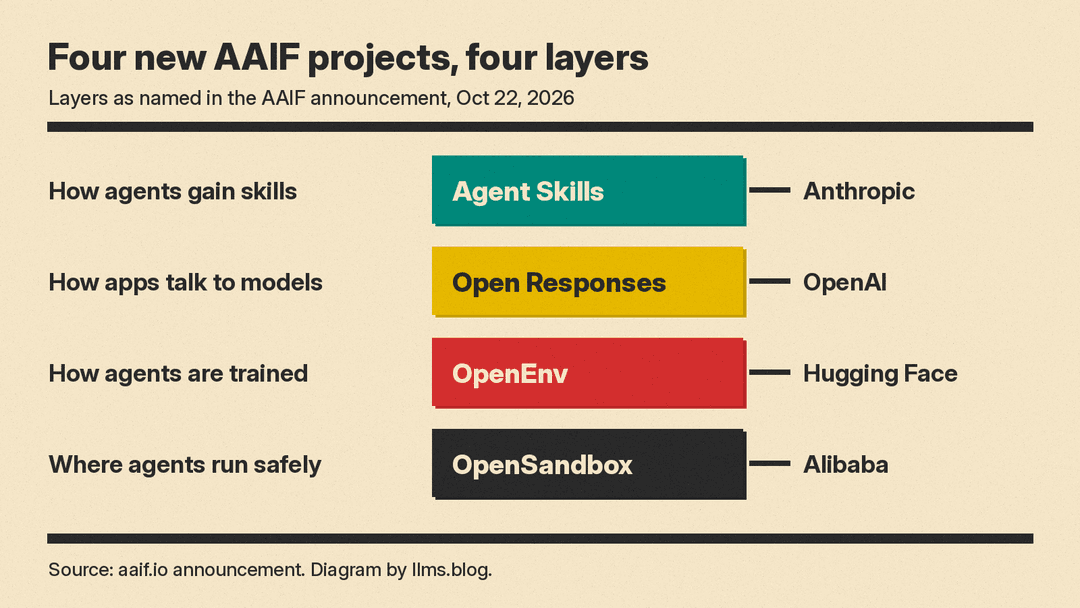
The foundation says the four projects "address four layers of the agentic stack: how agents gain new skills, how applications talk to models across providers, how agents are trained and evaluated, and where agents run safely." Here is each one, in the announcement's own terms.
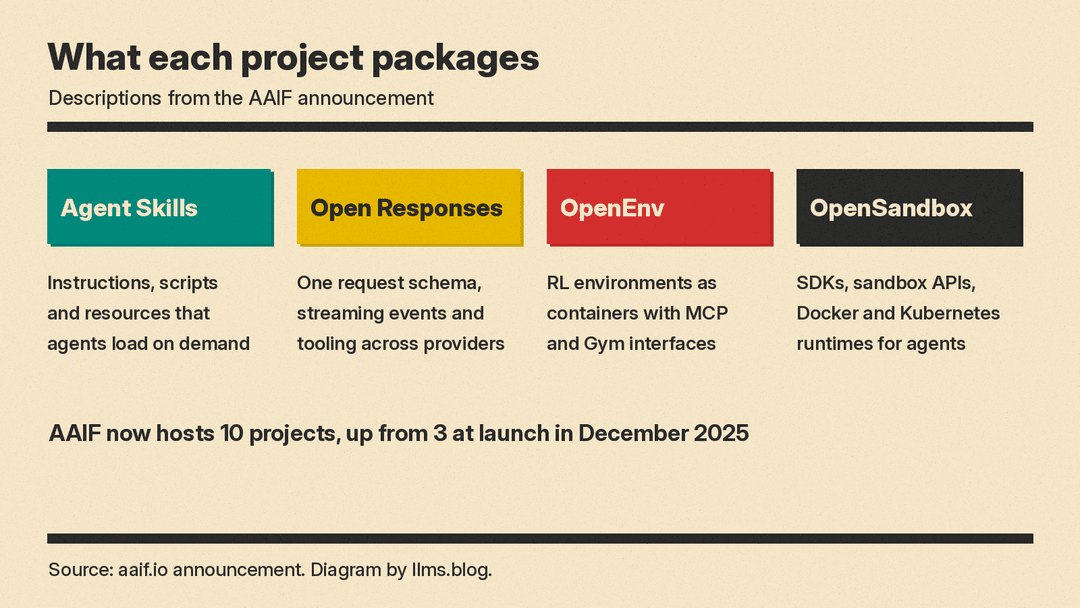
- Agent Skills (Anthropic). An open format for giving agents new capabilities and domain expertise. A skill packages instructions, scripts and resources that an agent can load on demand, so specialized know-how can move between agent products and platforms. Anthropic's David Soria Parra, co-creator and lead maintainer of MCP, said Anthropic launched Agent Skills "a year ago" and is now donating it so "anyone building with skills can shape what's next."
- Open Responses (OpenAI). An open specification for multi-provider LLM interfaces, based on the OpenAI Responses API. It defines a shared schema, consistent streaming events and extensible tooling, so developers can describe requests and outputs once and run them across model providers "with minimal translation."
- OpenEnv (Hugging Face). An open framework and community hub for reinforcement learning (RL) environments. It runs each environment as a containerized service that exposes MCP as the agent interface and Gym, the protocol that training libraries use. Hugging Face's Ben Burtenshaw listed Microsoft, Reflection, Meta-PyTorch, Fleet, Mercor, RadixArk, Modal and Prime Intellect among the groups that built and used it.
- OpenSandbox (Alibaba). A general-purpose sandbox platform for AI applications, with multi-language SDKs, unified sandbox APIs and Docker and Kubernetes runtimes. The listed use cases are coding agents, GUI agents, agent evaluation, AI code execution and RL training. A sandbox protocol defines lifecycle and execution APIs, so teams can add custom runtimes.
Why the donations matter
Each of these projects was contributed by a single company. Anthropic launched Agent Skills a year ago, per Soria Parra. Open Responses is based on OpenAI's own Responses API. Moving them to a foundation means the spec can change through shared governance rather than one vendor's roadmap. Alibaba's Xiaobin Xu put it plainly in the announcement: "we don't want its future to be defined by a single company."
This is the same move Anthropic made with MCP, which it donated to AAIF less than a year ago, per Soria Parra's quote. Earlier this month we covered how agents use MCP to reach accounts in our explainer on screen scraping, OAuth and MCP.
The practical upside for developers is portability. A skill written once could load in more than one agent. A request written against Open Responses could run on more than one model provider. An RL environment packaged for OpenEnv could plug into more than one training library. None of this is guaranteed by a donation, but a neutral spec is a precondition for it.
On October 27, SAP said new Joule Work capabilities use open protocols including A2A and MCP, and let third-party agents invoke its Joule Agents through a governed agent gateway, as our SAP Joule Work explainer covers.
What else came out of the conference
InfoQ's conference report, published October 26, adds detail from the stage:
- AAIF executive director Mazin Gilbert opened with the project news and three new governance committees.
- Soria Parra announced MCP tasks support in Claude Code, which lets tool calls run for minutes, hours or days instead of seconds.
- Anthropic's Den Delimarsky, whom InfoQ calls the protocol's lead maintainer, said cumulative MCP SDK downloads reached 4.17 billion, up from about 3 billion a month earlier. About a third of the 116 conformance scenarios now test security.
- OpenAI's Thomas Sarlandie said OpenAI rejects submitted MCP servers for the ChatGPT plugin directory unless every tool carries annotations.
- Chrome's Sarah Drasner presented WebMCP, a proposed web standard in origin trial that lets websites expose tools to agents instead of agents scraping the page.
- Entire CEO Thomas Dohmke argued that agents have turned code review into the bottleneck. We covered his new company in our Entire explainer.
InfoQ notes that several figures were stage claims without published data, and that some security extensions are still drafts.
The caveats
Outside coverage was cooler, according to InfoQ. It cites The New Stack, which noted that Open Responses already has support from AWS Bedrock, Databricks, Ollama, Nvidia and vLLM, among others, but that Anthropic still defines its own Messages API and Google its own Interactions API. A cross-provider spec has limits while major model vendors keep their own native APIs.
Governance is another open question. All four new projects were contributed by companies. InfoQ also points to The Register, which headlined its story "Vendor-affiliated AI agent tech gets adopted by friendly, funded foundation."
Security also stays the user's job. A shared file format does not make a file safe. AGENTS.md, one of AAIF's founding projects, was the vector in a recent attack we covered, where a planted AGENTS.md file hijacked Codex. Skills that bundle scripts carry the same kind of risk, so treat a third-party skill like any other code you run.
What to watch
- Whether Anthropic and Google add Open Responses support next to their own APIs.
- How many agent tools adopt the Agent Skills format under AAIF governance.
- How the three new governance committees work in practice.
- The next AGNTCon + MCPCon events, set for San Francisco on April 28-29 and London on September 15-16, 2027, per InfoQ.
Sources
- Agentic AI Foundation: Agentic AI Foundation Announces Four New Projects
- Linux Foundation press release
- InfoQ: AGNTCon + MCPCon 2026: Agentic AI Foundation Adds Four Projects as MCP Turns to Security
- The New Stack: OpenAI donates Open Responses, its spec for a common LLM API, to the Agentic AI Foundation
- The Register: Vendor-affiliated AI agent tech gets adopted by friendly, funded foundation (Oct 23, 2026)
- AGNTCon + MCPCon North America event page
