
3CX has shipped V20 Update 10, which the company calls its biggest AI release so far. The update gives the business phone system three new AI pieces: MCP support so ChatGPT or Claude can answer questions about your call data, xAI Grok as a second model provider for its AI agents, and an on-premises AI Server that runs call transcription on an Apple Silicon Mac or a Linux box.
For small and mid-sized businesses that already run 3CX, this update is mostly about practical gaps: what happens when the AI provider goes down, who can update the AI's knowledge, and whether call recordings have to leave the building to get transcribed. Here is what changed and what to check before you upgrade.
What is new in 3CX V20 Update 10
According to the release post by 3CX CEO Nick Galea, dated November 11, 2026, the main AI changes are:
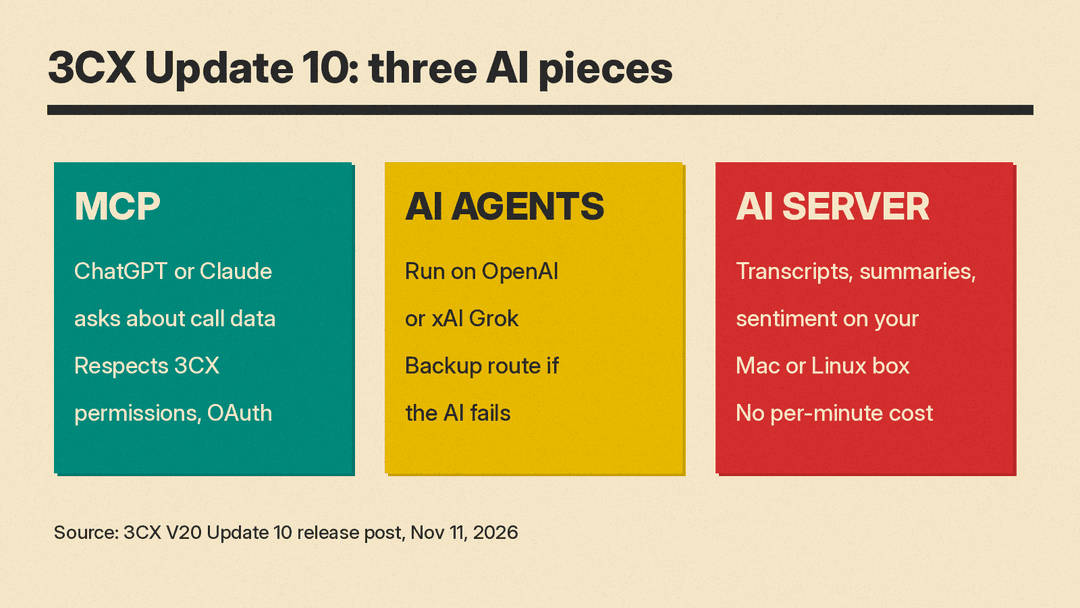
- MCP support. You can connect an AI app such as ChatGPT or Claude to 3CX and ask about call data you are allowed to see.
- Grok as a provider. The AI Receptionist and AI agents can now run on xAI Grok as well as OpenAI, including answers from your knowledge documents.
- More reliable AI agents. A backup route for calls when the AI fails, better instruction following, better directory search and handling of long calls.
- Better call summaries. Summaries now include a recap, notes and action items, and admins can write their own summary prompt.
- Local transcription. A new 3CX AI Server runs transcription, summaries and sentiment on your own hardware.
Ask ChatGPT or Claude about your phone system
The Model Context Protocol (MCP) is an open standard that lets AI assistants connect to outside tools and data. 3CX's example is a customer service manager who wants to know why so many calls were missed last Friday: which queues were affected, when calls were abandoned and what needs a closer look. Today that means reading reports and comparing numbers by hand. With MCP, the manager can ask the question in plain language in an AI app.
Two details matter for IT teams. 3CX says MCP respects existing 3CX permissions, so a user only gets answers about data they can already access, and it uses OAuth authentication to control access. The company also says this is "just the beginning" and that more MCP capabilities for reporting, troubleshooting and administration are planned.
Grok joins OpenAI for the AI Receptionist
3CX frames the Grok addition as part of a strategy to add providers over time so customers are not locked into one vendor. Its advice is to test each provider with your own callers, languages and questions and keep the one that works best for your customers. In 3CX's own tests, costs were similar between the two.
AI agents that fail safely
The most useful change for a small office may be the simplest one. If your AI provider has an outage or your API key fails, calls now go to a backup destination you choose, such as your support queue. That closes a real risk of putting an AI receptionist on the main line: a vendor problem should not mean unanswered customers.
3CX lists other reliability fixes too:
- Improved prompts keep agents on track and consistent.
- Better directory search in large companies, even when a caller gets a name slightly wrong.
- Long conversations are condensed so the AI does not lose track.
The Customer Service AI Agent answers calls from your documents and hands off to a queue, ring group or extension when it cannot help or when the caller asks for a person. 3CX's example: "How do I reset my router?" gets answered by the AI, while a billing dispute goes to the accounts team. Department managers can now update the AI's documents without waiting for the system owner. Supported formats are PDF, TXT, CSV and Markdown, and 3CX says Markdown gives the best answers.
If you are comparing this with chat-based support tools, see our guide to AI customer service chatbots for small business.
If you do not run 3CX, our comparison of AI receptionists for small businesses covers seven AI phone agents with their prices and plan limits.
Call summaries with action items
Call summaries now include a recap, notes and action items that say who does what and by when. Admins can write a custom summary prompt to set length, format and focus. 3CX also says transcripts are better at telling who said what, and sentiment results come back faster.
Transcription on a Mac mini, with no per-minute cost
The new 3CX AI Server runs transcription, call summaries and sentiment on your own Apple Silicon Mac or Linux server. 3CX says calls never go to the cloud and there is no per-minute cost. It is available in 3CX's AI Edition from the 8SC tier, according to the release post.
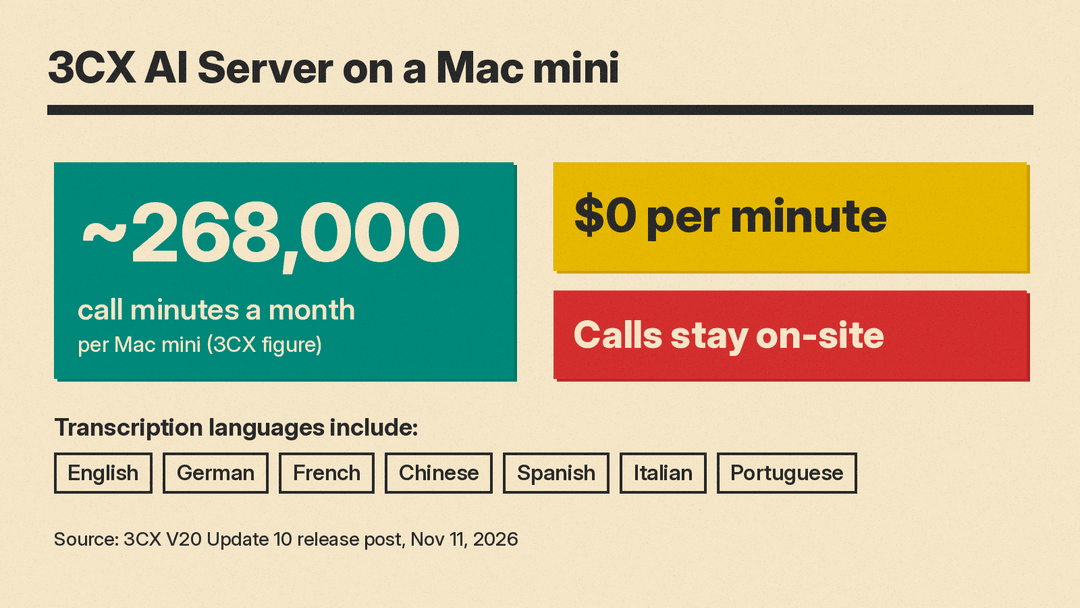
By 3CX's figure, a single Mac mini handles about 268,000 call minutes a month. The company says setup needs no port forwarding, firewall changes or certificates, because the AI Server connects to 3CX by itself. Supported transcription languages include English, German, French, Chinese, Spanish, Italian and Portuguese, with more available.
For businesses with privacy rules about call audio, this is the headline: transcription and summaries without sending recordings to a cloud AI service.
Other changes for everyday users and admins
- Choose your caller ID. Users can pick which outbound number to call from, if the admin turns it on. 3CX gives the example of one person calling for two brands.
- Pop-out dialer. The web client dialer opens in a small window that stays on top of your CRM or helpdesk, in Chrome and Edge.
- Quicker conference calls. Press Conference, pick people or type numbers, and the call starts, with controls to add, mute, remove or redial.
- Firmware management. A new Phones page puts deskphone firmware in one place, with scheduled updates and rollback.
- SSO for the Windows softphone. Users can sign in with Google or Microsoft SSO and the app configures itself. This needs Windows Softphone V5.8 and SSO turned on by the admin.
Before you upgrade: three things to check
3CX's release notes flag a few steps that are easy to miss:
- Copy any custom summary prompt first. If you customized the call summary prompt, the upgrade overwrites it with the new default.
- Reauthorize Zendesk and Salesforce. Both integrations need to be reauthorized after upgrading.
- Switch to the AI Server before upgrading if you want onboard AI transcription from Update 10.
To upgrade, 3CX says to open the Admin Console, go to System, then Updates, and follow the update sequence. Update your apps too, including Windows Softphone V5.8.
Why it matters
Phone systems are where many small businesses first meet AI agents, through an AI receptionist on the main number. Update 10 addresses the practical worries that come with that: a fallback when the AI fails, a choice of model provider, and a way to keep call audio on your own hardware. MCP support also points to where business software is heading: instead of logging in to a reporting screen, managers ask an AI assistant they already use. For a broader look at how support platforms are pricing and packaging AI agents, see our coverage of Zendesk's Outcome AI platform.
