
Alibaba's Wan 3.0 is a video model that makes up to 30 seconds of clip in one pass, with dialogue, music and sound effects generated with the picture. It has been available through Alibaba Cloud Model Studio since August 2026. As of November 2026 it also sits first on the Artificial Analysis text-to-video board that scores clips with audio. This explainer covers what the model does, what it costs, and how much weight that ranking can carry.
What Wan 3.0 is
Wan 3.0 is the newest model in Alibaba's Wan video family. In its launch post, dated August 6, 2026, Model Studio says the family has shipped eight iterations from Wan 1.0 to Wan 3.0. The Model Studio guide calls it an all-in-one model. Either model name covers text-to-video, image-to-video, reference-based generation, video editing and video extension. The service picks the task from the type of media you send and from the intent of your prompt.
Two model names are listed in the API reference. The standard version is wan3.0-video. The faster version is wan3.0-video-prime, which Alibaba describes as having capabilities aligned to the standard version with much better end-to-end speed. The same reference page says the model is currently in preview.
What it can do
Alibaba lists these capabilities in its launch post and guide:
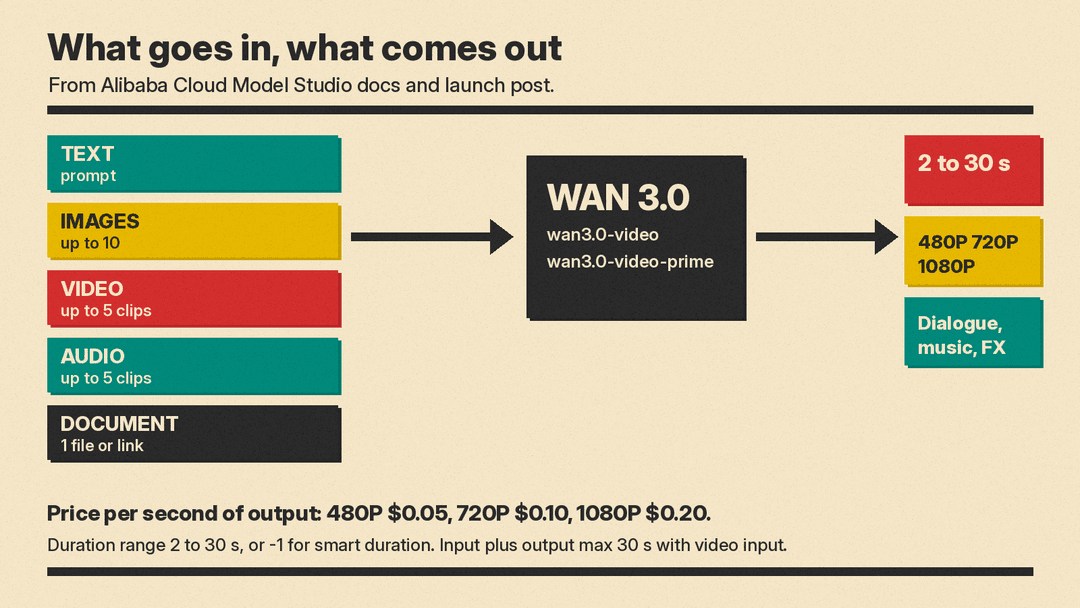
- Length. Up to 30 seconds in a single generation, at 30 frames per second, as MP4. A smart duration setting lets the model suggest a length. If you set duration to -1, the guide says it defaults to 5 seconds.
- Audio. The model writes dialogue, ambient sound effects and background music natively. Audio is on by default and can be turned off. The API reference says that switching audio on or off does not change the price.
- Resolution. 480P, 720P or 1080P, with 1080P as the default.
- Multi-shot prompts. The guide describes a storyboard format with 4 to 6 seconds per shot and timestamps in the prompt.
- References. Up to 20 reference items per request. The limits are up to 10 images, up to 5 video clips (15 seconds in total) and up to 5 audio clips (15 seconds in total).
- First and last frames. You can fix the opening frame, or both the first and last frames, and let the model fill in the motion between them.
- Editing and extension. You can add, remove or replace elements in a clip, change the style or lighting, or change the dialogue. You can also extend a clip forward, backward or both ways. Input plus output length must stay at or under 30 seconds.
- Documents as input. This is new for the family. A request can include one file or one public web link, up to 100 MB and 50 pages. Listed formats include PPT, PDF, Word, Excel, Keynote, Pages, Numbers, text and Markdown.
Alibaba's examples for document input include a product slide deck turned into an advertisement and a spreadsheet turned into animated charts. Those are Alibaba's own demonstrations. The launch post says audio texture and on-screen text rendering accuracy are improving but not yet where the team wants them. A video of numbers deserves a check, frame by frame, before it goes out.
What it costs
Model Studio bills per second of generated video, by output resolution. As of November 2026, the launch post lists these API prices:
- 480P: $0.05 per second
- 720P: $0.10 per second
- 1080P: $0.20 per second
Alibaba's own arithmetic in the post is that a full 30-second clip costs $6.00 at 1080P and $1.50 at 480P. It suggests drafting at 480P and finishing at 1080P. Drafting at the low tier lets you test a prompt for a fraction of the final cost.
The 1080P rate matches the figure on the Artificial Analysis board, which lists Wan 3.0 at $12.00 per minute of video. For comparison, the same board lists MiniMax H3 (768p) at $4.80 per minute and Dreamina Seedance 2.5 at $34.12 per minute. Artificial Analysis says its price column reflects the model maker's API at the settings it benchmarks, at 1080p where offered.
Where it ranks
Artificial Analysis runs a video arena. Voters compare two clips made from the same text prompt without knowing which model made which. The votes become an Elo score. The current text-to-video leaderboard is called AA-Video-T2V v2.1 and ranks models on video with audio. Here are rows 1 to 6 and row 10 of the table as of November 4, 2026:
- 1. Wan 3.0, Elo 1172, $12.00 per minute
- 2. Utopai X, Elo 1169, no API available
- 3. MiniMax H3 (768p), Elo 1160, $4.80 per minute
- 4. FLUX 3 Max, Elo 1156, $4.35 per minute
- 5. Dreamina Seedance 2.5, Elo 1155, $34.12 per minute
- 6. HeyGen Video 1, Elo 1153, $2.40 per minute
- 10. Gemini Omni Flash 1.1, Elo 1129, $9.12 per minute
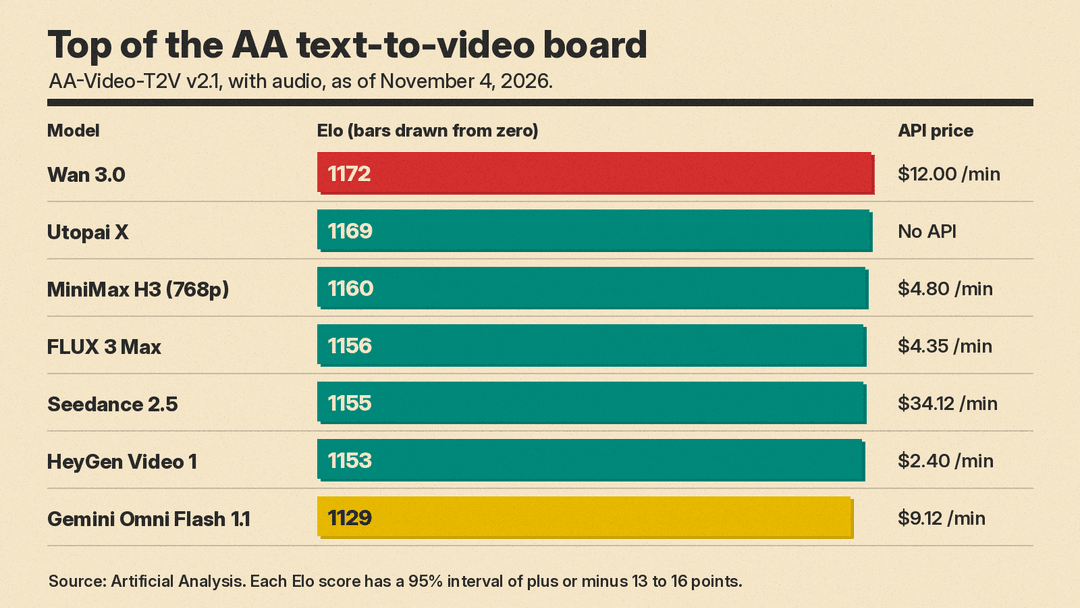
The margin at the top is thin. Each Elo score carries a 95 percent interval of plus or minus 14 points for Wan 3.0, and the board gives it a rank range of 1 to 3. That range means the board cannot rule out Wan 3.0 sitting as low as third. The board shows 7,179 samples for Wan 3.0. On the standard Elo formula, which is my own arithmetic and not a figure from Artificial Analysis, a gap of 12 points means the leader is preferred in about 52 percent of head-to-head votes. Even the 43 point gap to Gemini Omni Flash 1.1 works out to roughly 56 percent.
The audio matters here. Artificial Analysis publishes a separate silent board. On that silent board, HeyGen Video 1 leads at Elo 1143, and Wan 3.0 is fifth at 1131. So the first place belongs to the clips with sound, not to picture quality alone. A creator who adds music and voice in an editor may care more about the silent ranking. A creator who wants one prompt to produce a finished clip with sound may care more about the audio ranking.
Artificial Analysis describes the method behind v2.0 in its September 30, 2026 launch thread, as quoted on Alibaba Wan's X account. Every clip is judged at 1080p, the prompt set is refreshed regularly, and prompts are tagged by use case, capability and visual style. At the v2.0 launch the thread cited more than 68,000 human preference votes over 1,000 prompts, and said Wan 3.0 led 10 of the 20 category boards at that time. The leaderboard has been updated since, so check the live page for current numbers.
How to use the ranking
A single Elo number is a rough guide. Three cautions apply.
First, price changes the picture. Wan 3.0 costs $12.00 per minute on the board. MiniMax H3 (768p) sits 12 points lower at $4.80 per minute, which is 2.5 times cheaper per minute. Seedance 2.5 is 17 points lower and costs about 2.8 times as much. If a few Elo points do not change your client's answer, price may decide.
Second, access differs. Utopai X ranks second but lists no API. A model you cannot call cannot be part of a pipeline. Wan 3.0 is available through Model Studio, though the API reference labels it preview, and supported models can vary by region, according to the guide.
Third, Kling 4.0 is not on the board. It lists Kling 3.0 and Kling 3.0 Omni, and Kling 3.0 1080p (Pro) is the fixed reference at 1000 Elo. No Kling 4.0 row appears as of this writing. For a spec and price comparison of newer models, see our Gemini Omni Flash vs Kling 4.0 guide.
Who should try it
Wan 3.0 fits a few jobs. Short ads and product films are one, since a single pass can run up to 30 seconds. Explainer clips built from an existing deck or web page are another, because of the document input. Editing is a third: you can revise dialogue or style on a finished clip without starting over. If you start from a still, our image-to-video tools list covers other options.
It fits less well where exact text on screen is required, given Alibaba's own caveat. The Alibaba pages above describe access through Model Studio and do not mention downloadable weights. For work that needs open weights, the Artificial Analysis board names MiniMax H3 (768p) as the leading open-weights model on both its audio and silent boards. A research example built on the older open Wan 2.1 model is Wave Forcing, which streams video chunk by chunk.
A practical routine is simple. Write a storyboard prompt with shot timestamps, render at 480P to check the idea at $0.05 per second, then render the keeper at 1080P. Review the audio with headphones, since Alibaba names audio texture as a known weak spot. Prices, limits and rankings above are as of November 2026 and can change.
Sources
- Wan3.0: 30-Second AI Video Generation from Any Input, Alibaba Cloud Model Studio blog, August 6, 2026
- Wan3.0 Video Generation guide, Alibaba Cloud Model Studio
- Wan3.0 Video Generation API Reference, Alibaba Cloud Model Studio
- AA-Video-T2V v2.1 leaderboard, Artificial Analysis
- Alibaba Wan on X, quoting the Artificial Analysis v2.0 launch thread
- Artificial Analysis on X, AA-Video-T2V v2.0 launch thread, September 30, 2026
