
A research group at Shanghai Jiao Tong University has released Wave Forcing, a way to make a video model stream its output without stopping. The team shipped open weights for a 1.3 billion parameter model on Hugging Face, code on GitHub, and a paper on arXiv. The headline claim is speed: about 135 frames per second end to end on one node of eight data-center GPUs. This post explains what the method does in plain words, what the authors measured, and what limits they list themselves. Every figure below comes from the paper, the model card or the repositories.
What Wave Forcing is
Most AI video tools make a clip of fixed length, then hand it back. Streaming video generation works differently. The model produces short chunks one after another and keeps going, so the picture can play while it is still being made. That matters for live avatars, game-like worlds and any use where you cannot wait for a full render.
The new work builds on Wan 2.1 T2V 1.3B, the Wan team's small open text-to-video model. If you want the family context, our explainer on Wan 3.0, Alibaba's AI video model and its rank covers the newer line. The Wave Forcing authors start from the older 1.3B model and change how it is trained and how it runs.
The paper, titled "Wave Forcing: Towards Speed-of-Light Streaming Video Generation," comes from the DENG Lab at Shanghai Jiao Tong University. It names a problem with earlier chunk-by-chunk methods. Each chunk must finish its denoising steps, then a second pass refreshes the model's memory of what came before. The authors write that this takes two forward passes even with one-step denoising.
How the wave works
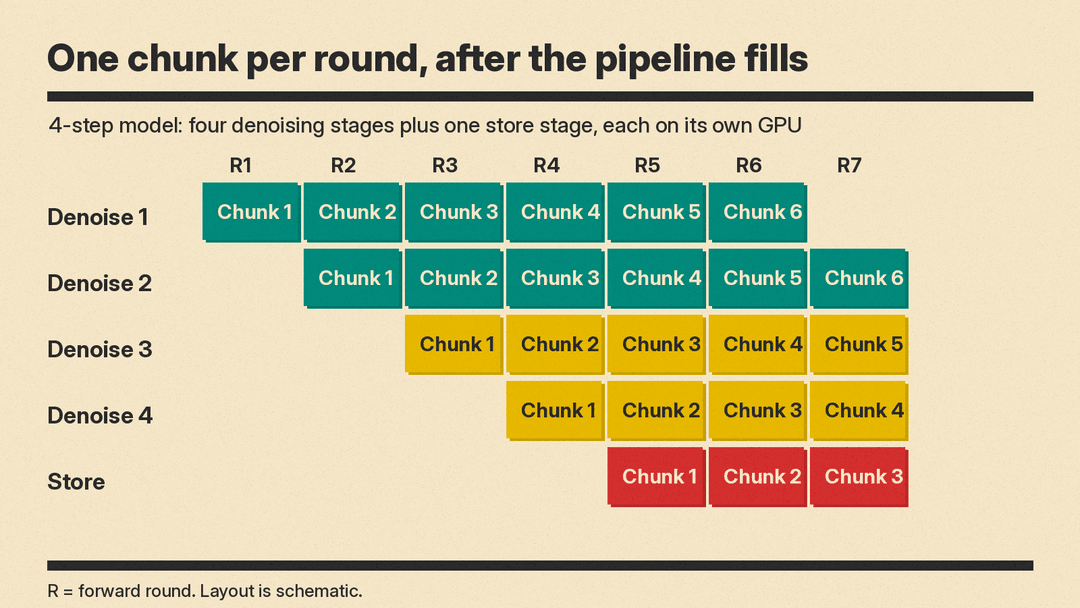
The key idea is overlap. In a normal chunked model, chunk two waits for chunk one to finish. In Wave Forcing, chunk two starts early and reads from chunk one's cleaner, partly finished state. The paper calls this a causal wavefront: newer, noisier chunks may look at older, cleaner ones, but never the other way round.
Each denoising step, and the memory-refresh step the paper calls "store," runs on its own full copy of the model on its own GPU. Once the pipeline has filled, the system finishes one chunk per round of forward passes. The authors name this target "1F1C," one output chunk per concurrent forward round.
The paper pairs this schedule with a three-stage training recipe and a custom runtime it calls WaveRT. The runtime sends the stored attention data between GPUs early and overlaps that transfer with computation, and it splits video decoding across extra GPUs. The authors say the runtime builds on SGLang Diffusion.
What the authors measured
There are two kinds of results: video quality and speed.
On quality, the 5-step model is compared with Rolling Forcing, an earlier streaming method, on the same base model. The paper reports these numbers:
- VBench Total: 81.64 for Wave Forcing, 81.15 for Rolling Forcing.
- VBench-Long Quality: 81.26 versus 81.18.
- Dynamic Degree, which scores how much motion a video has: 94.44 versus 51.39 on short videos.
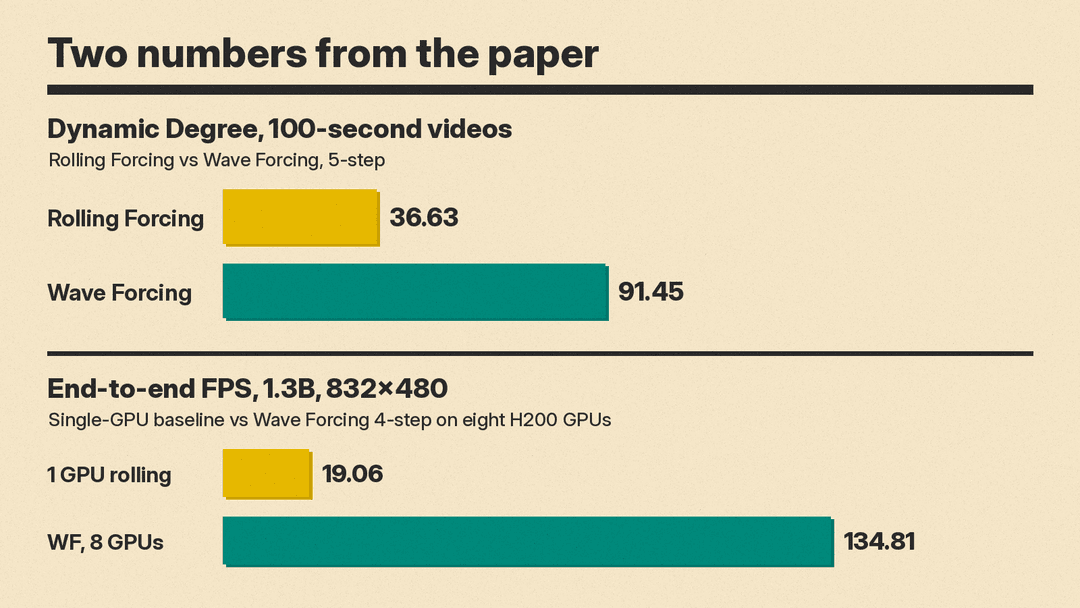
- Dynamic Degree on 100-second videos: 91.45 versus 36.63.
- Subject Preservation, which tracks whether the main subject stays in frame: 97.10 versus 92.75.
- Camera Drift, where lower is better: 0.37 versus 0.17.
So the quality scores are close, motion is much higher, and drift is a little worse. The authors describe the 5-step result as quality "comparable" to Rolling Forcing. They also tested Causal Forcing, which scored 96.61 on long-video Dynamic Degree. They call its stability "unusable": Subject Preservation was 71.11 and Camera Drift was 11.14, and the subject leaves the frame in their sample. High motion scores alone can hide that kind of failure, which is why the authors added their own stability checks.
On speed, the 4-step model reaches 147.6 DiT frames per second and 134.8 end-to-end frames per second on eight H200 GPUs. That is 7.07 times the 19.06 FPS of a single-GPU baseline. The 5-step model reaches 96.46 end-to-end FPS on the same eight GPUs. Videos in the tests are 832 by 480 pixels at 16 frames per second.
The runtime also gets a separate test against standard context-parallel methods, Ulysses and Ring, across six model sizes from 1.3B to 14B. With matched backends, the paper says Wave Parallelism delivers up to 2.53 times the throughput of the faster of the two. In plain BF16 it leads at five of the six sizes and trails Ulysses by about 1.5 percent at 9B.
What you can download
The Hugging Face repository holds two checkpoints, a 5-step and a 4-step version, each about 2.8 GB. The model card lists the license as Apache 2.0 and names Wan 2.1 T2V 1.3B as the base. It says the text encoder, tokenizer and VAE are not included, so you load those from the Wan 2.1 Diffusers repository. The inference code lives in the WaveForcing GitHub repository. The card shows the run command for the WaveRT runtime, with settings for each step count.
The authors tested on a node with eight H200 GPUs. Treat that as the setup behind the headline numbers. The paper does not report a laptop or single-GPU streaming result for Wave Forcing.
Limits the authors state
The paper has a full limitations section. Several points matter for creators and builders:
- The paper says its runtime speed tests used randomly initialized (dummy) model weights, because pretrained 14B weights are not available and the authors lacked the compute to train them. The GitHub README says its 1.3B rows use the released checkpoints. Either way, the speed figures measure execution cost, not video quality, and the 14B and intermediate-size tests have no trained model behind them.
- The method needs one full model copy per denoising step plus one for store. The paper says this bounds how far one pipeline can scale at a fixed step count.
- Throughput is not the same as responsiveness. The authors say high steady-state speed does not show low delay between an input and visible output, and they did not test prompt switching or camera and action control.
- The training recipe is complex, and the authors list simplifying it as future work.
- Standard video scores such as VBench miss problems like a subject leaving the frame, and the authors say their own stability checks use only a 100-prompt subset and need human-agreement tests.
Why it matters
Streaming video is where several threads meet: live avatars, interactive worlds and agent tools that need video on demand. Our recent posts on TaoMate-HD, a streaming avatar method on MiniMax H3 and on DeepMind's Genie 4 world model cover related ground. Wave Forcing adds an open, small-model recipe that is built around speed and long runs.
For now this is a research release, not a product. It will not change what you can do in a hosted video app this week. It does show that a 1.3 billion parameter open model can be pushed to well above real-time frame rates when several GPUs share the work, and that the authors count motion and subject stability together instead of trusting one score. Watch for independent tests, a hosted demo or a single-GPU recipe before building a workflow on it.
