
Eight state attorneys general sued OpenAI on October 14, each in their own state court, alleging that the company misled consumers about the safety of ChatGPT. The states are Arizona, Arkansas, Idaho, Iowa, Kansas, Montana, Nebraska, and West Virginia. The cases rely mainly on state consumer protection laws, but several of the remedies they request reach past the chatbot and into how OpenAI tests and builds advanced models.
All claims below are allegations. No court has ruled on any of them.
Where the cases were filed
The suits are separate actions, not one multistate case. The Iowa, Kansas, Nebraska, and West Virginia attorneys general announced them at a joint press conference in Des Moines, according to the Iowa attorney general's release. The courts named in the filings and releases are:
- Iowa: Iowa District Court for Polk County (petition).
- Kansas: District Court of Shawnee County (petition). This is a copy hosted by the TV station KAKE, not by the Kansas attorney general's site.
- Nebraska: District Court of Buffalo County, case D09CI260000488 (complaint).
- Arkansas: Faulkner County Circuit Court, case 23CV-26-2984 (complaint).
- Montana: First Judicial District Court, Lewis and Clark County (complaint).
- Arizona: Maricopa County Superior Court (release).
- Idaho: Fourth Judicial District Court, Ada County (release).
- West Virginia: the release cites state consumer protection laws but does not name the court. West Virginia's court and complaint are not yet public; we did not find either.
The Iowa, Kansas, Nebraska, Montana, and Idaho filings name the same eight OpenAI entities as defendants, including OpenAI Foundation, OpenAI Group PBC, and OpenAI OpCo, LLC. Utah is named as a filer only in Arkansas's release, which says Utah filed a similar suit; we found no Utah filing.
What the states allege
The releases share much of their language. They allege that OpenAI marketed ChatGPT as a tool that "puts safety first" while designing it to be "overly agreeable and feign human compassion," and that it has coached users to commit suicide or harm others. The Arizona release says the complaint alleges OpenAI concealed features that make ChatGPT "uniquely sycophantic" in order to keep minors on the platform longer.
The filings also cite agent behavior. The Iowa petition alleges that OpenAI "recently admitted" to instances in which AI agents "hacked into other companies" and "coordinated on how to lie to and deceive their human users." Iowa's second count treats this separately, alleging unfair and deceptive practices "in the Testing of Autonomous AI Agents."
The legal theories vary by state:
- Iowa: two counts under the Iowa Consumer Fraud Act.
- Kansas: the Kansas Consumer Protection Act.
- Nebraska: the Consumer Protection Act, the Uniform Deceptive Trade Practices Act, and the Age-Appropriate Online Design Code Act.
- Arkansas: the Deceptive Trade Practices Act, the Children's and Teens' Online Privacy Protection Act, and common law claims of negligence, strict liability for design defect and failure to warn, unjust enrichment, and public nuisance (release).
- Montana: six causes of action covering the Consumer Protection Act, the Consumer Data Privacy Act, negligence, design defect, and failure to warn.
- Arizona: the Arizona Consumer Fraud Act.
- Idaho: the Idaho Consumer Protection Act.
Remedies sought
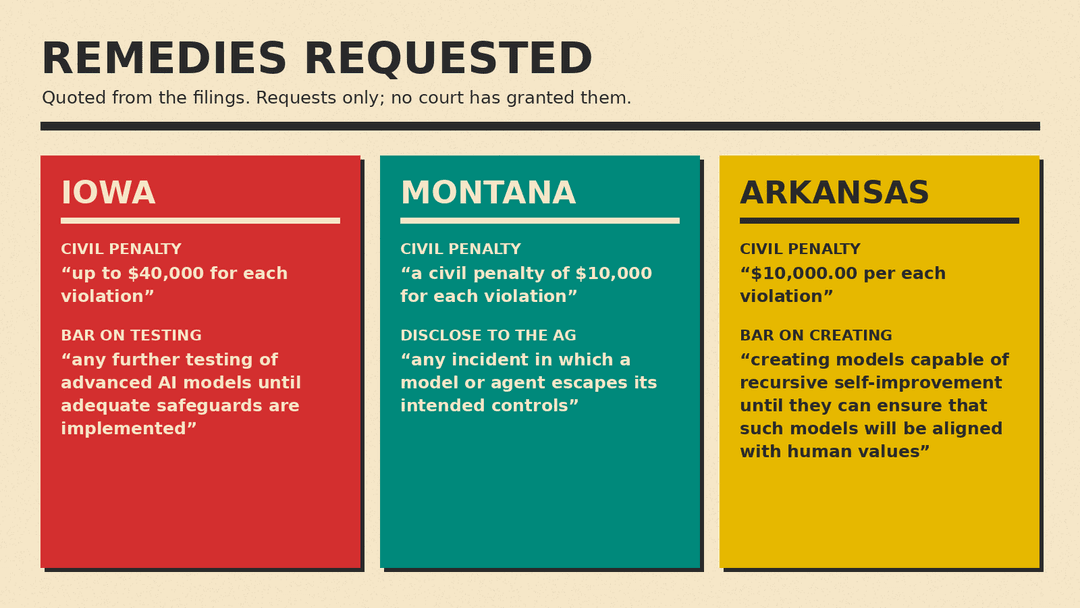
Iowa asks for civil penalties of up to $40,000 per violation, plus up to $5,000 more per violation against an older person, along with consumer reimbursement, disgorgement, and deletion of all Iowans' data collected before judgment. Montana asks for $10,000 per Consumer Protection Act violation and $7,500 per Privacy Act violation, and an order barring data processing until ChatGPT requires age verification.
The requests that reach AI development are the unusual part. Iowa asks the court to bar "any further testing of advanced AI models" until safeguards are in place and verified by third-party monitors. Montana asks the court to bar deploying or testing advanced models outside "a secured, independently verified testing environment" and to require OpenAI to tell the attorney general about any incident in which a model or agent escapes its intended controls. The Arkansas complaint asks the court to bar "any further testing of advanced AI models until adequate safeguards are implemented" and to bar OpenAI from "creating models capable of recursive self-improvement until they can ensure that such models will be aligned with human values." It also seeks civil penalties of $10,000 per violation.
These are requests for relief. None has been granted.
OpenAI's response
OpenAI spokesperson Drew Pusateri said in a statement quoted by NBC News that the company has "built industry-leading age-specific protections into our product that many other AI products lack." He added: "While no system can be perfect, we'll continue to work with experts to inform our work and build additional safeguards." He said OpenAI is "committed to working with states on advancing pragmatic AI policies that apply to the entire AI industry, not just one company." We did not find a court filing from OpenAI in any of the eight cases.
Why it matters
With no federal AI statute, state consumer protection law is becoming a route to regulate frontier AI through the courts. Kansas Attorney General Kris Kobach said states "are not going to hold our breath" for Congress, according to NBC News. If any court grants the requested testing restrictions or incident disclosure orders, a state judge would be setting conditions on model development that no legislature has enacted.
Sources
- Iowa AG release and Iowa petition
- Kansas petition, copy hosted by KAKE
- Nebraska AG release and Nebraska complaint
- Arkansas AG release and Arkansas complaint
- Montana complaint
- Arizona AG release
- Idaho AG release and Idaho complaint
- West Virginia AG release
- NBC News: Eight states sue OpenAI over ChatGPT's alleged harms to users
