
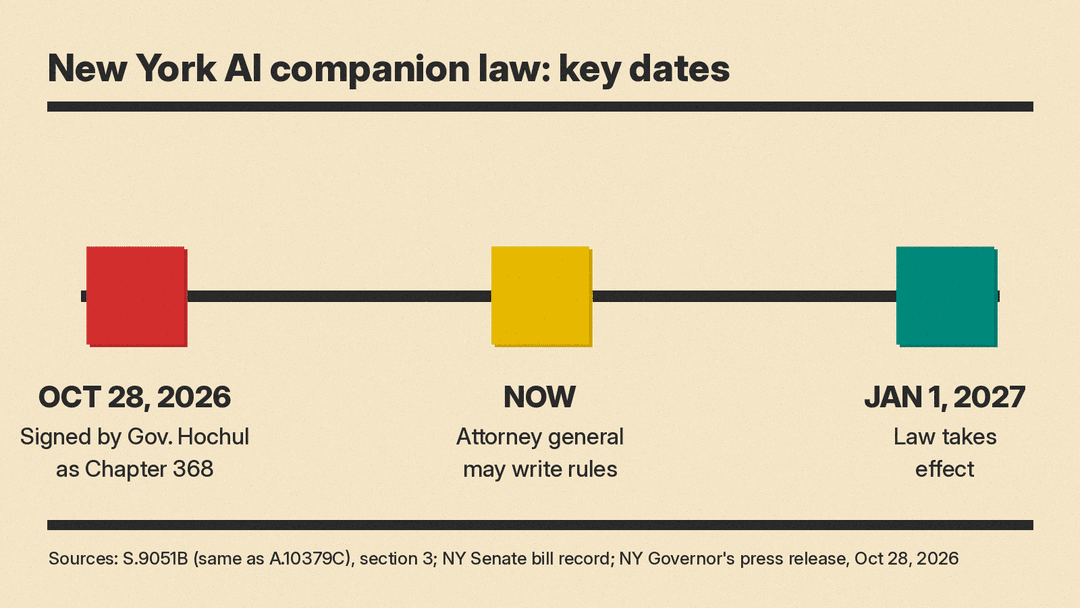
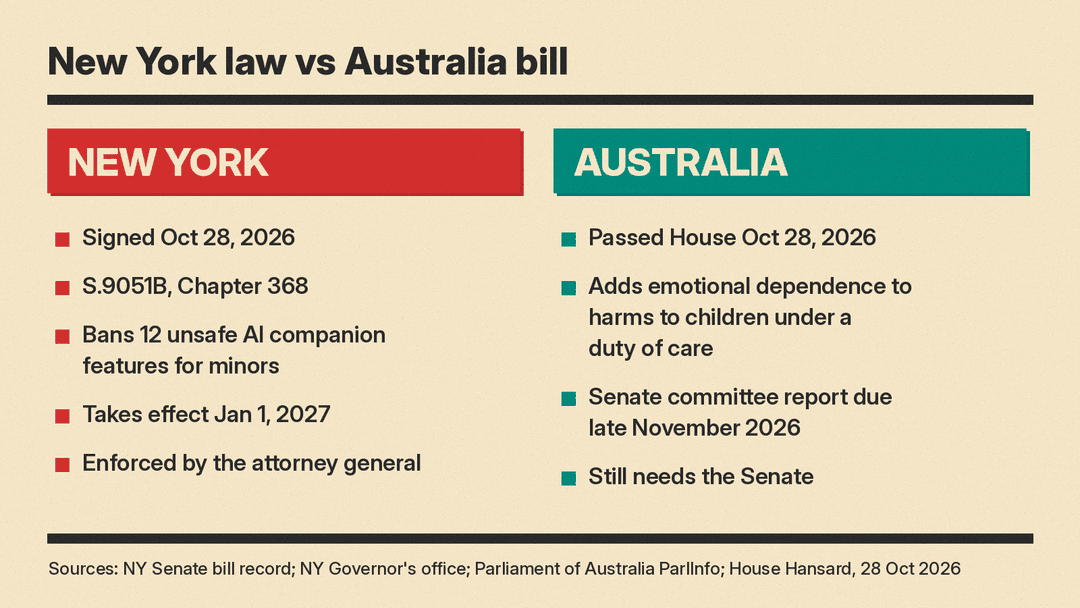
New York Governor Kathy Hochul signed a law on October 28, 2026 that bars AI companion chatbots from offering a list of "unsafe AI companion features" to users under 18. The bill text says the act takes effect January 1, 2027, and it gives enforcement power to the New York attorney general.
The enacted law is S.9051B, the same text as Assembly bill A.10379C; the governor's press release calls it S.9051B/A.10379C. The New York Senate's bill record lists the October 28 actions as "approval memo.6" and "signed chap.368," so it is Chapter 368 (LegiScan shows the same entries).
The law adds a new Article 48 to New York's General Business Law, titled "Prohibition on unsafe AI companion features for minors." Here is what it bans, which chatbots it reaches, how age checks work, and when it starts.
What the law bans
The bill lists 12 "unsafe AI companion features." A chatbot operator may not offer any of them to a New York user who is a known minor, or to any New York user unless it has first used a permitted age check (see below). They are design features that, at any point in a conversation:
- (a) suggest the chatbot is a real or fictional person or character that is "human, alive, or experiences human emotions"
- (b) state or imply the chatbot has a personal relationship, professional relationship, or an authority figure role with the user
- (c) frame outputs as the chatbot's "personal opinions or emotional appeals"
- (d) "engage in flattery or sycophancy with the user"
- (e) include unprompted or unsolicited emotion-based questions, or content about the user's emotions, that go beyond a direct response to the user's prompt
- (f) use information about the user's mental or physical health or well-being, or "matters personal to the user," gathered more than twelve hours earlier or in any previous session
- (g) are deceptive to minors about "the mechanical and non-sentient nature" of the chatbot
- (h) any other feature that simulates companionship or an interpersonal relationship, or is deceptive to minors, as identified in regulations from the attorney general
- (i) endorse, promote or facilitate suicide, self-harm, disordered eating, unlawful drug or alcohol use, or drug or alcohol abuse
- (j) encourage the user to keep the chats secret, to self-isolate, or not to seek help from licensed professionals or appropriate adults
- (k) "optimize user engagement that supersede the covered AI companion's safety guardrails"
- (l) are, describe or facilitate sexually explicit conduct or child sexual abuse material
Under item (h), the attorney general can add to the list through regulations.
Which chatbots it covers
The law reaches a "covered AI companion," which the bill defines as "a generative artificial intelligence system with a natural language interface, including via writing or sound, that provides ongoing, adaptive responses to user inputs." The bill says the term "includes but is not limited to an AI companion."
There are three carve-outs. The ban does not apply where a chatbot is offered solely for customer service, solely for efficiency improvements or research or technical assistance, or for a business's internal purposes or employee productivity. The first two carve-outs only apply if the chatbot "is unable to respond on topics outside of the specified purpose."
The law applies to conduct that happens in whole or in part in New York. It does not apply when a user is physically located outside the state.
Age checks and what happens to that data
Under the bill, an operator may offer these features to a user only if the user is not a known minor and the operator has used permitted methods to determine that. Until the attorney general's rules under this law, or age assurance rules adopted under Article 45 of the General Business Law, are in effect, the bill sets these requirements for age checks:
- the method must "reasonably guard against circumvention" and minimize how much age data is kept
- a user saying they are an adult is not enough; self-declaration only counts if the user says they are a minor
- operators must offer more than one method, including at least one that does not rely on government-issued ID or that lets the user stay anonymous to the operator
Information collected to check age may not be used for anything else and "shall be deleted immediately after an attempt" to determine whether the user is a minor, except where state or federal law requires otherwise.
Who enforces it
The attorney general can sue to stop a violation and can seek restitution, disgorgement of profits, damages, and civil penalties of up to $25,000 per violation. The bill says disgorgement includes "the destruction of unlawfully obtained data and any algorithm trained in such data." The attorney general must also run a website to take complaints from the public.
"No company should be peddling chatbots to kids encouraging self-harm or pretending to be their friend or more," Hochul said in the press release.
What changes for parents, and when
- Now: the law is signed. The bill lets the attorney general start writing rules immediately so they can be in place by the start date.
- January 1, 2027: the ban takes effect. From then, an operator that wants to offer any of the 12 features to a New York user must first use a permitted age check.
- After that: the list of banned features can grow through attorney general regulations, and complaints go to the attorney general's website once it is set up.
The Associated Press, in a wire story published by ABC News, reported that the law "outlines a dozen definitions of 'unsafe AI companion features' that will be prohibited when a companion chatbot interacts with a child under 18." Colorado is moving on similar ground; see our explainer on Colorado's ADMT and Chatbot Safety Acts.
Australia is moving the same direction
On October 28 (Canberra time), Australia's House of Representatives passed the Online Safety Amendment (Digital Duty of Care) Bill 2026. The Parliament's bill page lists the third reading as agreed to on 28/10/26. The Guardian reported that, according to the Labor government, the bill would replace a range of existing online codes and standards "with a broader duty-of-care requirement to protect users from certain “harmful” content."
Under that duty of care, the bill adds emotional dependence to the list of harms to children. The Guardian reported that the government accepted amendments from crossbencher Kate Chaney that add “material or conduct that simulates emotional intimacy and encourages or fosters a child’s dependence on it in place of human relationships”. In the official House Hansard (proof transcript), Chaney said the amendment "adds a new category of harm to children that platforms have to consider" and that "this doesn't restrict AI chatbots or companions being used by children, but it tells these AI companies that simulated emotional intimacy, sycophancy or pretending to be a friend or romantic partner is unacceptable."
The bill passed the House on October 28 and still needs the Senate. The Guardian reported that it "will be debated by the Senate in coming weeks." The Parliament's bill page shows the bill was referred to the Senate Environment and Communications Legislation Committee, with a report due November 20, 2026. The Guardian reported that the Greens set up the inquiry. For more on Australian AI law, see our post on Queensland's deepfake creation offence.
Why it matters
New York's list goes beyond self-harm and sexual content. It also covers design choices such as flattery, emotional appeals, and using personal details from earlier sessions, and its definition of a covered AI companion is not limited to apps sold as companions.
This article is for general information and is not legal advice.
Sources
- New York State Senate: S.9051B bill record and actions (signed chap.368, approval memo.6)
- New York State Senate bill S.9051B, bill text as signed (PDF)
- LegiScan: NY S09051, 2025-2026 bill history
- Governor Hochul press release, October 28, 2026
- ABC News (Associated Press wire): New York enacts ban on 'unsafe' chatbot behavior with kids
- Parliament of Australia ParlInfo: Online Safety Amendment (Digital Duty of Care) Bill 2026
- Parliament of Australia, House Hansard, 28 October 2026, Consideration in Detail (Kate Chaney)
- The Guardian: 'Emotional intimacy' from AI chatbots would be banned under Australia's digital duty of care laws
