
Tencent has released an open video model that you steer turn by turn. Hy-Nomas, released by the Tencent Hy (Hunyuan) visual generation team, builds a video "world" one segment at a time and lets you change direction between segments, with a new text instruction, a camera move, or both.
The code went up on GitHub on October 21, 2026, with weights on Hugging Face and a benchmark dataset. The code and weights are under the Apache 2.0 license, and an updated technical report landed on October 26. Here is what it does, what hardware it needs, and where Tencent's own numbers say it still falls short.
What Hy-Nomas is
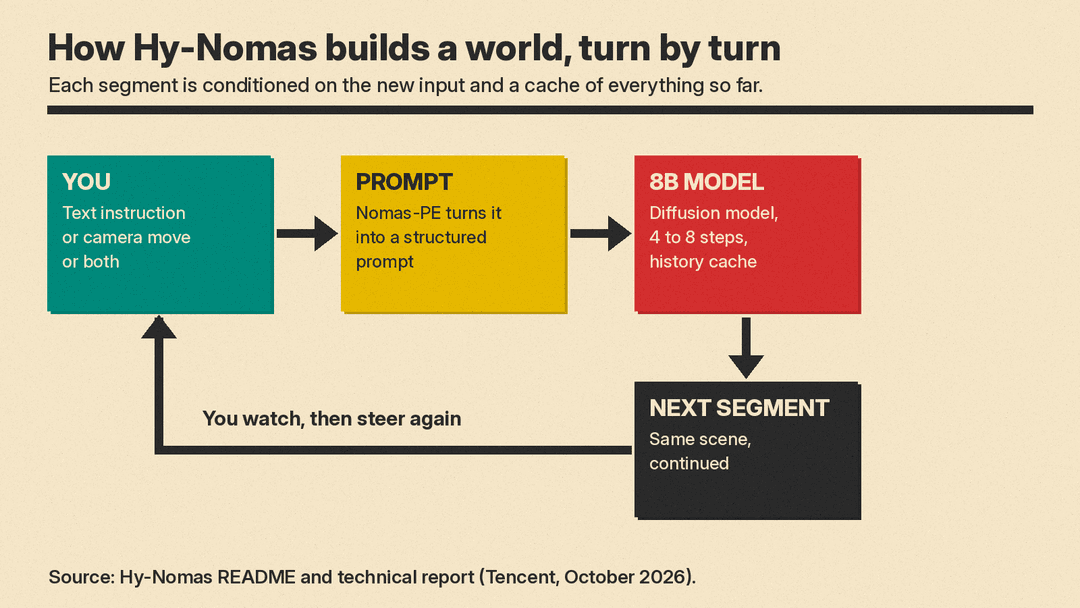
The technical report calls Hy-Nomas "a video world model with an 8B diffusion backbone that supports free-form text instructions and continuous camera control across multiple interaction turns." In plain terms:
- Turn-based video. You start a scene, watch the first segment, then say what should happen next (the README's example: "Glowing blue flowers open beside the path as the fox continues forward."), or steer the camera. The model continues the same scene instead of starting over.
- Memory of what came before. Each new segment is conditioned on a key-value cache of everything generated so far, so characters, objects and layouts are meant to stay consistent.
- Free-form text plus camera control in one model. The README says you can add objects, change style or scene, describe actions, or move the viewpoint. Text and camera inputs can be mixed in the same session.
- A prompt helper. A separate vision-language model, the Prompt Enhancer (Nomas-PE), turns your short request and the current frames into a structured prompt and picks a duration for the next segment. The report says it is fine-tuned from Qwen3.8-27B.
The model starts from Tencent's earlier HunyuanVideo 1.5, according to the report. If you want background on that family, our comparison of open-source video diffusion models including HunyuanVideo covers where it came from.
Why "world model" and not just "video model"
A world model tries to simulate a place you can act in, not just render a clip. Google DeepMind's Genie 3 and Runway's world models are in this category. We covered Runway's take in our GWM Worlds 2 explainer.
Hy-Nomas's pitch is the text side. The report says other recent interactive world models use coarser controls, such as fixed directional commands or discrete keyboard actions, and that Genie 3's official API does not take text prompts during interaction. Tencent focuses on following open-ended instructions about what happens in the scene, across many turns, and on keeping each action to its intended moment. The report describes "action-aware causal attention": descriptions of the scene stay visible to later segments, while an action instruction applies only during its own time window. The goal is that an action, such as a fox walking along a path, does not keep repeating in every later segment, but the fox stays.
The report says the system supports "minute-scale rollouts," and it gives an example of a 100-second video made across seven segments at 1280x704 and 24 frames per second.
What it runs on
Tencent's README and report give these hardware details.
- One consumer GPU. The README says Hy-Nomas "runs on a single RTX 4090 with low-memory inference." That mode stores weights and the history cache in INT8, keeps only a sliding window of history, and moves parts of the model to CPU memory between steps. The report says the 100-second, seven-segment example needs 20.53 GiB of peak GPU memory in this setup. The trade-offs: you need enough system RAM, CPU transfers add delay, and the report notes these optimizations "may introduce subtle differences" that grow over many segments.
- Fast sampling. The distilled checkpoint uses 4 to 8 denoising steps.
- Real-time streaming is a bigger job. The tested profile for the Reactor streaming demo uses eight Nvidia B200 GPUs.
- Fine-tuning. Tencent ships a LoRA workflow and two sample adapters: a "cinematic" LoRA for visual quality and a robotics LoRA trained on a dual-arm robot dataset. Its example training config assumes 128 GPUs, though you can size it to your hardware.
The README lists community integrations for ComfyUI, SGLang, the WanGP app (v18.81) and Reactor, plus a Diffusers example. There is also an online demo if you do not have a GPU.
How it compares, by Tencent's own tests
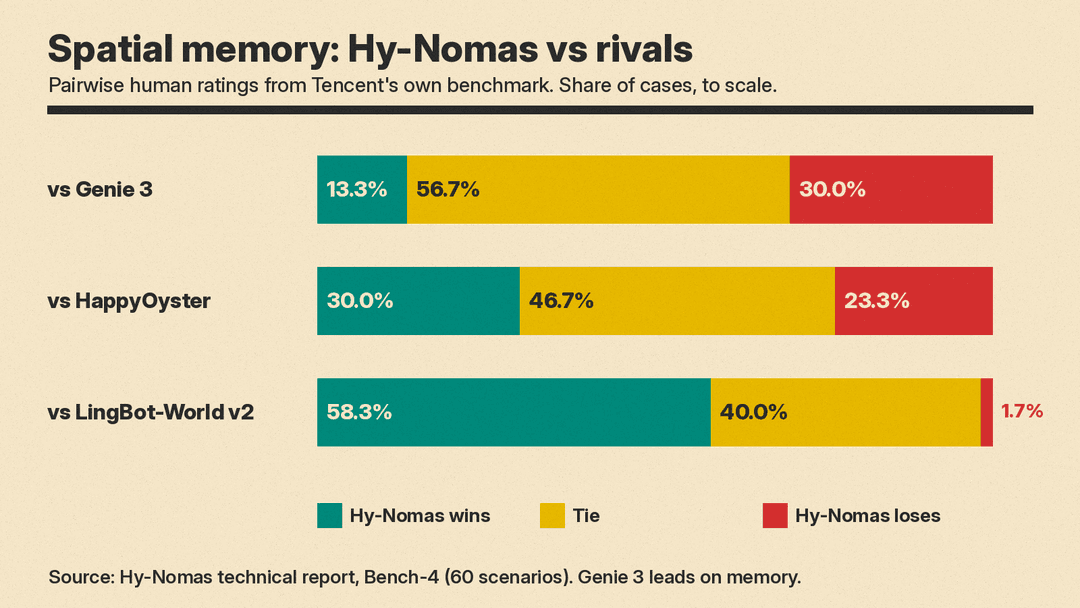
Tencent built a benchmark, Hy-Nomas-Bench, with 280 test cases across four tasks: multi-turn text interaction, camera navigation, mixed text and camera control, and spatial memory. It compared Hy-Nomas with Genie 3, Alibaba Cloud's HappyOyster and LingBot-World v2 using pairwise human ratings. Two caveats matter: Tencent made the benchmark and ran the ratings, and not every rival could do every task. Genie 3 was only tested on camera navigation and spatial memory, because its official API does not take text prompts during interaction.
The headline results from the report:
- Following text instructions. Hy-Nomas won 65.0% of prompt-following comparisons against HappyOyster (Directing mode) and 75.0% against LingBot-World v2.
- Camera control. Against Genie 3 it won 32.0%, tied 54.0% and lost 14.0%. The report says its edge here is smaller than for text.
- Spatial memory (does a place look the same when you come back to it?). Against Genie 3 it won only 13.3%, tied 56.7% and lost 30.0%. Tencent says plainly that "Genie 3 maintains stronger spatial consistency." It was about even with HappyOyster (30.0% wins, 23.3% losses) and well ahead of LingBot-World v2 (58.3% wins, 1.7% losses).
In short, by Tencent's tests, Hy-Nomas is strongest at doing what you tell it, ahead on camera moves by a smaller margin, and still behind Genie 3 at remembering a scene. The report also found that the cinematic LoRA improved looks and prompt following but made camera control worse (19% wins versus 37% losses against the base model).
Who should care
- Creators and indie game makers who want to direct a scene step by step instead of re-rolling whole clips. The online demo needs no GPU, and the community ComfyUI node runs it locally.
- Researchers and robotics teams. Tencent released the weights under Apache 2.0, with training code, a benchmark and a robotics LoRA.
- Anyone tracking open video AI. Hy-Nomas is an open-weight model for multi-turn, interactive video generation.
What it is not: a polished app for finished, high-resolution films. Tencent's examples run at about 720p (1280x704), and all quality claims in this post come from Tencent's own demos and ratings.
