
Google's Gemini 4 Argon for Robotics post on its Developers Blog, published October 13, 2026, presents Gemini 4 Argon as a general-purpose model used across the robotics workflow. It is not a separate robot-control product. The same model writes control code, builds physics simulations and labels robot video. InfoQ covered the post on November 9 and framed the question it raises for architecture reviews: "whether one frontier model plus heavy prompt harnesses displaces a pipeline of VLA, simulator, and labeler services."
What is Gemini 4 Argon for robotics?
Google calls Argon "a general-purpose physical reasoning model" that "can be applied across the entire robotics lifecycle." Argon is Google's general frontier model (see our Gemini 4 Argon explainer), and the robotics post shows what it can do when given long, task-specific prompts and robot tooling.
Google points to the Embodied Reasoning (ERQA) benchmark, which tests a model's ability to understand and solve physical, spatial problems in 3D environments. Google says: "Using pure reasoning, Argon scores 87%, outperforming every other frontier model." That is Google's own result.
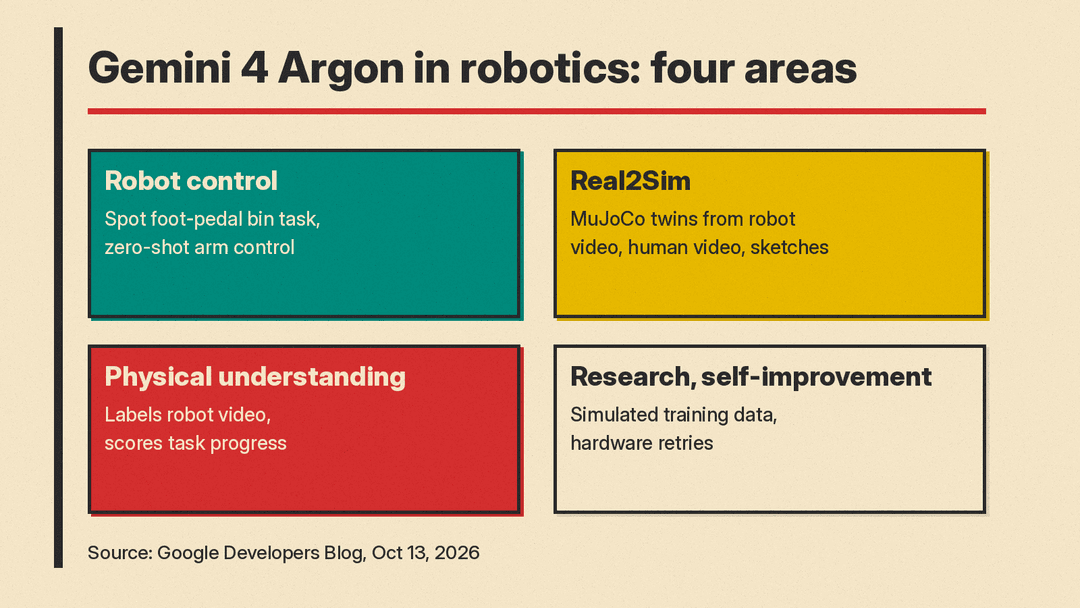
The post shares representative prompts in four areas: robot control, Real2Sim (building simulation twins of real scenes), physical understanding (labeling robot video), and research and self-improvement.
What can Gemini 4 Argon do with robots?
In the headline demo, Argon controls a Boston Dynamics Spot quadruped (12-DoF legs plus a 6-DoF arm) to learn a new skill: stepping on a foot-pedal trash bin to throw away soda cans. Before it steps on the real pedal, Argon builds a MuJoCo digital twin of the bin and practices there. MuJoCo is a physics simulator.
In a zero-shot demo, a simple robot arm sets a fallen mug upright and puts a crumpled napkin inside. Argon works over several turns, using a visual coordinate grid drawn on the wrist camera image and action primitives that it sends as HTTP commands with curl.
A third demo moves into video. Argon steers robots inside the Gemini Omni video world model to arrange five Scrabble tiles so they spell ARGON. It writes timestamped action prompts, looks at keyframes from each rollout, and refines its prompts.
For Real2Sim, Argon builds MuJoCo scenes from real robot teleoperation video and tunes them to match both the visuals and the contact events in the recording. From egocentric human video, it retargets the person's hand motion onto a simulated humanoid with 22-DoF five-fingered hands. From a photo of a rough pen-and-paper sketch, it builds a simulation of a humanoid throwing a ball at a 3-2-1 stack of boxes.
How does Argon label and improve robot data?
Google also shows Argon labeling robot video. Given an overhead video of a two-armed ALOHA 2 robot folding a square sheet of paper into an origami fox over 136 seconds, Argon produced a four-level annotation: the episode goal, 6 subtasks, 17 contact-level primitives, and quality-control reweighting that "holds task progress flat during fumbles and retries."
Google also uses Argon as a value function, a score of how well a task is going. On a 60-second two-handed ring-sorting episode, Argon split the trajectory into 28 segments with positive, neutral and negative progress slopes.
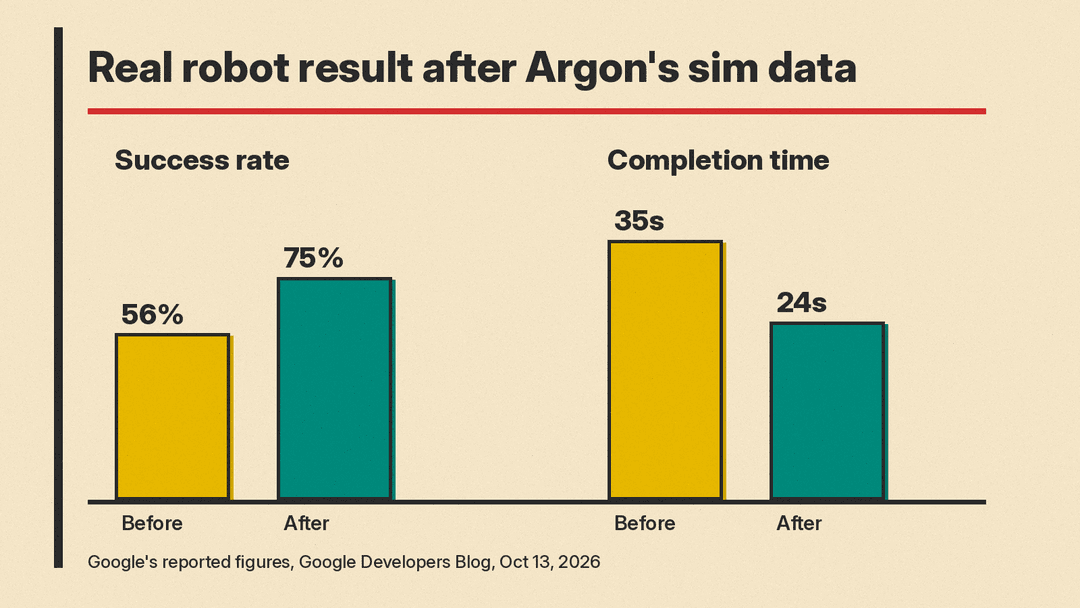
The result with the clearest real-world number is data generation. From a single RGB photo of a real tabletop, Argon built a calibrated MuJoCo twin, defined a 77-task curriculum and generated more than 4,500 domain-randomized simulated episodes to fine-tune a vision-language-action (VLA) model. Google reports that the real robot's success rate rose from 56% to 75% and completion time fell from 35 seconds to 24 seconds.
On a simple 6-DoF arm (SO-101), Argon improved its own pick-and-place run over three iterations: 58.9 seconds, then 22.9 seconds (it grazed the box rim on the drop), then 17.4 seconds. Google also says Argon reproduced robotics papers as MuJoCo WebAssembly labs that run in a browser; the post mentions 68 interactive browser sandboxes.
What are the limits of these demos?
These are Google's demos and Google's numbers. InfoQ notes that the robotics post "uses long, task-specific prompts, coordinate grids, motion primitives, verifiers, so scaffolding is part of the system under test, and Google does not publish per-demo failure rates beyond the single VLA case."
Simulation fidelity is the other open question. InfoQ quotes Davin YC Dong on X: "Google's Argon robotics examples tune simulation twins against contact events as well as visuals. That is the part I'd inspect: a scene can look convincing while its objects behave incorrectly. For manipulation, matching what happens at contact matters as much as matching pixels."
Argon is also not Google's only robotics model. Google has a separate robotics line, including the model in our Gemini Robotics-ER 2 post. The robotics post itself does not say how Argon and that line divide the work.
How can you try Gemini 4 Argon for robotics?
Google lists three ways in:
- Google AI Studio, for Google AI Ultra subscribers.
- The paid tier of the Gemini API, using the model name
gemini-4-argonin the Interactions API with thegoogle-genaiSDKs. - Google Antigravity, Google's agent-first development platform, for Google AI Ultra subscribers.
The prompts in the post are printed in full. They assume tools such as MuJoCo and robots that expose simple HTTP motion commands, so they read more like templates than one-click recipes.
Why it matters
InfoQ contrasts Argon with specialized vision-language-action policies and separate scene-to-sim tools. Google's post shows one general model, given the right prompts and tools, doing parts of control, simulation and data labeling. Agentic use of Argon is not new territory for DeepMind either: we covered four Argon agents finishing Minecraft in 27 hours. Until Google or others publish failure rates across demos, the single 56% to 75% result is the main real-robot number in the post.
