
Google DeepMind has introduced Gemini Robotics 2.5, which it calls "our most capable vision-language-action (VLA) model to date." A VLA model takes in what a robot sees plus an instruction in plain language, and outputs the arm and hand movements to carry it out. In a blog post dated November 10, 2026, Carolina Parada of DeepMind says the model "increases both the breadth of skills a robot can learn and the speed at which it can acquire them."
The post gives numbers from a factory pilot with Apptronik and Mercedes-Benz. It also says DeepMind is releasing a new open-source jailbreak benchmark for robots. The model has no public API. DeepMind says it "is rolling out to our robotics partners."
What DeepMind says is new
DeepMind groups the update into three areas: dexterity, reliability and safety.
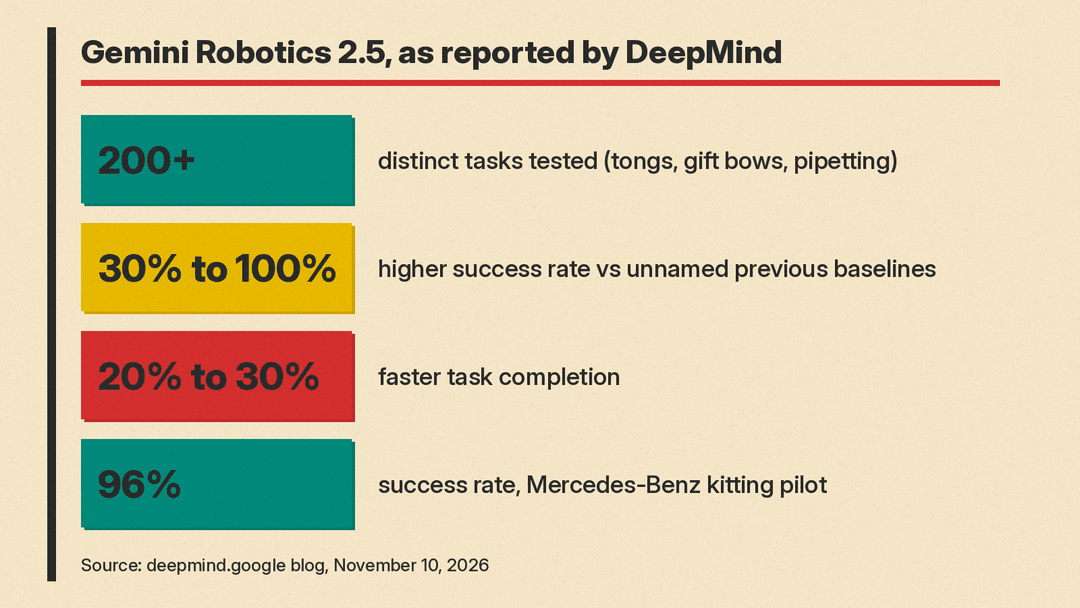
- Dexterity. DeepMind says it tested the model on "over 200 distinct tasks." Examples it gives include "serving food with tongs, tying a bow on a gift box, and pipetting a liquid." These mix tool use, soft and floppy objects, and fragile items.
- Success rate and speed. DeepMind says: "Compared to previous baselines, Gemini Robotics 2.5 achieves a 30% to 100% higher success rate depending on the type of task, while completing tasks 20% to 30% faster." The post does not name which earlier model is the baseline, and it does not give a per-task table.
- Robot types. Like earlier Gemini Robotics models, it works with different robot bodies. DeepMind names Apptronik's Apollo 2 humanoid, fitted with the five-finger, 22 degree-of-freedom SharpaWave hand, and the Franka Duo platform with two-fingered parallel grippers.
The Mercedes-Benz pilot
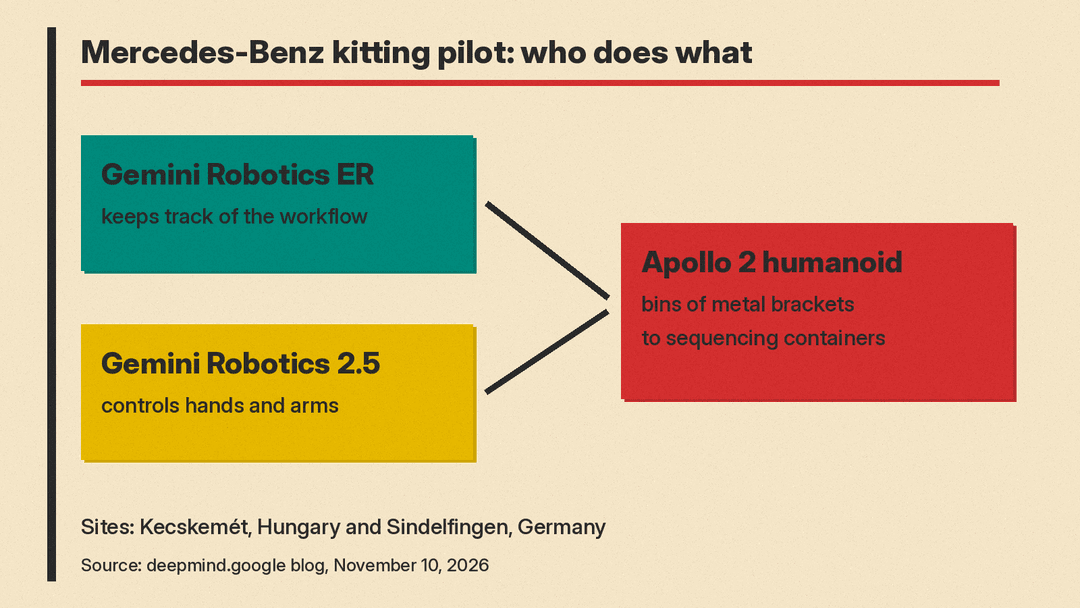
The reliability claim comes from a proof-of-concept on active car production lines in Kecskemét, Hungary, and Sindelfingen, Germany. There, Apollo 2 robots did "automotive kitting." DeepMind describes this as sorting parts from bulk bins into trays "in the exact order needed for each vehicle on the line."
Two models split the work. Gemini Robotics ER, DeepMind's embodied reasoning model, keeps track of the workflow. Gemini Robotics 2.5 controls the hands and arms. The robot picks metal brackets out of supply bins and places them into sequencing containers.
DeepMind reports a "96% success rate" for this pilot. It calls the result "promising progress toward widespread real-world industrial applications," not a production deployment. The post does not say how many picks the rate is based on or how long the pilot ran.
Apptronik co-founder and CEO Jeff Cardenas is quoted in the post: "Pairing Apollo 2 with Gemini Robotics, we saw the models improve dramatically in just a few weeks of post-training and carry over to Mercedes-Benz production with very little drop-off."
We covered the reasoning half of this pair when Gemini Robotics ER 2 came to Google Cloud in October.
Safety: steering and a jailbreak benchmark
DeepMind says Gemini Robotics 2.5 uses "inference-time reasoning guidance to steer around physical hazards in real-time." It compares this to the way safety classifiers "add a protective layer around Gemini's responses." In DeepMind's evaluations, the feature "boosted safe task completion around obstacles by 33% and around nearby people by 43%." The post does not say whether these are relative gains or percentage points, or what they are measured against.
The second safety item is about the planner, not the actions model. DeepMind is releasing ASIMOV-Jailbreak, which it describes as "a new open-source benchmark containing hundreds of prompts that disguise unsafe requests across dozens of scenes." On that benchmark, DeepMind says Gemini 4 Argon reaches "99.5% jailbreak resistance," compared with "the 82% rate of our previous baseline, Gemini Robotics ER 2." That figure is for Argon. The post gives no ASIMOV-Jailbreak score for Gemini Robotics 2.5 itself. DeepMind links its wider agentic robotics results to the Gemini 4 safety report.
How Gemini 4 Argon helped build it
DeepMind says Gemini 4 Argon "greatly accelerated" its development of the model. It says Argon acted "as a simulation engine." Per the post, Argon "can generate thousands of varied, simulated practice runs from a real-world camera scene and build a realistic digital twin." Mixed with real demonstrations, that helps the robot handle new scenes and objects faster. DeepMind also says Argon can help researchers guess why a task failed from video, then test fixes in simulation and on real robots.
Google showed some of these Argon robotics abilities earlier. Our post on what Google's Gemini 4 Argon robotics demos show covers that developer blog post.
Why it matters
This release attaches a success rate to work on active car production lines, names the sites, and quotes the robot maker. DeepMind still calls it a proof-of-concept, and the post leaves out sample size and pilot length.
For builders, the practical limit comes first: there is no self-serve access. Gemini Robotics 2.5 is going to DeepMind's robotics partners, and the post gives no API, price or date for wider access. Teams that want Google's robot models today can use Gemini Robotics ER 2, which is in preview on Google Cloud and the Gemini API.
Other recent physical AI models take a more open route. Runway released Praxis-1 with open weights under Apache 2.0, and NVIDIA published weights for its Alpamayo 2 Edge driving model on Hugging Face.
The open ASIMOV-Jailbreak benchmark may matter beyond Google. Because DeepMind describes it as open source, other robot labs could use it to test their own planners against disguised unsafe requests.
