
NVIDIA announced two new physical AI models, each with a version built to run on the computer inside the car or robot. Alpamayo 2 Edge, published November 10, is a self-driving model for the DRIVE AGX Thor car computer. GR00T 2, introduced November 9 at the Conference on Robot Learning (CoRL) in Austin, is a robot model, and its smaller GR00T 2 Turbo variant runs on the Jetson Thor computer inside a Unitree G1 humanoid, according to NVIDIA's research page.
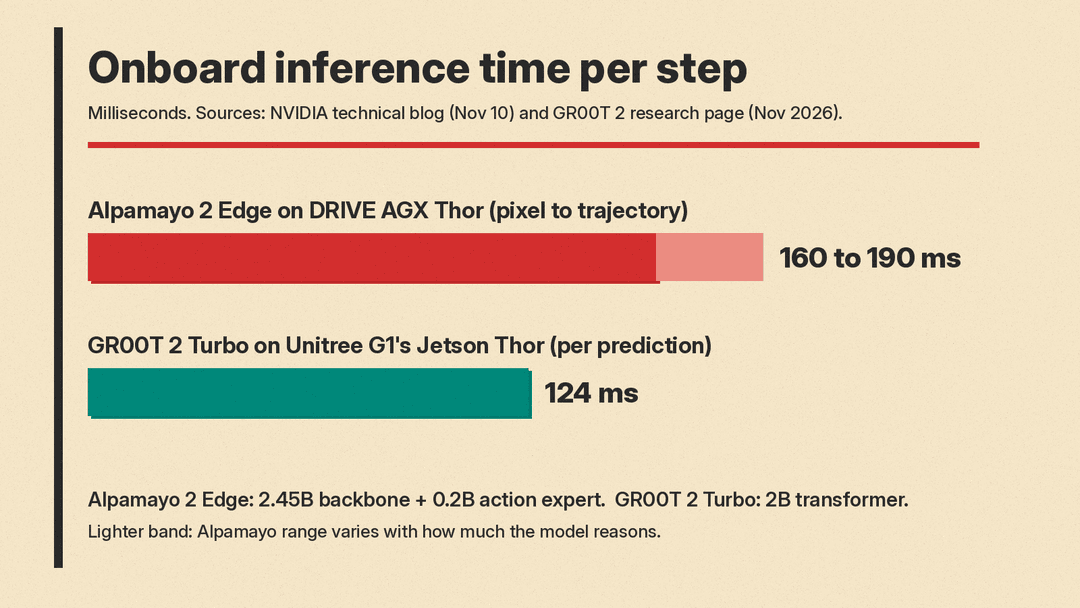
Alpamayo 2 Edge and GR00T 2 Turbo are both 2B-class models. NVIDIA says the Alpamayo backbone is "sized for onboard inference."
What Alpamayo 2 Edge is
NVIDIA's technical blog, by Marco Pavone and Boris Ivanovic, calls Alpamayo 2 Edge "an adaptive reasoning vision-language-action (VLA) model designed for real-time operation on NVIDIA DRIVE AGX Thor." In plain terms, it takes in surround-camera video, recent motion history and a navigation instruction, and outputs a planned path plus a short written explanation of its driving decision. NVIDIA calls that explanation Chain-of-Causation (CoC) reasoning.
The model is built on the 2B Nemotron-based reasoning backbone of NVIDIA Cosmos 3 Edge, paired with a diffusion action expert that produces the trajectory. The Hugging Face model card gives the split: a 2.45B parameter backbone and a 0.2B parameter action expert.
The key design choice is adaptive reasoning. NVIDIA says the model generates reasoning "only when needed," which reduces unnecessary token generation and conserves inference compute during routine driving.
NVIDIA also post-trained the model with closed-loop reinforcement learning in its AlpaGym simulator. It says this improved closed-loop driving performance by 48.9% on top of the best checkpoint without closed-loop RL. A separate model, AlpaJudge, scores the reasoning text and supplies RL rewards.
Running on DRIVE AGX Thor
The downloaded weights are in BF16 and run as a PyTorch model on supported NVIDIA GPUs. The model card says it was tested on one NVIDIA H100 80GB and recommends at least 16 GB of GPU memory for the measured setup.
To reach real time in the car, NVIDIA publishes a deployment recipe in its Alpamayo Developer Hub. It calibrates FP8 scales, builds NVIDIA TensorRT engines with TensorRT Edge-LLM plugins, and uses DFlash2 speculative decoding. NVIDIA says the optimized model has a pixel-to-trajectory latency of 160 ms to 190 ms on DRIVE AGX Thor, "depending on the amount of reasoning."
NVIDIA compares the 2B model with Qwen-Drive-1.0, a 4B model, and says Alpamayo 2 Edge achieves approximately 60x the distance between at-fault incidents in its AlpaSim simulator. That is NVIDIA's own benchmark result.
The weights are released under the OpenMDW-1.1 license and the code under Apache 2.0, with a Hugging Face release date of November 10, 2026. The model card lists training data of roughly 115,000 hours of multi-camera driving video and roughly 3,700,000 CoC reasoning traces.
What partners report
NVIDIA's blog quotes early users. "In less than 48 hours, we made NVIDIA's Alpamayo 2 Edge run at 10 Hz on AGX Thor for real-time planning," said Hans Salomonsson, CEO and co-founder of Embedl.
Matas Simonavicius, CTO of PORT, said that in the company's early simulation tests on its own London street recordings, Edge kept its lane in more than twice as many runs as Alpamayo 1.5.
GR00T 2 and GR00T 2 Turbo
NVIDIA describes GR00T 2 as "an open frontier world action model built on NVIDIA Cosmos." Its research page says it predicts future video and robot actions together, so it learns how a scene should change as the robot acts.
NVIDIA's headline results, from its CoRL announcement:
- It completed 40 of 50 evaluated tasks at least once without task-specific demonstrations.
- It reached 71% average success across 50 tasks with one demonstration per task, and 95% with five.
- Foxconn is applying GR00T 2 to factory automation for server manufacturing, Siemens is evaluating it across industrial use cases, and Nexuni is testing it for robotic laundry handling.
On compute, the research page says five demonstrations per task, under 3 minutes of robot data, raise success to 95% after a 30-minute fine-tune on a single RTX 5090. The Decoder reports that NVIDIA trained the system on a cluster with more than a thousand GB300 chips.
GR00T 2 Turbo is the version sized for the robot itself. NVIDIA says it uses a smaller joint video-action transformer (2B parameters) and a higher-compression video encoder. Each prediction takes 124 ms on the G1 humanoid's own Jetson Thor. The Decoder notes limits the research team flagged: the model does not yet use touch sensor data, and in trash sorting the robot sat idle for about a third of the time waiting for a higher-level planning model.
Technology.org reports that GR00T 2 weights are expected in December. As of November 11, NVIDIA's Hugging Face page lists no GR00T 2 checkpoint; the newest GR00T models there are N1.7 releases.
Why it matters for chips
Both releases end on NVIDIA's own onboard silicon. Alpamayo 2 Edge ships with a TensorRT recipe for DRIVE AGX Thor, and GR00T 2 Turbo runs on the G1's Jetson Thor. Alpamayo 2 Edge weights are open now, and GR00T 2 weights are expected in December, per Technology.org. In both cases, the documented path to real-time speed runs through NVIDIA chips and NVIDIA software.
For earlier NVIDIA physical AI coverage, see our posts on Cosmos 3 Nano world-sim checkpoints and what Nemotron is. For a different approach to car compute, see Waymo's custom 5nm ASIC.
For a robot model with no public weights or API, see our post on Gemini Robotics 2.5, which DeepMind is rolling out only to robotics partners.
Sources
- NVIDIA Technical Blog: Running AV Reasoning Models Within Onboard Compute and Latency Limits (Nov 10, 2026)
- Hugging Face: nvidia/Alpamayo2-Edge model card
- NVIDIA Blog: Practice Makes Precise, CoRL announcements (Nov 9, 2026)
- NVIDIA Research: GR00T 2 project page
- The Decoder: GR00T 2 watches humans on video (Nov 10, 2026)
- Technology.org: GR00T 2 learns robot tasks from one demo (Nov 10, 2026)
