
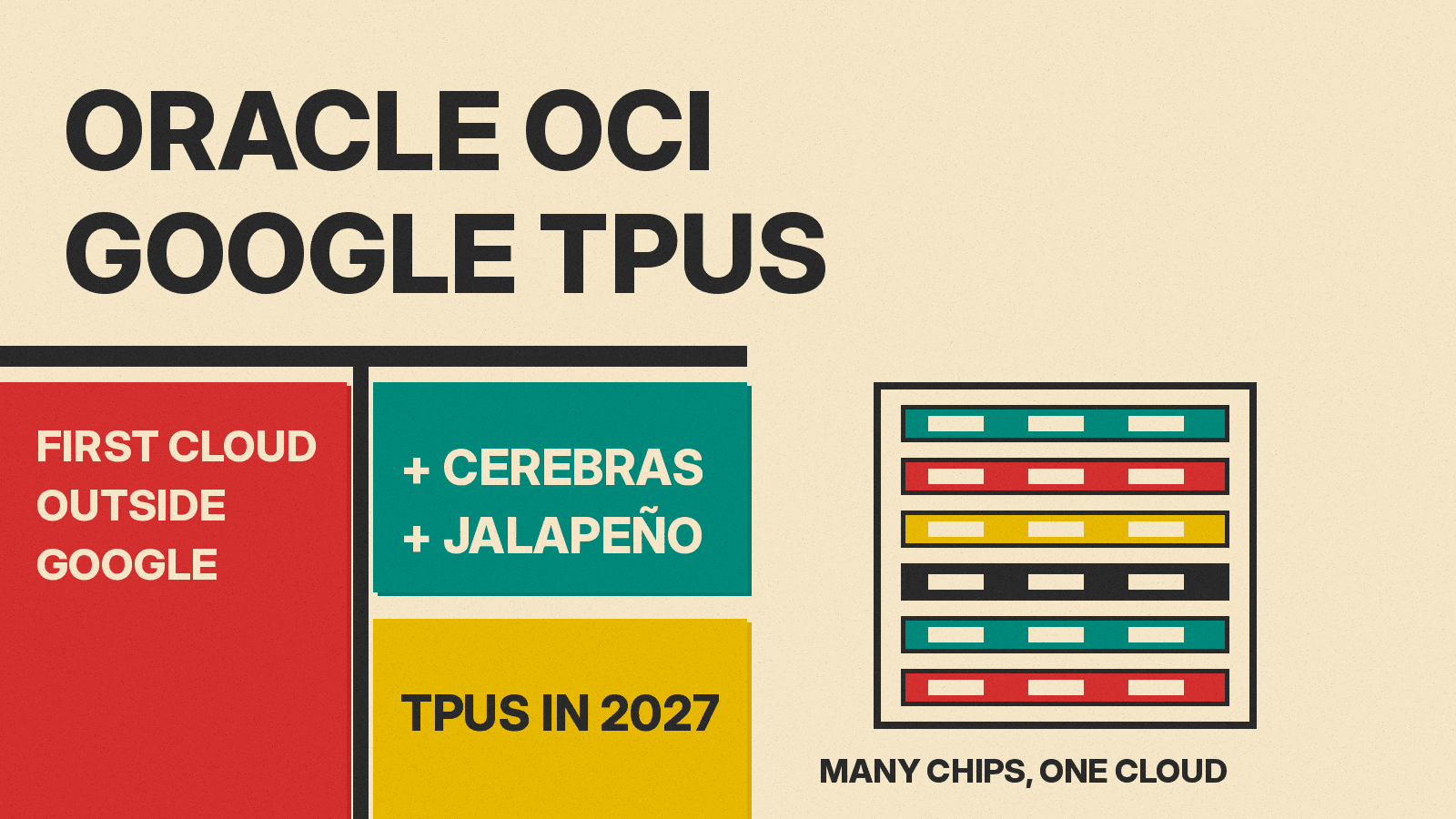
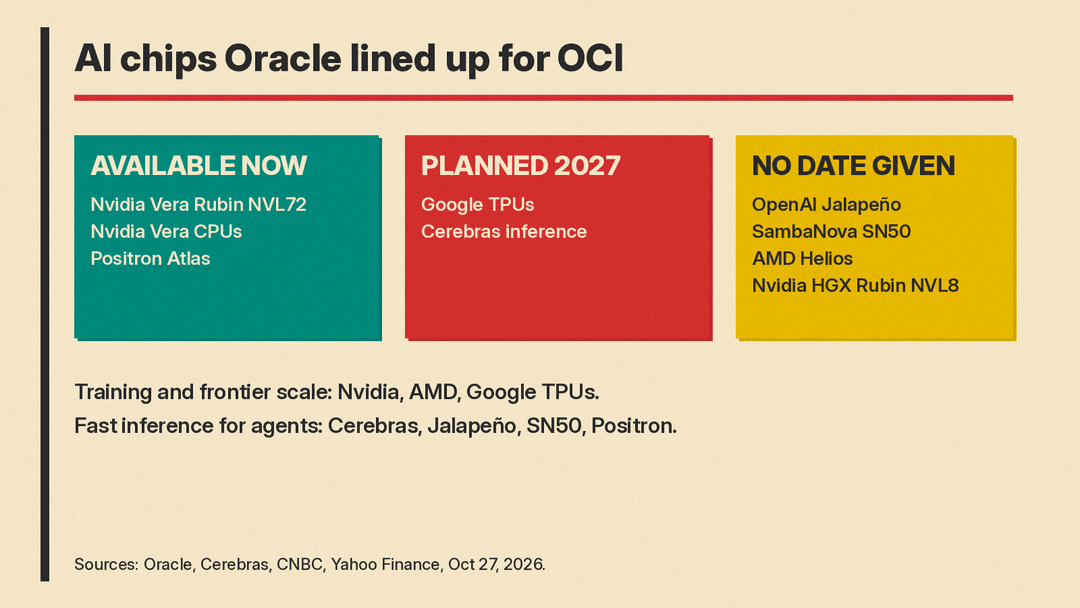
Oracle used Oracle AI World in Las Vegas to turn Oracle Cloud Infrastructure (OCI) into a cloud with many kinds of AI chips. The headline item: Google's Tensor Processing Units (TPUs) will be offered on OCI, which Oracle and Google say is the first time Google TPUs will be available on a hyperscale cloud outside Google. Oracle also lined up inference hardware from Cerebras, OpenAI's Jalapeño chip, SambaNova's SN50 and Positron, next to new Nvidia and AMD rack systems.
OCI president Mahesh Thiagarajan said the TPU deal gives customers "access to multiple leading AI compute architectures in one cloud." The software side of the event, ChatGPT and Codex inside Oracle apps, is in our post on Oracle bringing ChatGPT and Codex to its business apps.
What Oracle announced
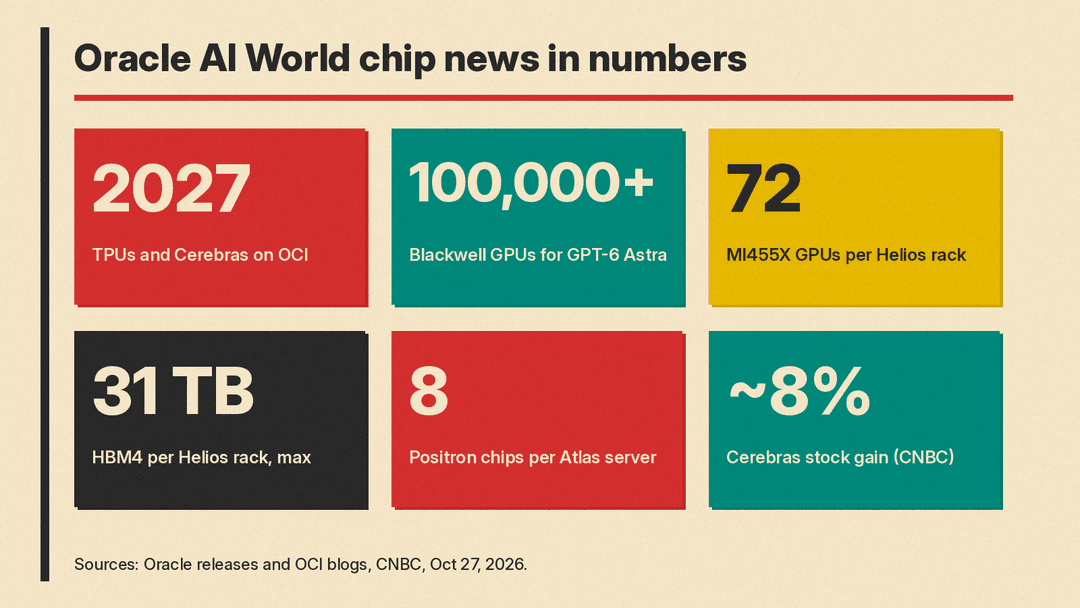
- Google TPUs. Per the joint Oracle and Google release, TPUs on OCI "will be available in calendar year 2027, ramping over a multi-year period." OCI will provide "the power, cooling, and datacenter networking" to run them. The release does not say which TPU generation goes to OCI first. Google's next chip, TPU v9, is reportedly running late, per our report on the TPU v9 tape-out slip.
- Cerebras. Cerebras and Oracle said Cerebras inference on OCI "is planned to be available in calendar year 2027." A Cerebras spokesperson told CNBC the deal is material but that the company won't disclose its scale because it is in a quiet period.
- OpenAI Jalapeño. CNBC reports that OpenAI's Jalapeño chip will also run on OCI. We did not find a date for it in Oracle's releases.
- SambaNova SN50. Yahoo Finance reports that Oracle signed a deal to bring SambaNova's SN50 to its network for agentic inference.
- Positron Atlas. An OCI blog post announces general availability of Positron Atlas inference servers, each with 8 Positron accelerators and memory for "up to 500B model weights."
- Nvidia. Nvidia and Oracle said Vera Rubin NVL72 systems and Vera CPUs are now generally available on OCI, with plans to grow OCI Superclusters with Vera Rubin NVL72 "to multi-gigawatt scale." OCI also plans HGX Rubin NVL8 servers with eight Rubin GPUs.
- AMD. An OCI blog post describes AMD Helios racks on OCI: 72 AMD Instinct MI455X GPUs per rack, up to 31 TB of HBM4 memory and up to 1.7 PB/s of aggregate peak memory bandwidth.
Why Google TPUs on OCI matter
Oracle and Google say this is the first time Google TPUs will be offered on a hyperscale cloud platform outside Google. Yahoo Finance describes it as the first time Google is selling TPUs for use within a third-party data center rather than simply renting capacity.
Google's Amin Vahdat said in the release that "the next generation of AI will require a diverse range of compute" and that the deal "will give more organizations access to this technology." CNBC says the deal shows how companies are looking for ways to get their hardware to frontier labs.
The release also restates Google's eighth-generation TPU split: TPU 8t for training and TPU 8i for inference. Google says TPU 8t delivers "nearly 3x the compute performance per pod over the previous generation." Those are Google's figures, not tests on OCI.
Why so many inference chips
Most of the non-Nvidia additions are aimed at inference, and several at AI agents. The Cerebras release says each additional model call adds latency, which can slow agentic workflows. Cerebras CEO Andrew Feldman put it this way in the Cerebras release: "Every step an agent makes requires inference, whether it's reasoning, checking its work, or taking action."
That is the pitch behind Cerebras, SambaNova, Positron and Jalapeño, which are all offered here for inference. OpenAI said in June that Jalapeño is its first inference accelerator, built with Broadcom, and that early testing shows performance per watt "substantially better than current state-of-the-art." In August, OpenAI published first benchmark results for Jalapeño.
Agents also need CPUs. Oracle and Nvidia point out that agents spend time "executing tools, testing code and retrieving data" between model calls. OpenAI's Uday Ruddarraju said OpenAI is "bringing Vera into production on OCI" for its agentic sandbox workloads.
Is this a move away from Nvidia?
Oracle says no. Asked by CNBC whether this marks a pivot away from Nvidia GPUs, OCI president Mahesh Thiagarajan said no and called Nvidia chips "the best, most fungible." He added that chip scarcity is still a problem and that customers like OpenAI benefit from more choice.
The Nvidia news supports that. In the Nvidia release, Oracle says OpenAI trained and served GPT-6 Astra on an OCI Supercluster in Abilene, Texas, with more than 100,000 Nvidia Blackwell GPUs, and that the companies plan to grow Vera Rubin capacity to multi-gigawatt scale.
Oracle is still adding Nvidia systems while it adds other chips. Yahoo Finance frames it as an effort to reduce reliance on Nvidia; Oracle frames it as choice per workload.
What to watch
- Timing. The two biggest new items, Google TPUs and Cerebras, are both 2027 plans. Per the releases, neither is planned to be available before 2027.
- Pricing. None of the releases list prices for TPUs, Cerebras, Jalapeño or SN50 on OCI.
- Scale. Cerebras would not size its deal, and Oracle did not size the TPU deployment beyond "a multi-year period."
- The market. CNBC reported Cerebras stock climbed about 8% after the news and Oracle shares were up nearly 5% on Tuesday.
If these plans ship, one cloud will offer Nvidia, AMD, Google TPU and several inference chips side by side. Oracle says the aim is to let customers "choose the right infrastructure for the performance, throughput, and economics of each AI workload."
Sources
- Oracle Brings Google TPUs to Oracle Cloud Infrastructure (Oracle and Google)
- Cerebras and Oracle Team Up to Bring Cerebras AI Inference to OCI (GlobeNewswire)
- NVIDIA and Oracle Expand NVIDIA Vera Rubin to Multi-Gigawatt Scale (Oracle)
- Positron Atlas on OCI (Oracle blog)
- OCI and AMD Helios (Oracle blog)
- Oracle integrates ChatGPT, Codex into apps, expands cloud chip lineup (CNBC)
- Oracle adds AI chips from Google, Cerebras, and SambaNova (Yahoo Finance)
- OpenAI and Broadcom unveil LLM-optimized inference chip (OpenAI)
