
NVIDIA's RTX Spark is a new kind of Windows PC chip: one package that holds an NVIDIA GPU, an Arm CPU and a large pool of shared memory. Laptops built on it went on sale on October 16, and NVIDIA is pitching them as machines that can run large language models and AI agents on the device instead of in the cloud. This explainer covers what the chip is, which laptops use it, what NVIDIA and its partners say it can run locally, and what the machines cost at the retailers that print a price.
What RTX Spark is
RTX Spark is what NVIDIA calls a superchip. According to NVIDIA's launch press release, it is "a single superchip combining an NVIDIA Blackwell RTX GPU and an NVIDIA Grace CPU with up to 128GB of unified memory and up to 1 petaflop of FP4 AI performance." The same release says MediaTek collaborated with NVIDIA on the custom CPU design.
When NVIDIA first unveiled the chip at GTC Taipei in May, its announcement with Microsoft described a Blackwell RTX GPU with 6,144 CUDA cores and fifth-generation Tensor Cores with FP4 precision, connected via the NVIDIA NVLink-C2C chip-to-chip interconnect to a 20-core NVIDIA Grace CPU.
Three ideas sit underneath the product:
- One chip, one memory pool. The CPU and GPU share the same LPDDR5X memory. A conventional laptop GPU has its own, separate pool of video memory. A large shared pool is what lets these laptops hold large AI models.
- Arm, not x86. Grace is an Arm CPU, so these are Windows on Arm machines. Dell's XPS 16 Creator Edition post says Windows supports both native applications and existing x86 applications through Prism emulation.
- The full NVIDIA software stack. NVIDIA's release lists CUDA, DLSS, OptiX, Reflex, G-SYNC, TensorRT and hardware-accelerated video as part of the platform. For developers, CUDA running natively is the main draw, since most AI software is built and tuned for it.
The specs, chip by chip
NVIDIA's RTX Spark specifications page lists one chip name, N1X, in three versions: two for laptops and one for desktops.
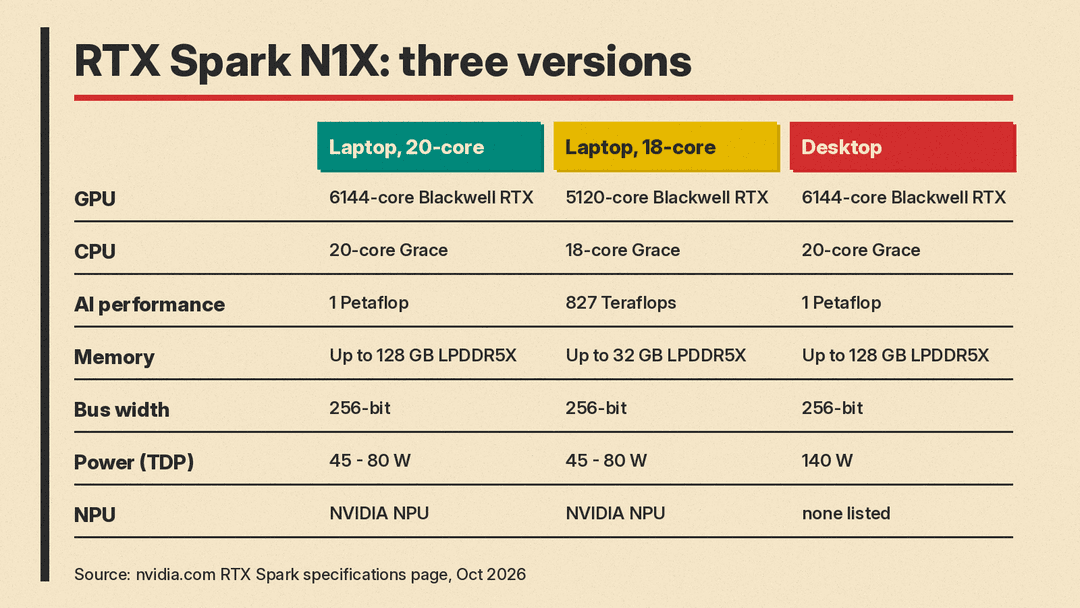
Laptop RTX Spark N1X, 6144-core GPU and 20-core CPU
- GPU: 6144-core NVIDIA Blackwell RTX GPU
- CPU: 20-core NVIDIA Grace CPU
- NPU: NVIDIA NPU
- Power (TDP): 45 - 80 W
- AI performance: 1 Petaflop
- Memory: up to 128 GB LPDDR5X, unified, 256-bit interface
Laptop RTX Spark N1X, 5120-core GPU and 18-core CPU
- GPU: 5120-core NVIDIA Blackwell RTX GPU
- CPU: 18-core NVIDIA Grace CPU
- NPU: NVIDIA NPU
- Power (TDP): 45 - 80 W
- AI performance: 827 Teraflops
- Memory: up to 32 GB LPDDR5X, unified, 256-bit interface
Desktop RTX Spark N1X, 6144-core GPU and 20-core CPU
- GPU: 6144-core NVIDIA Blackwell RTX GPU
- CPU: 20-core NVIDIA Grace CPU
- Power (TDP): 140 W
- AI performance: 1 Petaflop
- Memory: up to 128 GB LPDDR5X, unified, 256-bit interface
All three list fourth-generation ray tracing cores, fifth-generation Tensor Cores, DLSS 5, CUDA Capability 12.1, PCI Express Gen 5 and Windows 11 support. NVIDIA's own pages disagree on one figure. The RTX Spark specifications page lists the laptop chip with the 5120-core GPU and 18-core CPU at "Up to 32 GB LPDDR5X," while the laptop spec table on the main RTX Spark page lists the same laptop chip at "Up to 64 GB LPDDR5X." Neither page says which figure is current, so check the exact configuration with the laptop maker before you buy.
Two fine-print points matter for AI work:
- The petaflop is a sparse FP4 figure. Microsoft's Surface pre-order post footnotes the claim as "Based on theoretical FP4 performance of 1 petaflop using the sparsity feature." FP4 is a 4-bit number format, and sparsity is a technique that skips zero values. Real throughput on a given model will be lower.
- Not all 128 GB goes to the GPU. The same Microsoft footnote says the 128GB is "dynamically shared between CPU and GPU" and that the "Maximum amount addressable by the GPU depends on system configuration and workload and is less than the total." Windows and your other apps use part of the pool too.
NVIDIA's pages list a 256-bit memory interface but, in the material we checked, no memory bandwidth figure. Bandwidth often limits how fast a local model generates text, so it is a number to look for in independent reviews.
Which laptops ship it
NVIDIA's launch release says RTX Spark laptops are available from ASUS, Dell, HP, Lenovo, Microsoft and MSI, "with additional systems to follow." It names this lineup:
- ASUS ProArt P14 and P16
- Dell XPS 16
- HP OmniBook Ultra and OmniBook X 14
- Lenovo Yoga Pro 9n
- Microsoft Surface Laptop Ultra
- MSI Prestige N16 Flip AI+ and Prestige N16
The May announcement said models from Acer and GIGABYTE would follow, and that compact RTX Spark desktops were also coming.
What the makers say about their own machines:
- Microsoft Surface Laptop Ultra. Microsoft's devices blog describes a 15-inch PixelSense Ultra touchscreen, a chassis "less than 18 mm thin and under 4.5 lb," and Magnetic Connect, which Microsoft calls the world's first built-in magnetic USB-C charging on a laptop. Microsoft also opened pre-orders for a Surface RTX Spark Dev Box, a small desktop sold exclusively on Microsoft.com in the U.S., which Microsoft says will begin shipping this November.
- Dell XPS 16 Creator Edition. Dell says it is its first XPS laptop powered by RTX Spark, with a 3.2K Tandem OLED display in a chassis just 17.8mm thin. Dell says pre-orders are open at Best Buy and that the laptop is coming to Dell.com soon.
- ASUS ProArt P16 and P14. ASUS says both went on sale in the United States on October 16 at the ASUS Store and Best Buy, with up to 128GB of unified memory. ASUS lists P16 configurations from 24GB to 128GB and P14 configurations from 24GB to 128GB, and preloads its own local image apps, including MuseTree, which uses the FLUX and WAN image models.
- HP OmniBook Ultra 16 and OmniBook X 14. HP's store lists both with either the 18-core chip and 32 GB of memory or the 6144-core GPU version with 64GB of memory and a 2TB SSD.
- Lenovo. NVIDIA's release calls it the Yoga Pro 9n; Lenovo's US store lists it as the Lenovo Pro 9n (15-inch NVIDIA).
- MSI Prestige N16 Flip AI+. MSI's US store lists a 2-in-1 with a 16-inch 2.8K OLED touchscreen and support for the MSI Nano Pen, powered by RTX Spark "with up to 128GB of unified memory."
What it runs locally
This is the core of NVIDIA's pitch, and most of the claims come from NVIDIA and its partners. Independent testing will show how they hold up.
How big a model fits
NVIDIA's Help Me Choose page is the clearest guide. It links memory size to the largest local model it recommends:
- 24GB: "Runs local models up to 12B parameters," with agents running in the cloud
- 32GB: "Runs local models up to 25B parameters," with agents running in the cloud
- 48GB: "Runs local models up to 60B parameters," with agents running locally
- 64GB: "Runs local models up to 90B parameters," with agents running locally
- 128GB: "Runs local models up to 200B parameters," with "Advanced agents run locally"
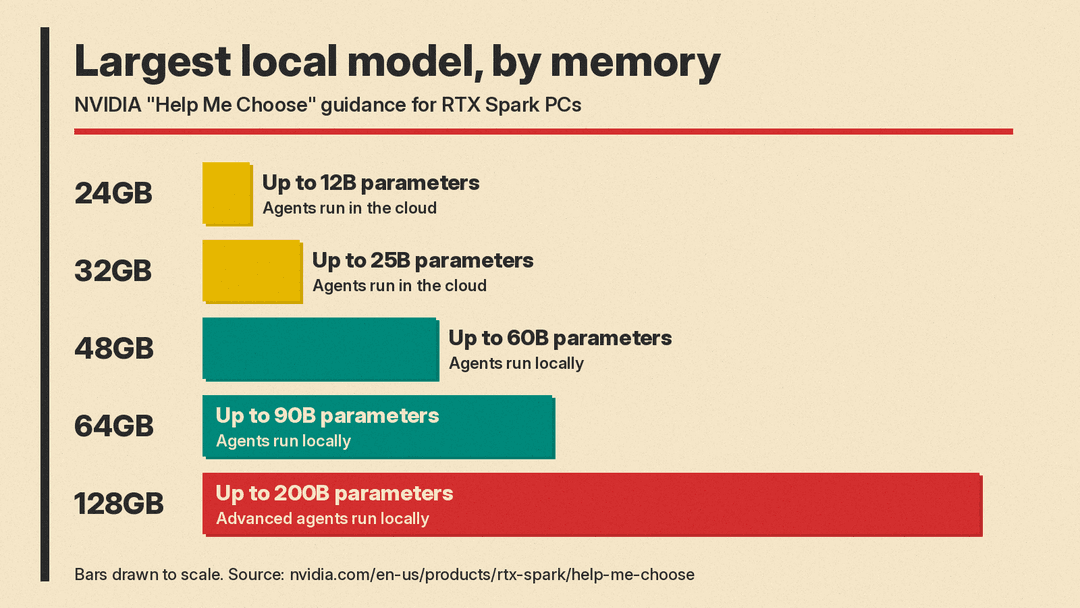
The practical reading: memory, not the chip version, decides what you can run. NVIDIA itself says agents run in the cloud on the 24GB and 32GB tiers, so a base configuration is not the local-agent machine the marketing describes.
Other big-model claims are framed differently. The May announcement said users can "run 120-billion-parameter large language models with 1 million tokens context." NVIDIA's product page says "Run models up to 120B parameters with 1M context." Microsoft says Surface Laptop Ultra can "Run AI models exceeding 120B parameters locally." These numbers apply to the top memory configurations, and none of the pages state a speed.
Nemotron 3.5 Bolt, NVIDIA's model for these laptops
NVIDIA released a model built specifically for RTX Spark. Its October 13 blog post describes Nemotron 3.5 Bolt 74B-A9B 24GB, available Thursday, Oct. 15, as "a new LLM purpose-built for running local agents on RTX Spark." It is a 74B parameter mixture-of-experts model with 9B active parameters, packed into 24GB using 2-bit quantization with quantization-aware training. NVIDIA says users can run it through llama.cpp, vLLM, Ollama, Unsloth and LM Studio, and that it is accessible via agents such as Hermes and OpenClaw. NVIDIA says the training data, weights and recipes are open. The press release calls it "optimized for tool calling and multistep tasks" and says it brings more capable local AI to "supported RTX Spark configurations."
For a closer look at the model, its hardware needs and its speed, see our Nemotron 3.5 Bolt explainer.
A smaller sibling, Nemotron 3.5 Bolt E4B 4GB, is the third-generation small language model for NVIDIA ACE game characters. The same blog says it releases Friday, Oct. 23.
Agents and the software around them
NVIDIA's release says guided setup and installers help users start agents including GitHub Copilot, Hermes, OpenClaw, Perplexity, Pi and WorkBuddy "without requiring a command line." The October 13 blog adds more detail:
- First boot. Users see a "Getting Started" screen to choose and install an agent app. NVIDIA says the agent apps then recommend an optimized local model and settings for RTX Spark.
- Sandboxing. NVIDIA OpenShell and Microsoft Execution Containers (MXC) are meant to contain what agents can do. NVIDIA says OpenClaw and GitHub Copilot now support MXC, and Hermes Agent will integrate OpenShell controls and MXC by the end of the month.
- Local and cloud routing. NVIDIA Switchyard is an open source library that routes queries between local and cloud models. NVIDIA says Hermes will add it later in October.
- Sharing compute. NVIDIA PAIR, a free, open source personal AI router, is out of beta. It spreads AI workloads across compatible PCs on a home network and works on Windows, Linux and macOS.
- Local runtimes. The blog says llama.cpp released Llama Windows, a Windows-native app for downloading and running models, and that Microsoft is making coding models such as MAI 1.1 Coding Flash available locally.
Developer tools and creative apps
For developers, NVIDIA's release lists the first PyTorch-CUDA build for Windows on Arm, the first Python build that is native by default, the first native Conda installer, and support for 97% of the top 15,000 Python packages. Windows Subsystem for Linux is also available.
For creators, NVIDIA says Adobe Photoshop and Premiere offer native RTX Spark support through beta releases available at launch, with Substance coming soon. It says new RTX Video nodes in ComfyUI can turn 15 fps AI-generated video into smoother 60 fps footage. NVIDIA's product page says up to 128 GB of unified memory handles 3D scenes up to 90 GB.
Availability and prices
NVIDIA's latest official starting price is $2,399, from its October 17 blog post, which says the laptops are "Starting at $2,399." Its October 16 launch release had said "starting at $2,599," and added that "Pricing and configurations vary by region." ASUS notes that "Actual retail pricing is determined by the retailer," so the list below uses only prices printed on retailer pages we checked on October 19, 2026. Prices and stock change often.
Microsoft Store, Surface Laptop Ultra (configurator):
- 18-core CPU, 5120-core GPU, 24 GB, 512 GB SSD, Windows 11 Home: $2,599.99
- 18-core CPU, 5120-core GPU, 24 GB, 1 TB SSD, Windows 11 Home: $2,999.99
- 18-core CPU, 5120-core GPU, 32 GB, 1 TB SSD, Windows 11 Pro: $3,299.99
- 20-core CPU, 6144-core GPU, 32 GB, 1 TB SSD, Windows 11 Pro: $3,699.99
- 20-core CPU, 6144-core GPU, 48 GB, 1 TB SSD, Windows 11 Pro: $3,999.99
- 20-core CPU, 6144-core GPU, 64 GB, 1 TB SSD, Windows 11 Pro: $4,299.99 (Microsoft Exclusive)
- 20-core CPU, 6144-core GPU, 64 GB, 2 TB SSD, Windows 11 Pro: $4,699.99 (Microsoft Exclusive)
- 20-core CPU, 6144-core GPU, 128 GB, 1 TB SSD, Windows 11 Pro: $5,899.99 (Microsoft Exclusive)
MSI US Store, Prestige N16 Flip AI+ (C1XMT-066USY):
- 20-core CPU, 6144-core GPU, 64GB LPDDR5X, 1TB SSD, Windows 11 Pro: $4,199.99, listed "In Stock"
For the ASUS, Dell, HP and Lenovo models, we did not find a retailer page that printed a price we could check, so we do not list one. Dell says pre-orders are at Best Buy, and ASUS says the ASUS Store and Best Buy are selling its models.
Use the memory tiers above to read these prices. On the Microsoft Store list, the step from the cheapest 24 GB model to the 128 GB model is $3,300. On NVIDIA's own guidance, that step moves you from cloud-run agents and models up to 12B parameters to local agents and models up to 200B parameters.
Why it matters
RTX Spark puts NVIDIA's CUDA stack on a shared-memory design inside a thin Windows laptop. That gives developers who write CUDA code a portable machine with the same software stack, and it gives agent apps a Windows platform with built-in sandboxing hooks.
The caveats are just as concrete:
- Cost. The configurations that NVIDIA says can run agents locally start at 48GB. On the Microsoft Store, 48 GB costs $3,999.99.
- Arm compatibility. Dell's post says Windows runs native apps and existing x86 apps through Prism emulation, and it names Easy Anti-Cheat and BattlEye as supported anti-cheat solutions. Check the apps you depend on before you buy.
- Marketing numbers. The petaflop figure assumes FP4 with sparsity, and the GPU cannot use all of the memory. NVIDIA has not, in the pages we checked, published a memory bandwidth figure or tokens-per-second numbers for specific models.
- Early software. Several pieces are in beta or still on the way: Adobe's builds, Hermes' MXC and Switchyard support, and Bolt E4B.
If you are deciding whether to buy one, start with memory. Pick the tier that matches the size of the models you want to run, then check that exact configuration's price and stock at the retailer.
Sources
- NVIDIA Newsroom: NVIDIA RTX Spark PCs Available Today
- NVIDIA Newsroom: NVIDIA and Microsoft Reinvent Windows PCs for the Age of Personal AI
- NVIDIA: RTX Spark specifications
- NVIDIA: RTX Spark product page
- NVIDIA: Help Me Choose, RTX Spark
- NVIDIA Blog: All Systems Go: Global PC App Ecosystem Ready for NVIDIA RTX Spark
- NVIDIA Blog: RTX Spark Ignites Global Celebration as New Windows PCs Arrive
- Microsoft Devices Blog: Pre-order our most powerful Surface devices ever
- Microsoft Store: Surface Laptop Ultra configurator
- Dell: XPS 16 Creator Edition: Where NVIDIA RTX Spark Meets Premium Design
- ASUS: ProArt P16 and P14, Powered by NVIDIA RTX Spark, Now Available for Purchase
- HP Store: NVIDIA RTX Spark laptops
- Lenovo US: Lenovo Pro 9n (15-inch NVIDIA)
- MSI US Store: Prestige N16 Flip AI+ C1XMT-066USY
- llms.blog: Nemotron 3.5 Bolt Explained
