
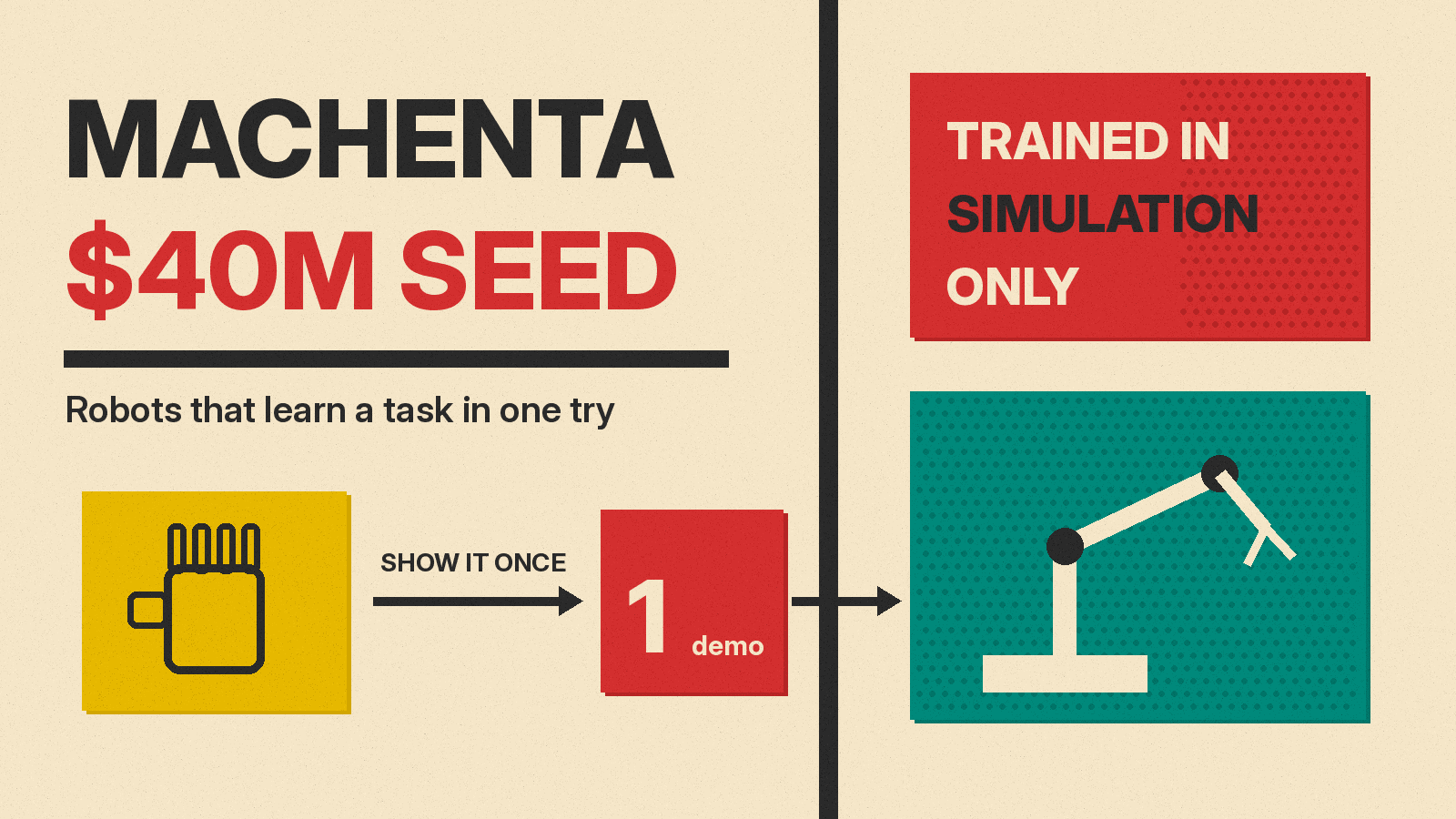
London startup Machenta came out of stealth on Oct 27, 2026 with a $40 million seed round and a robot model that it says can learn a new physical task from a single human demonstration, with no extra training. Creandum and Union Square Ventures co-led the round, according to Business Insider, which reported the deal as an exclusive. Imperial College London and Tech.eu also name both firms as the round's leads. Machenta declined to disclose its valuation, Business Insider reported.
The bigger claim is about data. Machenta says its model was trained entirely in simulation. In its launch post, the company says it built its model "without a single pixel of real-world training data."
What Machenta says it built
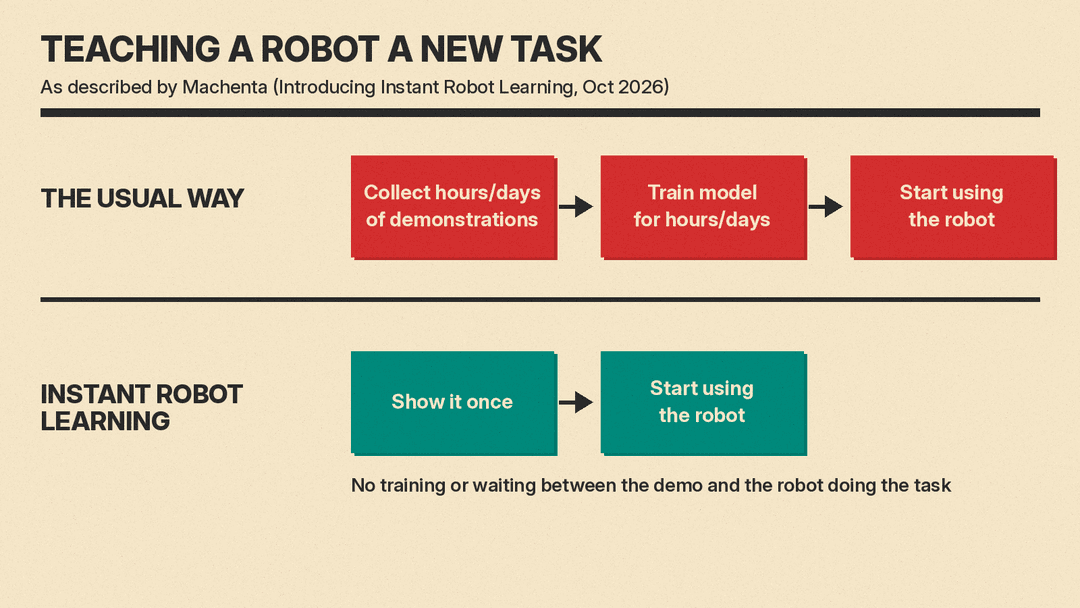
Machenta's post says robot foundation models typically look at camera images and a task description and predict the robot's actions. When the task is given in language, that is a vision-language-action (VLA) model. Machenta's post says these models usually need post-training before they can do a specific job: "they are typically post-trained on a large number of real-world demonstrations, a process which can take days or weeks per task."
Machenta swaps the language prompt for a demonstration. It calls its design a vision-demo-action model, or VDA. A person shows the robot the task once, using a leader arm, a VR controller, by moving the robot by hand, or with their own hands. The model then takes that demonstration plus a live stream of camera images and predicts actions in a closed loop.
The company says the trick is in what the model learns during training. Instead of memorizing tasks, it is trained across a huge range of randomized simulated environments so that it learns "how to learn a new task." Machenta argues this sidesteps the usual gap between simulation and reality. "To the model, reality is just one more environment to adapt to," the post says.
Machenta's post makes these claims about the model:
- The same pre-trained model runs every task in its videos, with no task-specific fine-tuning. Only the demonstration changes.
- It runs on six different robots with different camera setups in the company's videos.
- It reacts to disturbances and retries steps that were undone, without those behaviors being shown in the demonstration.
- Users can add more demonstrations to clear up an ambiguous task, or split a long task into parts.
In one video, three robots with different grippers, cameras and teaching modes run the same model. Machenta says: "Within just two minutes, an entire assembly line is fully automated, a process that would traditionally require weeks of systems integration and manual robot programming." Business Insider says that in a video shared with it, three robots pack and close a box on an assembly line, a task CEO Edward Johns said they learned this way.
Machenta's post calls trying different demonstrations until one works "physical vibe coding." Tech.eu reports that Johns likens Machenta's method to "physical vibe coding."
The test numbers
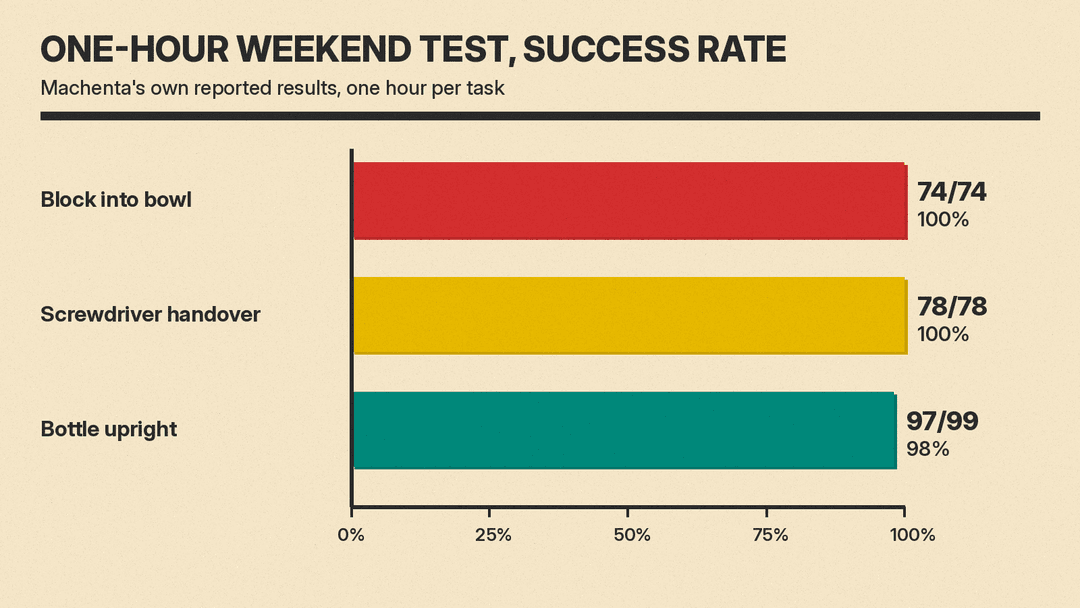
Machenta published one reliability test. It set up self-resetting tasks and let the model run for an hour on each over a weekend. The company reports these results:
- 74 of 74 block placements into a bowl
- 78 of 78 back-and-forth screwdriver handovers
- 97 of 99 attempts at standing a bottle upright
Machenta says the two failures "are caused by a potential collision and kinematic constraints." It also hedges the result itself: "While these tasks are relatively simple, the results are very encouraging." These numbers come from Machenta's own test, not an outside benchmark.
Who is behind it
Machenta was founded by Edward Johns, a professor of robot learning at Imperial College London, and his former PhD student Vitalis Vosylius. Imperial College London says the work began six years ago in Johns's Robot Learning Lab. Imperial calls the deal "the largest ever seed raise by a UK robotics startup." Tech.eu reports the same claim from the company.
Johns explained the goal in Imperial's announcement. "Intelligence is not so much about what you can already do, it's about how quickly you can learn to do something new," Johns said. "Humans don't need to see the same thing over and over before they can do it."
Business Insider reports the startup has 11 employees. Tech.eu says the team "numbers around a dozen" and works from an office in London's King's Cross.
The limits
Business Insider reports the company "remains focused on research, with no near-term plans to commercialize its technology." It also reports that the model "can learn some tasks immediately, but more precise tasks and complex movements remain challenging."
The money will go toward more people, more compute and more simulated data, with the aim of handling more precise and complex tasks, per Business Insider. Machenta's own post says the results so far come from "our first few months" and a "modest amount of compute and data scaling."
The bet and the rivals
Business Insider reports that companies are increasingly buying and collecting data to teach robots how to interact with the real world, and that Johns believes simply collecting more data isn't the answer. Machenta's post says it reserves real data "just for that single, teaching demonstration." The company argues that if every new task needs days or weeks of data collection and training, "robots will remain too slow and too expensive to deploy at scale."
The competition is well funded. Business Insider lists Physical Intelligence, valued at roughly $11 billion, and FieldAI, which it reports is raising at a $10 billion valuation. It also names Skild AI, valued at over $14 billion, which Business Insider says "is already selling technology with similar capabilities." Business Insider reports that in August, Skild said a model could perform previously unseen tasks lasting up to 10 minutes after a single video demonstration.
Generalist AI made a similar claim for its GEN-1.5 model on August 19. Its post says the model learns new tasks when prompted with 3 to 12 seconds of a single demonstration, with no training required.
For more on robot models, see our post on Gemini Robotics ER 2 on Google Cloud, a planning model for robots that hands motor control to separate action models.
Sources
- Machenta: Introducing Instant Robot Learning
- Business Insider: This 11-Person Startup Raised $40 Million to Train Robots in Virtual Worlds
- Imperial College London: Imperial AI spinout Machenta raises $40 million to make robots instant learners
- Tech.eu: London robotics startup Machenta raises $40M seed investment
- Generalist AI: GEN-1.5: Embodied Foundation Models are One-Shot Learners
