This is an opinion and analysis piece. The figures come from Anthropic's S-1 filing and are linked below; the argument is ours.
The number everyone is passing around from Anthropic's IPO filing is 85%. The Information reported that the S-1 shows an 85% gross margin in the first half of 2026 from running its models, and Techmeme's summary framed it as "a reality check for skeptics who said pay-as-you-go model sales wouldn't be profitable."
That is a fair headline. But I think it is the wrong number to anchor on, for a simple reason: Anthropic's own filing no longer presents its costs that way. The numbers the S-1 does print tell a more useful story, and a riskier one.
The filing does not have a gross margin line
In the S-1, Anthropic says that during 2025 it changed how it presents expenses. Cost of revenue and gross profit “are no longer presented as separate line items”. Expenses now appear by type: compute and infrastructure; personnel; sales, marketing, and partnerships; the Bartz settlement; and other operating and administrative costs.
The company also says it manages compute “as a single, fungible pool” and moves it between research, model development, serving customers, and internal use of Claude based on where the marginal unit is expected to be most productive. When one pool of chips moves between training and serving, any split between "cost of serving" and "cost of research" is an allocation choice. The Information's article is paywalled, so I cannot check how its 85% was built. My point is narrower: a gross margin is not a figure Anthropic reports on the face of its income statement, so readers should treat it as a derived view, not the headline fact.
The numbers the S-1 does print
Here is the six-month comparison from the filing's consolidated statements of operations, in millions of dollars:
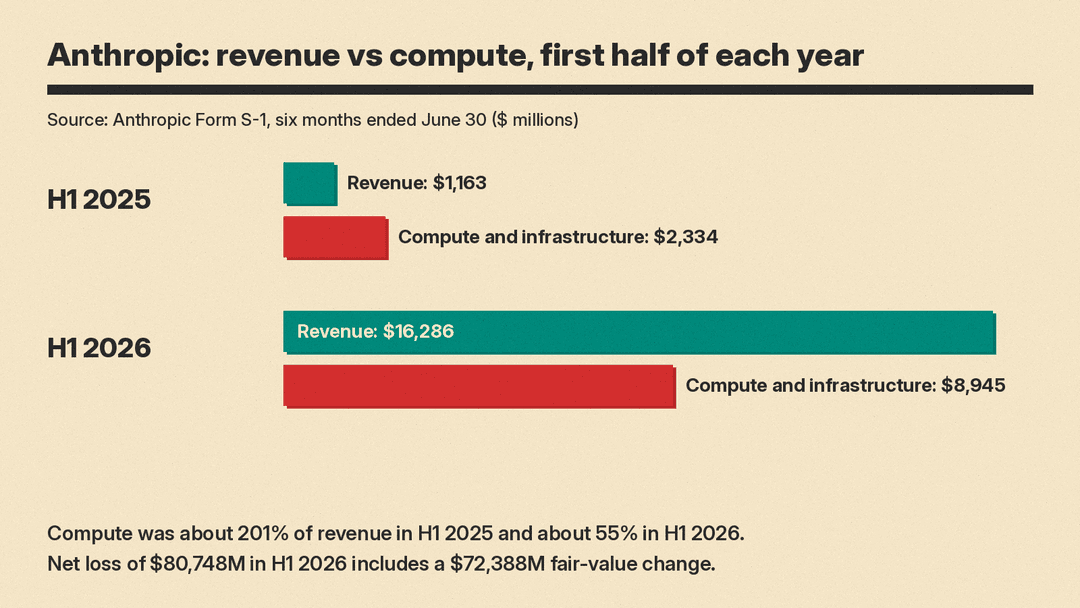
- Revenue: $1,163 in the first half of 2025, $16,286 in the first half of 2026. That is more than 14 times as much.
- Compute and infrastructure: $2,334, then $8,945. That is about 3.8 times as much.
- Total operating expenses: $3,298, then $16,979.
- Operating loss: $2,135, then $693.
- Net loss: $12,969, then $80,748.
Two things jump out. First, compute went from about 201% of revenue to about 55% of revenue across those two half years. The filing gives the quarterly version: compute and infrastructure expenses as a share of revenue “decreased from 251% to 48%” between the quarter ended March 31, 2025 and the quarter ended June 30, 2026. That is the real answer to the skeptics, and it is stronger than any single margin, because it covers all compute, training included.
Second, the scary loss is mostly not about running the business. Of the $80,748 million net loss, $72,388 million is a change in the fair value of convertible notes, derivative liabilities, and SAFEs (simple agreements for future equity). The filing says these changes were primarily driven by a rise in the fair value of its outstanding convertible promissory notes, as its enterprise valuation increased. That is roughly 90% of the net loss. We covered the size of that loss when the leaked S-1 numbers first surfaced, and it was the main fight in our roundup of reactions to the filing. The operating line, a $693 million loss on $16.3 billion of revenue, is the better gauge of the business.
Why the good number is also the fragile one
So who wins the argument? On the evidence in the filing, the people who said pay-as-you-go model sales would not be profitable are losing it. Revenue is outrunning compute by a wide margin.
But the S-1 is unusually direct about why that picture can flip. Anthropic says it typically buys compute “12 to 18 months in advance of availability”, so those costs are “generally fixed in the near term”. It says its revenue “is primarily consumption-based, and much of it is not subject to long-term contractual commitments”, while compute commitments “generally extend over multiple years”. And it warns that as new compute comes online, its operating margin “may compress in those periods”, and that it expects more short-term compute, which it says typically carries a higher cost per unit, to compress margins in the near term.
Put plainly: the current margin looks great partly because revenue arrived faster than the compute Anthropic had pre-ordered. When the next large block of compute lands, expenses jump before the revenue it is meant to support. That is a timing bet, and the filing says so.
What I would watch instead
- Compute and infrastructure as a share of revenue, quarter by quarter. If it climbs back up when new capacity arrives and then falls again, the model works. If it climbs and stays up, the 85% story was a lucky window.
- Operating loss, not net loss. The fair-value swings in the net loss say more about the company's financing instruments than about whether Claude pays for itself.
- How much of revenue becomes contracted. Consumption revenue can fall as fast as it rose. Long multi-year compute bills do not.
The skeptics were wrong about whether serving models can pay. The open question now is whether Anthropic can keep buying compute 12 to 18 months ahead of availability without getting the timing badly wrong. For more on what else sits in the filing, from governance to the delayed training run, see our full S-1 explainer.