
Ant Group released LingGuang 2.0 on October 27, 2026. The update turns its AI assistant app from a chatbot that waits for a prompt into what Ant calls a "proactive personal agent." With the user's permission, the assistant can watch connected services, spot things that need attention, and keep working on a task after the user closes the chat.
The announcement came in an Ant Group press release on Business Wire and was reported the same day by China Daily, IT Home and TechNode. Most details below come from Ant itself. None of these reports includes its own test of the new features.
What changed in LingGuang 2.0
Ant describes the shift as moving the "starting point" of AI help earlier. Before, Ant says, the user had to notice a problem and ask before the AI acted. In LingGuang 2.0, Ant says the assistant can "draw on connected information and services to spot potential needs, initiate analysis and follow-ups, and alert users when their attention is required," but only with explicit user authorization.
According to the press release, three upgrades make this possible:
- Cross-session memory. The assistant remembers context from earlier conversations, not only the current one.
- Long-horizon task scheduling. It manages tasks over the long term, not only one-off jobs.
- Tool calling. It can use built-in services and outside tools.
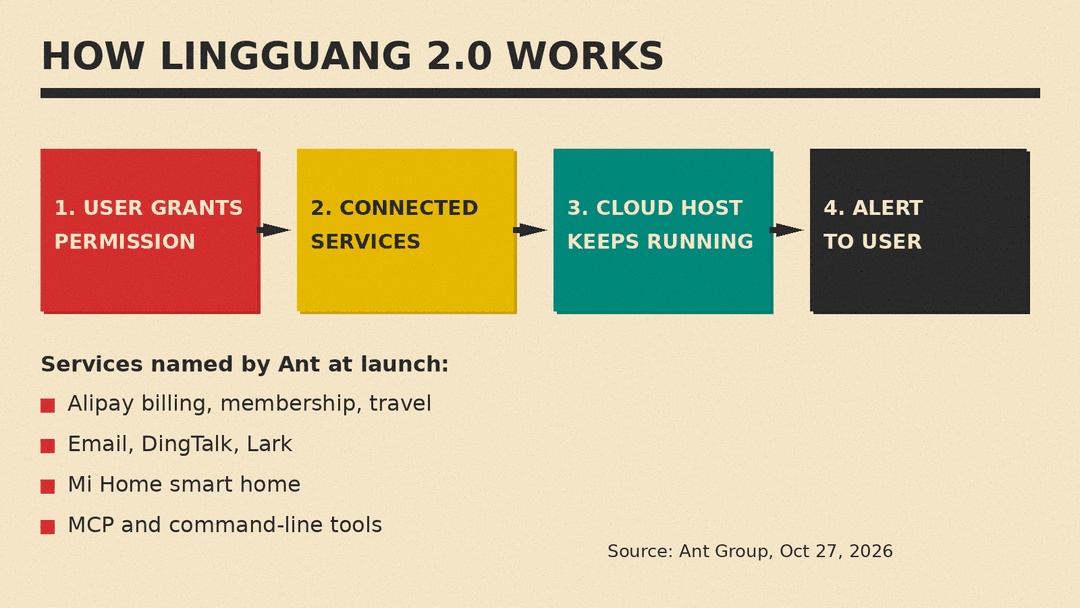
Ant says LingGuang now runs on "independent cloud instances," so it can keep executing tasks beyond a single conversation session and follow up as new information and status changes arise.
What it can do, according to Ant
Ant lists everyday examples rather than benchmarks. Each one depends on the user connecting the relevant account first.
- Spending. With access to Alipay, LingGuang can review bills, flag auto-renewing subscriptions the user may have forgotten, analyze spending habits and suggest savings.
- Travel. After a flight or hotel booking, it keeps watching the price and tells the user if it drops.
- School and family. With permission, it can read teacher notices in DingTalk class groups, pull out to-do items, and format related documents.
- Long-running reminders. Ant names pet care, children's vaccinations, family anniversaries and vehicle inspections as tasks where the agent tracks key dates and schedules follow-ups.
Built-in connections at launch, per the release, are Alipay billing, membership and travel services, email, DingTalk, Lark (Feishu in China) and Xiaomi's Mi Home smart-home platform. Ant also says LingGuang supports MCP (Model Context Protocol, a common standard for connecting AI agents to tools) and command-line tools "in open environments," which Ant says extends LingGuang across platforms.
How Ant handles permissions
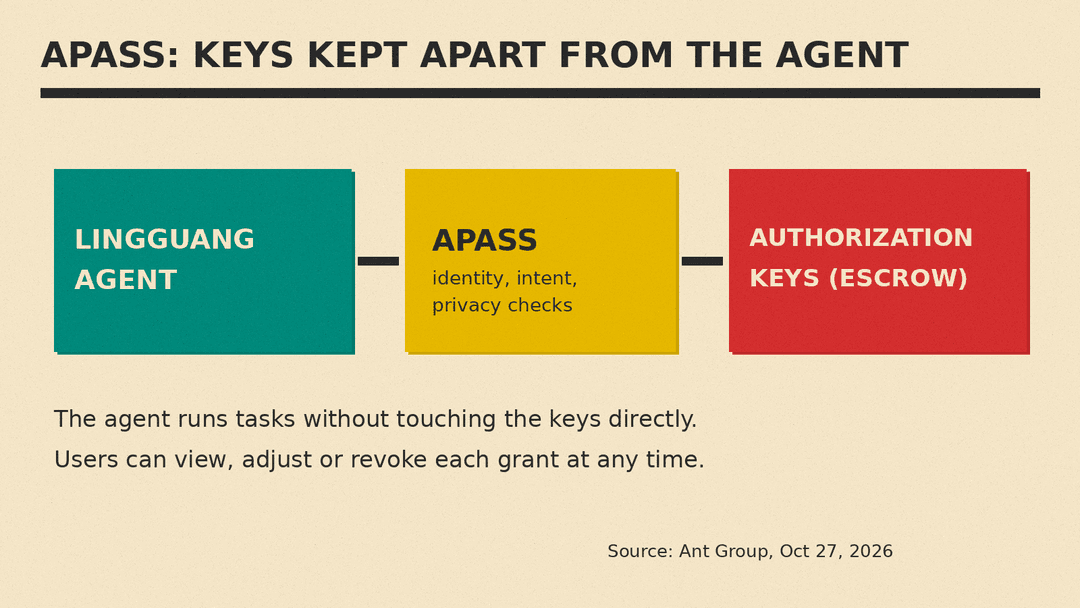
LingGuang 2.0 plugs into APASS, which Ant describes as "a unified account and security management service for the AI era across agents, devices, applications, and services."
Ant says APASS builds identity checks, "intent safety" and privacy protection into the agent's execution process. One mechanism the release names is separating authorization keys from the agent and holding them in escrow. The release says this lets agents "execute tasks without directly accessing credentials." Users can view, change or revoke each permission at any time.
The release gives no technical detail on how the key separation works, so how well it holds up in practice is not yet known. For how other agents get into user accounts, see our explainer on agent account access.
Background on LingGuang
LingGuang is Ant Group's general-purpose multimodal AI assistant. It launched on November 18, 2025, according to Sina Tech and China Daily, and passed 2 million downloads in its first six days, according to Ant's release. Earlier features included generating small "Flash Apps" from a single prompt and creating scenes with world models. TechNode reports that version 2.0 follows limited testing earlier in October.
Ant Group runs Alipay and also builds its own models, such as the Ling-3.1-flash-1019 open model released this month.
Why it matters
Ant's release contrasts LingGuang 2.0 with "conventional conversational AI and task-oriented agents" that wait for a command. Anthropic's Claude Duet, opened in research preview on October 21, also watches connected apps and keeps working after the user puts the phone down. Ant operates Alipay, and the release says LingGuang 2.0 integrates data and services within the Alipay ecosystem.
The release names permission boundaries, data security and execution trustworthiness as critical challenges for personal agents. LingGuang can read bills, subscriptions and school group notices, which are sensitive data. Ant's answer is the APASS permission layer and user-revocable grants. The release does not say what the agent can do without a fresh confirmation or how errors are handled.
LingGuang 2.0 is rolling out in China on iOS, Android and the LingGuang.com website, according to the release. It ties a background agent directly to a payments app, and its use will show whether people want an AI that acts before it is asked.
