
AGIBOT, the Shanghai robot maker, held AGIBOT Innovation Day 2026 in Shanghai on October 29, 2026. Its English press release, dated the same day, leads with a measurement idea rather than a robot. The company calls it Worken, and its release says: "AGIBOT today introduced Worken, a proposed framework for measuring the productive work performed by robots in real-world environments, at AGIBOT Innovation Day 2026 in Shanghai." Around that idea, AGIBOT unveiled a hardware platform, two AI models, an industrial robot and an operating system.
This explainer covers what AGIBOT says it launched, what it means by autonomous working hours, and why the company says it wants to move beyond measuring how many robots are built or delivered. Every capability below is AGIBOT's own description from its October 29 release or its Chinese G2 Max release published October 28, 2026. llms.blog has not tested any of these products.
What AGIBOT announced on October 29, 2026
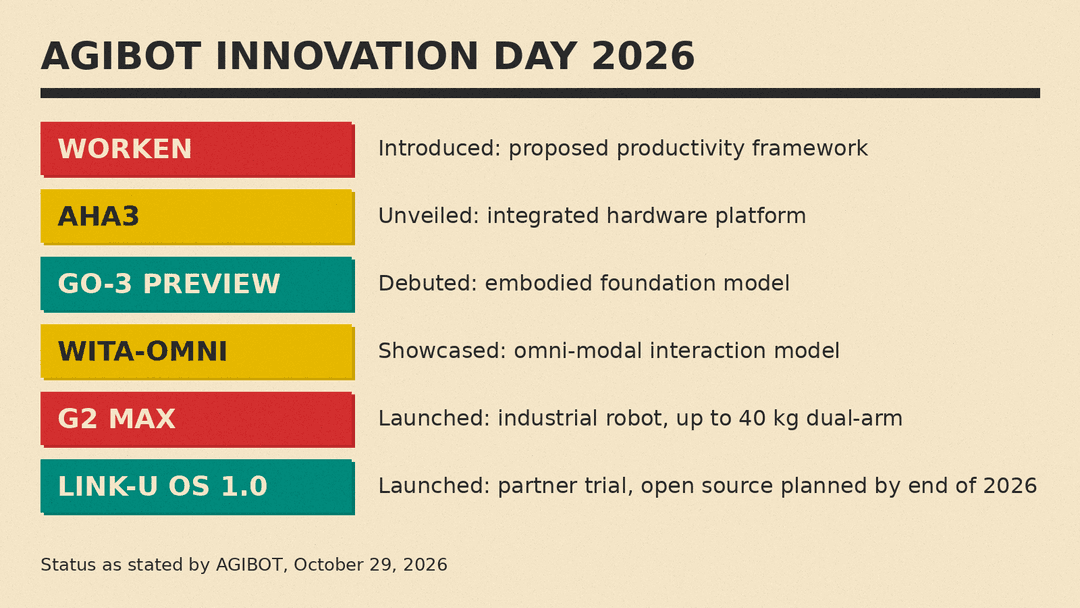
The release groups the news into one framework and five named products or platforms. In AGIBOT's own verbs from the release:
- Worken: introduced, as a proposed framework for measuring productive robot work.
- AHA3: unveiled, as AGIBOT's integrated hardware platform.
- GO-3 Preview: debuted, as its next-generation embodied AI foundation model.
- WITA-Omni: showcased, as an omni-modal interaction model.
- G2 Max: launched, as an industrial robot.
- Link-U OS 1.0: launched, with plans to become fully open source.
AGIBOT also highlighted advances in AGILE, its motion intelligence framework. The release summarizes the event this way: "Together, the announcements reflect the event's deployment-first focus: practical innovation spanning robot hardware, locomotion, task and interaction intelligence, operations and an ecosystem intended to support real-world deployment at scale."
Worken, and what "autonomous working hours" means
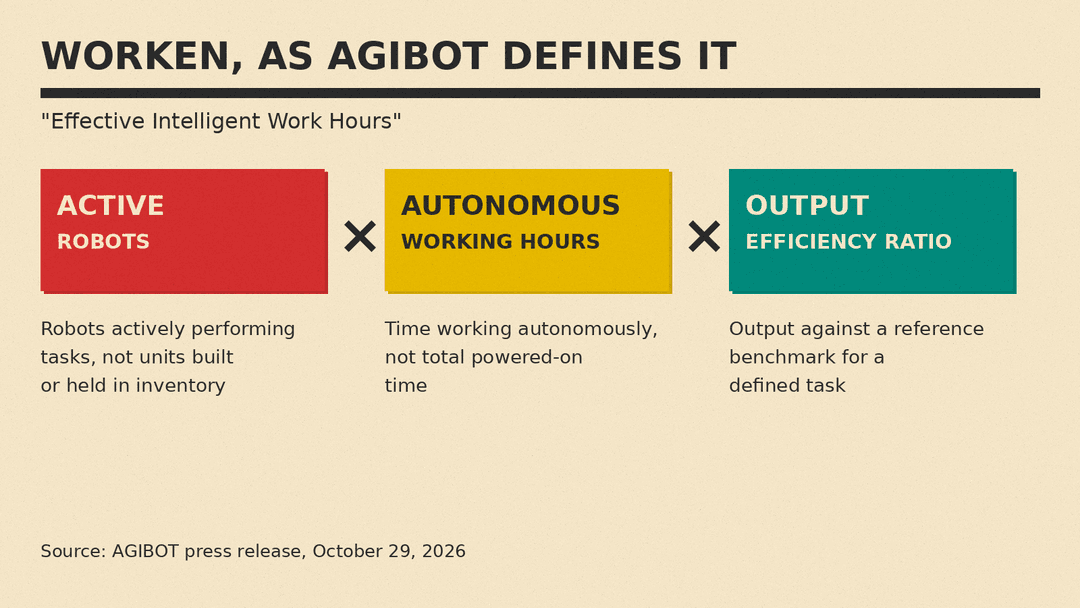
AGIBOT says the name combines the words Work and Token. The release says: "AGIBOT describes Worken as “Effective Intelligent Work Hours,” bringing three factors into a proposed measurement framework:" It then gives this formula:
Worken = Number of Active Robots × Autonomous Working Hours × Output Efficiency Ratio
AGIBOT defines each factor in its release:
- Number of Active Robots. "The first factor counts robots actively performing tasks in real-world environments, rather than units simply manufactured or held in inventory."
- Autonomous Working Hours. "The second measures time spent working autonomously, rather than total powered-on time."
- Output Efficiency Ratio. "The third assesses productive output against a reference benchmark for a defined task, such as the amount of acceptable work completed by a human worker under established operating standards."
That is the full definition of autonomous working hours that AGIBOT published. The release does not give a numeric threshold for what counts as autonomous, a method for logging those hours, or a Worken figure for any AGIBOT deployment. This post does not add one.
AGIBOT's co-founder, president and CTO, Peng Zhihui, framed the problem in the release: "But as robots begin working in factories, warehouses and service environments, we need to answer a more practical question: how much productive work are they actually delivering?" He added: "Worken is our attempt to develop a new way of answering that question. We want to move beyond measuring how many robots are built or delivered and begin measuring how effectively they can perform useful work, autonomously and consistently, in the real world."
Why AGIBOT says autonomous hours matter
AGIBOT's case starts from this statement in the release: "Even deployments involving similar numbers of robots can deliver different levels of productivity, depending on how independently the machines operate, how frequently human intervention is required and how much acceptable work they complete."
By the company's definition, the second factor counts only time spent working autonomously, and AGIBOT contrasts that with total powered-on time.
The company also ties the idea to robot economics. Its release says: "While hardware depreciates over time, improvements in software and AI models may enable the same machine to perform more useful work during its operating life." It continues: "Measuring that output alongside total lifecycle costs could help businesses evaluate the longer-term value of robotic deployments."
AGIBOT presents Worken as unfinished. The release says: "AGIBOT views Worken as an evolving framework that will be further explored and refined through real-world deployments and operational data." It adds: "By developing task-specific benchmarks and accumulating practical experience across different applications, the company hopes Worken can eventually serve as a widely applicable reference for measuring the productive value of physical AI."
The release explains why the third factor is tied to a task. It contrasts factory handling with public-service work: "A successful industrial operation and a successful public-service interaction produce different kinds of value. AGIBOT is using real deployment data and operating experience to explore how measures of autonomous working time and task output can be applied meaningfully in each setting."
AGIBOT also reports that the event featured the release of the 2026 Embodied Intelligence Industry Innovation Report, jointly compiled by China Economic Information Service and the Shanghai Industrial Innovation Center of the China Academy of Information and Communications Technology (CAICT). According to AGIBOT, that report includes Worken and AGIBOT's deployment examples as part of its industry analysis.
AHA3 hardware platform
AGIBOT describes AHA3 (AGIBOT Humanoid Architecture) as its third-generation humanoid hardware architecture and its first commercial "Three Intelligences in One" hardware platform. According to the release, AHA3 integrates the hardware foundations for locomotion, interaction and task execution intelligence into a unified architecture. AGIBOT says it is built on advances in motor-drive technology, integrated computing and high-speed connectivity, including Wi-Fi 6 and 5G.
Alongside AHA3, AGIBOT says it introduced:
- a joint liquid-cooling system, which AGIBOT says is intended to improve thermal performance during continuous operation
- specialized joints with IP67-rated protection
- a dexterous-hand family: OmniHand 3 Lite, OmniHand 3 and OmniHand 3 Ultra
- the OmniPicker 3 tactile gripper
The release does not give prices or ship dates for AHA3 or these parts.
AGILE motion framework
AGIBOT calls AGILE its multimodal, end-to-end motion intelligence framework. The new piece announced on October 29 is a self-evolving agent capability. AGIBOT says it is designed to enable robots to explore the boundaries of their physical capabilities and progressively improve their performance through experience in real-world environments. The company describes this as a shift from motion control toward spatial mobility intelligence.
GO-3 Preview foundation model
The release says: "AGIBOT also debuted GO-3 Preview, a next-generation embodied foundation model built around a unified reasoning, prediction and action framework called WRAM (World Reasoning Action Model)." It adds: "The model is designed to help robots anticipate the consequences of their actions, adapt to changing environments and generalize beyond previously learned task sequences." AGIBOT says it demonstrated zero-shot and few-shot capabilities at the event.
On benchmarks, the release states: "According to evaluation results presented at the event, the model ranked first in both task success rate and process score on RoboDojo, achieved the highest overall score on RoboTwin, and ranked first in overall score on RoboColiseum." These are AGIBOT's figures as presented on October 29, 2026. The release does not list scores, rival models or test dates.
AGIBOT's English release does not say when or how GO-3 Preview will be available to outside users.
AGIBOT is not the only company pitching robot foundation models this month. Google put its Gemini Robotics ER 2 planning model into public preview on Google Cloud on October 27, and London startup Machenta says its model can learn a new physical task from a single human demonstration.
WITA-Omni interaction model
AGIBOT describes WITA-Omni as an omni-modal foundation model that integrates visual perception, speech, real-time dialogue, facial expressions and physical actions into a continuous interaction system. The release says: "The model supports full-duplex conversation, coordinated speech and movement, and on-device deployment, enabling more natural and responsive communication in complex environments." It also says: "WITA-Omni currently ranks first on multiple benchmarks related to embodied interaction, including Daily-Omni." That ranking is AGIBOT's claim as of October 29, 2026.
AGIBOT says Xiong Yan, its president of central R&D and of the interaction business, presented a planned deployment roadmap for WITA-Omni. The release does not give the roadmap's dates.
G2 Max industrial robot
AGIBOT's English release of October 29, 2026 says: "AGIBOT launched G2 Max, a heavy-duty industrial robot designed for manufacturing and logistics applications." The release lists 21 degrees of freedom, a dual-arm handling capacity of up to 40 kg and an adjustable working height ranging from 0.1 to 2.5 meters.
AGIBOT's Chinese release, published October 28, 2026, says the company introduced G2 Max on October 26 and calls it a safety-standard heavy-load embodied robot. That release reports these figures:
- 20 kg single-arm payload, 40 kg dual-arm rated payload, and up to 50 kg dual-arm peak payload
- arm repeat positioning accuracy of ±0.5 mm or better
- vertical working range of 0.1 m to 2.5 m and horizontal reach of 1.2 m
- dual hot-swappable batteries plus autonomous recharging, which AGIBOT says allows 7×24 continuous operation
The same Chinese release reports a deployment at a leading e-commerce warehouse, where AGIBOT says G2 Max works with an existing goods-to-person storage system. There, according to AGIBOT, its overall task success rate is above 99%, and it can depalletize 80 boxes and palletize 75 boxes per hour. AGIBOT does not name that customer.
The Chinese release also says G2 Max is already running on multiple production lines. It describes one on the Qiyuan T1 robot production line, where it says G2 Max keeps pace with a cycle of one T1 robot every 2.5 minutes, and it quotes Zhou Ye, director of Huguang's robot manufacturing plant, on that pace. Qiyuan is a consumer robot brand of Swancor Advanced Materials, and auto wiring harness maker Huguang is its manufacturing partner, according to Gasgoo. Neither AGIBOT release gives a price.
The English release lists wider G2 family deployments: tablet production at Longcheer, semiconductor packaging and testing, CNC machine tending and logistics operations. The release says: "At Longcheer, robots are used in production-line material handling, where operating performance is assessed against cycle time, sustained operation and successful task completion." AGIBOT also names service deployments at Guangzhou Metro and the Chimelong tourism and entertainment complex.
Link-U OS 1.0 operating system
The release says: "AGIBOT also announced the official release of Link-U OS 1.0, positioning it as the industry’s first operating system purpose-built for embodied intelligence." The company says it is built on a unified hardware abstraction layer, an embodied intelligence-native kernel and an intelligent service framework. It also says: "The operating system has already been validated on mass-produced robots."
Availability, in AGIBOT's words: "Link-U OS 1.0 is currently being trialled by selected ecosystem partners, with plans for it to become fully open source by the end of 2026." AGIBOT also announced an OpenAtom Foundation Platinum Level Sponsorship and the donation of the Link-U OS project to that foundation.
As of October 29, 2026, AGIBOT says its ecosystem spans 255 universities, 511 enterprises and more than 80,000 developers.
Where and when you can get these products
Based only on what AGIBOT published on October 28 and 29, 2026:
- Link-U OS 1.0: in trial with selected ecosystem partners; AGIBOT plans for it to become fully open source by the end of 2026.
- G2 Max: AGIBOT says it is already running on multiple production lines. Neither release gives a price or a list of sales regions.
- AHA3, GO-3 Preview, WITA-Omni: the releases do not give public availability, pricing or dates.
AGIBOT lists sales@agibot.com as its contact in the English release.
What to watch
AGIBOT calls Worken a proposed framework. Its October 29, 2026 release defines the three factors but does not include a Worken figure for any deployment. AGIBOT says it plans to refine the framework through real-world deployments and operational data, and to develop task-specific benchmarks. The next thing to look for is AGIBOT publishing those benchmarks and Worken figures: how many robots were active, how many hours they worked autonomously rather than total powered-on time, and the task reference used for the output efficiency ratio.
Sources
- AGIBOT: AGIBOT Introduces Worken to Measure Productive Robot Work at AGIBOT Innovation Day 2026 (October 29, 2026)
- AGIBOT (Chinese): AI WAVE, AGIBOT releases G2 Max heavy-load embodied robot (October 28, 2026)
- Gasgoo (Chinese): Qiyuan Robotics rolls out 5,000 robots in a month, one every 2.5 minutes (October 26, 2026)
