
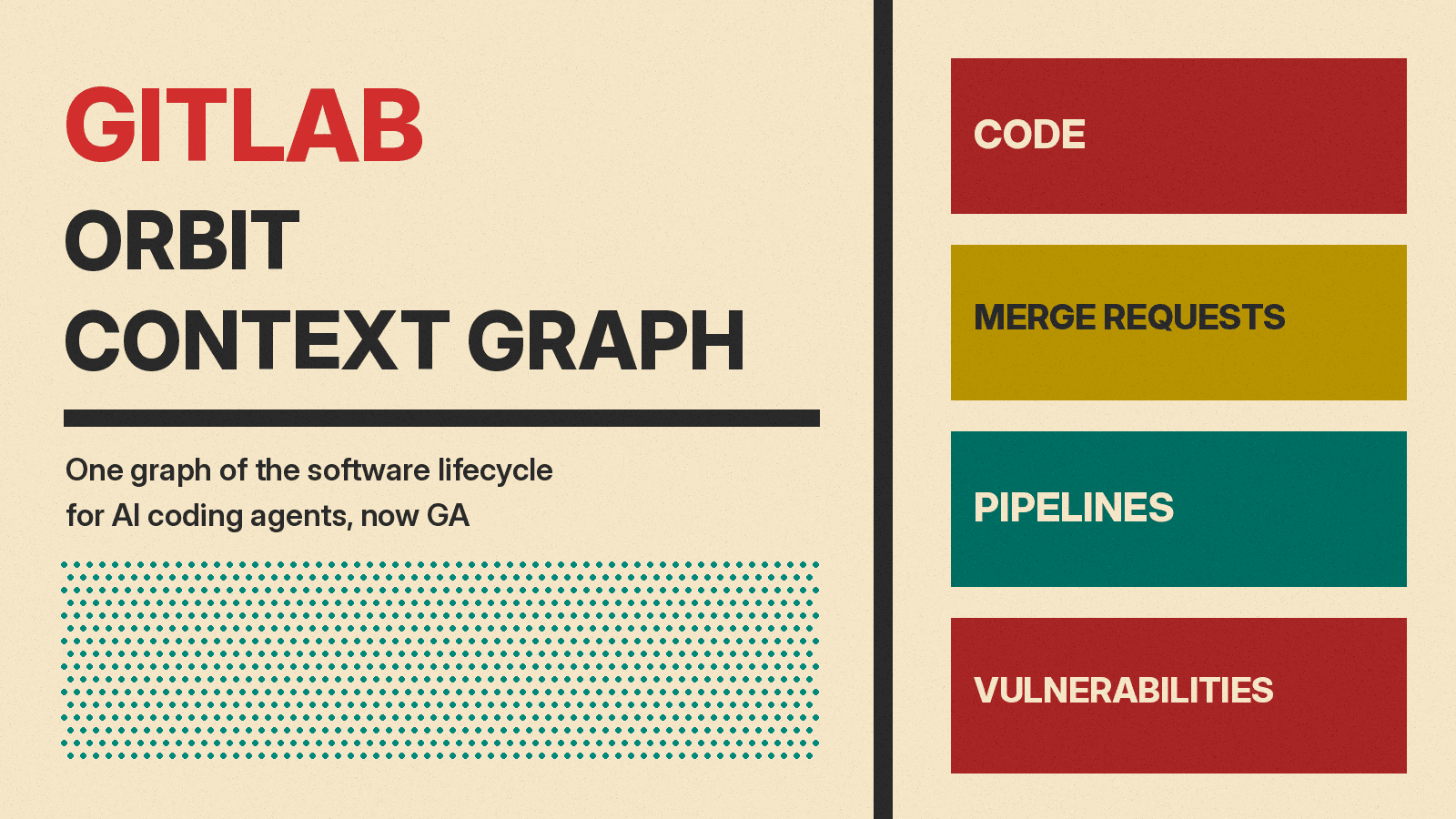
GitLab says GitLab Orbit is now generally available. In its October 29, 2026 launch post, GitLab describes Orbit as "the context graph for your software lifecycle: a live, queryable view of all your code, merge requests, work items, pipelines, vulnerabilities, and ownership." GitLab says agents such as Claude Code can query the graph instead of crawling files.
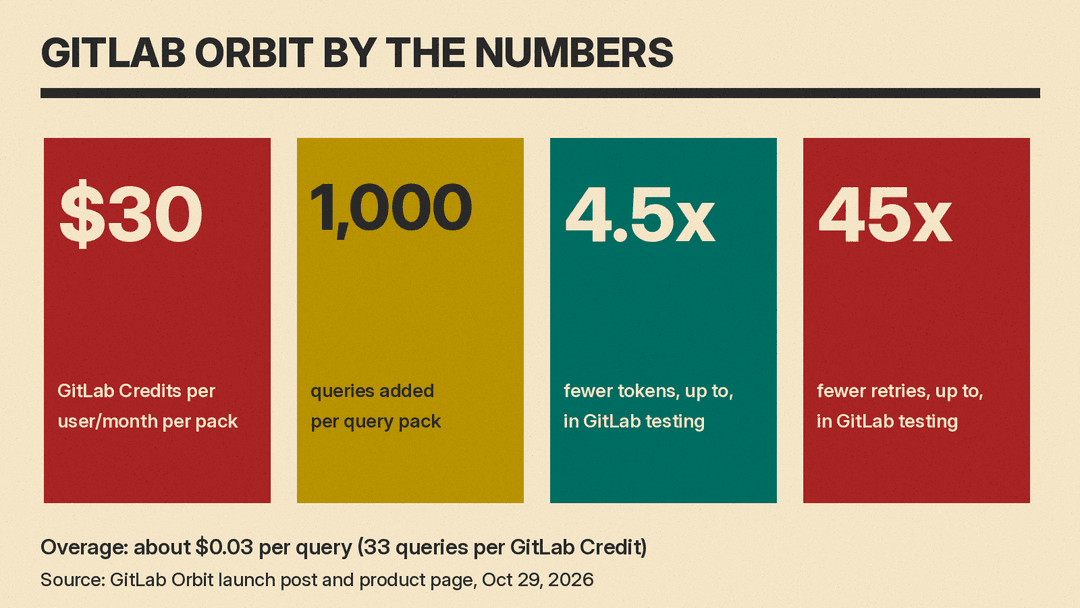
The same post says that "In GitLab testing, agents connected to Orbit needed up to 45x fewer retries and used 4.5x fewer tokens on the same tasks with the same model." GitLab's press release on Business Wire words the first figure differently: agents with Orbit "completed the same agentic tasks with up to 45x fewer hallucinations, leading to fewer retries, and up to 4.5x fewer tokens."
What Orbit does
GitLab's problem statement is in the launch post: agents "guess because code is all they can see; they can't see the merge request that last changed it, the pipeline that ran it, the vulnerability it carries, or the people who wrote and reviewed it."
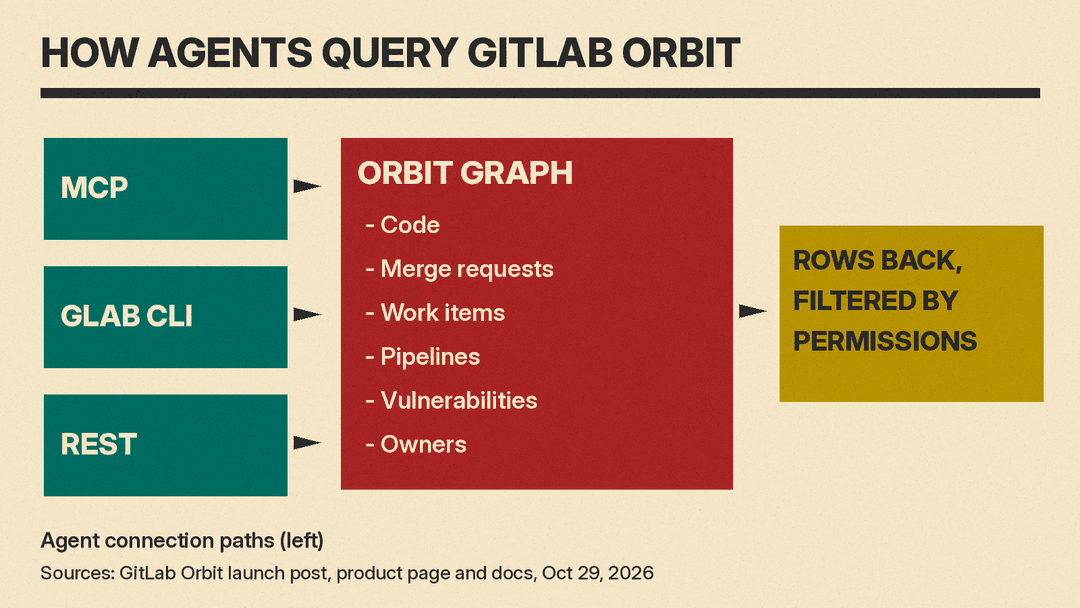
Orbit builds its graph from data already in GitLab. The launch post says there is "no connector to configure, no ETL pipeline to maintain," and that Orbit "mirrors nested groups, roles, and security-domain access." The Orbit docs say it "filters every answer by your GitLab permissions" and that an agent "sends one graph query and gets back rows, not pages of JSON to filter."
GitLab lists questions that design partners asked Orbit, among them:
- Which production services are exposed to a vulnerability.
- What breaks if a developer changes a piece of code.
- Why a CI job keeps failing, and in which other projects.
- What depends on a service before a migration.
According to the launch post, one design partner answered a security-coverage question "across 34 million entities in seven minutes," which GitLab says would have taken half a day through the API.
How agents connect
The launch post says agents on GitLab Duo Agent Platform query Orbit natively, and that "Claude Code, Codex, Cursor, OpenCode, Gemini CLI, Antigravity, and any other MCP-compatible agent connect through MCP or the GitLab CLI." Setup starts with glab auth login and glab orbit setup. Custom tools use REST.
The Orbit product page names two MCP tools, query_graph and get_graph_schema, and a REST endpoint at /api/v4/orbit/query. The Connect your agent docs page says setup needs glab 1.126 or later, supports Claude Code, Codex, GitLab Duo, OpenCode and Pi, and points agents "that cannot run shell commands or that prefer the Model Context Protocol (MCP)" to the Orbit MCP endpoint. For other recent MCP launches, see our post on Notion 3.8 and MCP for agents.
The test numbers
GitLab's product page says its figures come from "GitLab internal testing with Orbit Observatory, an evaluation harness comparing Claude Code with and without GitLab Orbit on the same tasks and model," and adds: "Results vary by workload." The page lists three results:
- Up to 11x faster, measured as time from prompt to a finished answer.
- Up to 4.5x fewer tokens to finish the same task.
- Up to 45x fewer retries.
The launch post also cites one customer test. Compare the Market tested four context approaches for an internal AI code reviewer across 79 real merge requests. GitLab says the Orbit-grounded reviewer "matched about 70% of expected inline comments; RAG managed about 58%, worse than no added context at all." We covered a separate study on when plain RAG beats agent memory earlier this week.
The press release says that since its introduction, "more than 3,500 organizations have used Orbit, and their coding agents have run more than 280,000 queries."
Pricing and availability
GitLab sells Orbit as query packs that form one shared pool for an organization, so humans and agents draw from the same pool. The launch post gives the price: "Each query pack is $30 in GitLab Credits per user per month and adds 1,000 queries to your organization's shared pool; usage beyond the pool is billed at 33 queries per GitLab Credit, about $0.03 per query." It also says "Promotional pricing is available this quarter for early customers."
The GitLab pricing page adds detail in its FAQ:
- Orbit query packs "are paid in GitLab Credits reserved for Orbit, purchased separately," so existing GitLab Credits and GitLab Flex commitments do not cover them.
- The number of paid GitLab users in an organization sets how many packs it needs.
- Agents have "no separate agent charge."
- "Usage above the included query allotment is metered so you can see it, but it isn't billed during your first year." The launch post gives the overage rate but does not mention this first-year waiver.
The pricing page lists Premium at $29 per user per month, billed annually, and Ultimate at custom pricing. Orbit is bought through a GitLab account team.
The launch post says Orbit is "generally available for Premium and Ultimate customers, starting with GitLab.com today and reaching Self-Managed and GitLab Dedicated over the coming weeks." Customers "can try it free for 30 days through their GitLab account team." The docs list the history: an experiment in GitLab 18.10, beta in 19.1, Self-Managed support in 19.2.2 and general availability in GitLab 19.5.
For a different way to run coding agents inside a code host, see our post on GitHub Agentic Workflows.
