
OpenAI sells access to its AI models in several ways at once: monthly ChatGPT subscriptions for consumers, seats and usage for businesses, per-token API access for developers, and now advertising inside ChatGPT. It also has a revenue-sharing deal with Microsoft, though under the current contract the payments flow from OpenAI to Microsoft rather than the other way.
OpenAI is a private company and has not published audited financials. What follows draws on OpenAI's own posts and on reporting by Reuters, CNBC, The Information and the Financial Times, much of it based on documents OpenAI shared with investors. Each figure is attributed to its source, and several are run-rate estimates rather than reported annual results.
The short answer
As of late 2026, OpenAI's main revenue streams are ChatGPT consumer subscriptions, business plans, the developer API and a young ads business. Its costs, led by research and development and the computing power behind it, are larger than its revenue. The company is preparing for a public listing.
Revenue stream 1: ChatGPT consumer subscriptions
In an October 5 post, OpenAI said ChatGPT reaches 1.2 billion people each week. Paying users choose from several plans, including Go, Plus and Pro.
The mix of those plans is shifting. The Information reported in April that OpenAI forecast its cheaper Go plan, which costs $8 a month in the US and around $5 a month in countries such as India, would grow about 36 times to 112 million subscribers in 2026, according to an excerpt quoted by Ed Zitron. In the same forecast, according to The Information, OpenAI projected that $20-a-month Plus subscribers would fall 80% to about 9 million, and that Pro users would double but remain under 1% of the total.
That shift matters for revenue per user. A move from $20 subscriptions toward $5 and $8 subscriptions only works financially if volume rises sharply or if another source, such as ads on the cheaper tier, fills the gap.
Revenue stream 2: business and enterprise
OpenAI sells ChatGPT plans for companies, from team workspaces to large enterprise deployments.
OpenAI has not broken out enterprise revenue publicly. In an investor presentation, OpenAI cited 107% run rate growth for its enterprise business during its third quarter, compared with 77% total run rate growth, according to a person familiar with the matter who spoke to CNBC. If those figures are accurate, the enterprise business is growing faster than the company as a whole.
Revenue stream 3: the API
Developers and companies pay per token to use OpenAI models such as the GPT-6 family through its API. Prices vary by model and by input versus output tokens. For current rates, see our GPT-6 Astra explainer and our LLM API pricing comparison.
The API is also where OpenAI competes with Anthropic, Google and open-weight models on price. Since the April 2026 change to its Microsoft agreement, OpenAI can serve its products to customers across any cloud provider, and Reuters notes that OpenAI does not count revenue from sales through cloud partners such as Amazon Web Services and Google Cloud in its own figures.
Revenue stream 4: advertising in ChatGPT
Advertising is OpenAI's newest revenue line. OpenAI says it allows the company "to serve a much larger market than subscriptions alone." We covered the ad launch on the Free and Go tiers in India.
How it works, according to OpenAI's help center:
- Ads appear below ChatGPT responses and include the advertiser name, a favicon, a headline, a description, a landing page and an image.
- Ads are not shown to users on Plus, Pro or any Business plan, or to accounts identified as belonging to users under 18.
- Advertisers pay for impressions or valid clicks. OpenAI recommends starting with a maximum bid of $3 to $5 per click for click-based campaigns.
- Ads are selected through a relevance-weighted, second-price auction.
The ad product is expanding. On October 5, OpenAI announced a visual ad format that it will test during image generation for Free and Go users, with US testing to begin later in the month, plus new measurement partners. Then, in an update sent to advertisers late Friday, October 16, OpenAI described tests of wider cards and larger images, a coming multi-image format, plus a redesigned conversions page and weekly performance emails, according to Search Engine Roundtable. Our ChatGPT Ads explainer covers formats and bidding in detail.
OpenAI has not disclosed how much revenue ads produce. The structure points to the strategy: ads target the free and low-cost tiers where the subscriber base is projected to grow, while premium subscribers stay ad-free.
Revenue stream 5: partnerships, and the Microsoft revenue share
Microsoft is a major OpenAI partner and shareholder. The two companies revised their agreement on April 27, 2026. According to OpenAI's announcement:
- Microsoft remains OpenAI's primary cloud partner, and OpenAI products ship first on Azure unless Microsoft cannot and chooses not to support them. OpenAI can now serve its products through any cloud provider.
- Microsoft keeps a license to OpenAI IP for models and products through 2032, now non-exclusive.
- Microsoft no longer pays a revenue share to OpenAI.
- OpenAI's revenue share payments to Microsoft continue through 2030 at the same percentage, subject to a total cap.
The percentage is 20%, according to a source who spoke to CNBC, which means Microsoft gets a cut of every ChatGPT subscription. The cap is $38 billion in total, The Information reported, as summarized by Reuters.
The money flow is lopsided. According to OpenAI's 2025 audited financial documents, obtained by Ed Zitron and verified by the Financial Times, OpenAI paid Microsoft a total of $17.2 billion in 2025, including $10.59 billion for research and development expenses and $6.047 billion in cost of revenue charges, while Microsoft paid OpenAI $303 million, as reported by Yahoo Finance. So for OpenAI, the Microsoft relationship is mostly a cost line, not a revenue line.
Costs: compute is the business
Training and running large models is expensive, and costs remain far larger than revenue.
According to the same 2025 audited documents, verified by the Financial Times and reported by Yahoo Finance and TechSpot:
- Research and development rose from $7.81 billion in 2024 to $19.18 billion in 2025.
- Cost of revenue, which reflects the cost of serving users, rose from $2.65 billion to $7.5 billion.
- Sales and marketing rose from $1.11 billion to $5.73 billion.
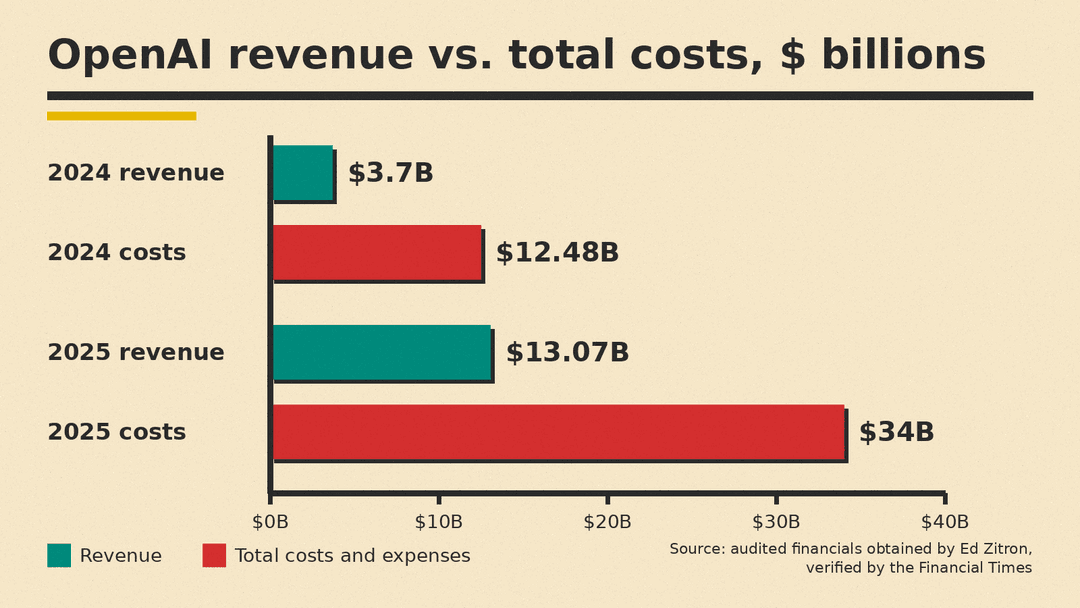
- Total costs and expenses rose from $12.48 billion to $34 billion.
The forward commitments are larger still. OpenAI expects to spend $50 billion on computing power in 2026, President Greg Brockman said in court testimony, according to Reuters. In February, OpenAI was targeting about $600 billion in total compute spend through 2030, a source told Reuters. The Financial Times later reported that a July company presentation put computing power and infrastructure at about $856 billion through 2030 and projected negative free cash flow of $278 billion from 2026 to 2030, as summarized by The Next Web. The Next Web notes that the February and July figures may not cover identical categories.
Reported revenue and losses over time
The clearest annual figures come from the 2025 audited documents. According to those documents, verified by the Financial Times and reported by Yahoo Finance:
- 2024: revenue of $3.7 billion, total costs and expenses of $12.48 billion, and a net loss attributable to the company of $5.09 billion.
- 2025: revenue of $13.07 billion, total costs and expenses of $34 billion, an operating loss of $20.92 billion, and a net loss of $38.5 billion. The net loss includes a $41.55 billion charge tied to changes in the fair value of convertible interests and warrant liability after OpenAI's conversion to a for-profit structure.
The 2025 revenue beat OpenAI's own $10 billion projection, a source told Reuters in February.
For 2026, the numbers are run rates and quarterly figures from investor materials rather than audited results:
- OpenAI started 2026 with $20 billion in annualized revenue, according to Reuters.
- In the first quarter, OpenAI burned $3.7 billion on $5.7 billion of revenue, The Information reported, as summarized by Reuters.
- Second quarter revenue was $6.7 billion, according to Reuters, which said it was the first quarter in which Anthropic's revenue, at $11.5 billion, was higher.
- At the end of September, OpenAI told investors its annualized revenue was nearly $50 billion. The Financial Times first reported that figure, and CNBC and Reuters confirmed it.
That last figure caused confusion. A run rate approaching $70 billion had been widely reported earlier. According to Reuters, the gap mainly came from an attempt to compare OpenAI directly with Anthropic, which counts revenue from sales through cloud partners such as AWS and Google Cloud, while OpenAI does not. According to CNBC, the higher figure included gross revenue from OpenAI's partners. Analysts treat annualized run rate as a sometimes misleading metric, Reuters noted, because it often multiplies a single month's revenue by 12.
What to watch
- The IPO filing. OpenAI confidentially filed its prospectus in June, and executives have signaled a 2027 debut, according to CNBC. A public filing would be the first full, official view of its revenue by segment.
- Ads revenue. OpenAI has not disclosed ad revenue. Watch whether it reports a figure, and whether ads reach more markets and formats.
- The subscription mix. If The Information's reported forecast holds, Go subscribers will vastly outnumber Plus subscribers. That puts more weight on ads and volume.
- Microsoft payments. The 20% revenue share continues through 2030 up to its reported $38 billion cap, after which more of each dollar stays with OpenAI.
- Compute versus revenue. OpenAI's compute commitments run to hundreds of billions of dollars through 2030. Whether revenue growth keeps pace is the central question for investors.
Sources
- OpenAI: Building advertising for the way people use AI (October 5, 2026)
- OpenAI Help Center: Ads in ChatGPT: The Basics
- Search Engine Roundtable: ChatGPT Ads new visual ad formats, updated conversion page, performance emails
- OpenAI: The next phase of the Microsoft OpenAI partnership
- CNBC: OpenAI shakes up partnership with Microsoft, capping revenue share payments
- Reuters: OpenAI, Microsoft agree to cap revenue sharing at $38 billion, The Information reports
- CNBC: Nvidia, Oracle, other AI stocks sink on OpenAI revenue report
- Reuters via Investing.com: OpenAI's September annualized revenue nears $50 billion
- Reuters: OpenAI burned $3.7 billion in first quarter of 2026, The Information reports
- Reuters: OpenAI projects $50 billion spending on computing power this year, Brockman says
- Reuters: OpenAI expects compute spend of around $600 billion through 2030
- The Next Web: OpenAI's compute bill and cash burn, per the Financial Times
- Yahoo Finance: OpenAI 2025 financials leaked
- TechSpot: OpenAI made $13 billion in 2025 and lost $21 billion doing it
- Ed Zitron: OpenAI projects ChatGPT Plus subscriptions to drop (quoting The Information)
