
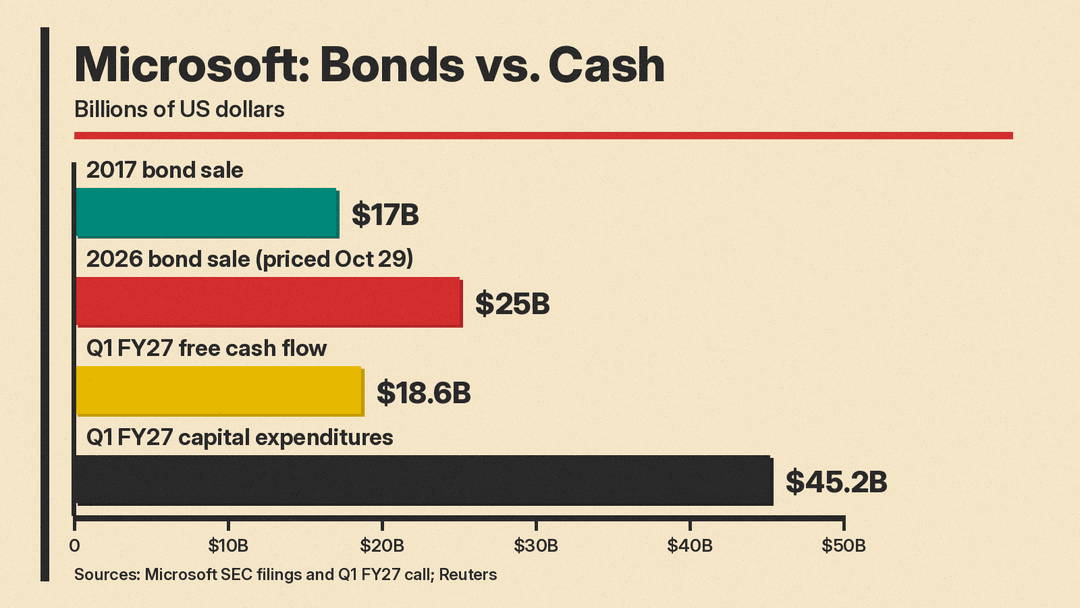
Microsoft priced $25 billion of senior unsecured notes on October 29, its first US investment-grade bond sale since 2017. The company announced the pricing on Thursday: 10 tranches, two floating rate and eight fixed rate, due from 2028 to 2066. The offering had drawn more than $100 billion of orders, one of two sources familiar with the matter told Reuters. Microsoft says the offerings are expected to close on November 4, 2026.
The timing follows a direct signal from the CFO. On the fiscal first-quarter call a day earlier, Amy Hood said: "To complement cash generated by the business and preserve financial flexibility, we will access additional sources of funding when we believe it is attractive to do so."
What the filing says
The preliminary prospectus describes 10 series of notes: two floating rate notes that pay Compounded SOFR plus a spread, and eight fixed rate notes. All are senior unsecured obligations, and none will be listed on an exchange. J.P. Morgan, UBS Investment Bank and Wells Fargo Securities are the joint book-running managers.
The use of proceeds is broad. Microsoft says the net proceeds "will be used for general corporate purposes, which may include, among other things, funding for working capital, capital expenditures, repurchases of our capital stock, acquisitions and repayment of our existing debt." The use of proceeds section does not mention AI or data centers.
The capitalization table in the same filing puts Microsoft's total debt at $35.5 billion as of September 30, 2026, against total stockholders' equity of $470.5 billion.
Before pricing, Microsoft pointed Reuters to the preliminary filing, which confirmed the sale without disclosing its size, Reuters reported.
The final terms
Microsoft's pricing announcement lists these tranches:
- $1.00 billion of floating rate notes due November 3, 2028
- $1.00 billion of floating rate notes due November 3, 2029
- $2.00 billion of 4.85 percent notes due November 3, 2028
- $3.25 billion of 5.00 percent notes due November 3, 2029
- $3.25 billion of 5.20 percent notes due November 3, 2031
- $2.50 billion of 5.35 percent notes due November 3, 2033
- $4.00 billion of 5.55 percent notes due November 3, 2036
- $2.00 billion of 6.15 percent notes due November 3, 2046
- $4.00 billion of 6.25 percent notes due November 3, 2056
- $2.00 billion of 6.35 percent notes due November 3, 2066
The tranches add up to $25 billion. Notes due 2046 and later make up $8 billion of the total.
How the deal came together
Bloomberg News first reported the sale. According to Bloomberg, as cited by Reuters, Microsoft is selling the debt in as many as 10 tranches with maturities from 2 to 40 years, and no final decision had been made on the size, which may change according to demand.
According to Bloomberg, as summarized by Investing.com on Yahoo Finance, Microsoft is one of only two publicly traded US companies with AAA ratings from both Moody's and S&P Global, alongside Johnson & Johnson. Investing.com said the notes carry expected ratings of Aaa/AAA.
In a later story on Thursday, Bloomberg reported that the $25 billion, 10-part offering drew more than four times demand, which let the underwriters lower the extra yield Microsoft pays over Treasuries. Bloomberg said the deal broke a nearly three-month drought in Big Tech hyperscaler bond sales.
The last comparable Microsoft deal was in January 2017. Its pricing term sheet lists seven fixed rate series that add up to $17 billion, from notes due 2020 to notes due 2057.
Why Microsoft is borrowing now
The numbers from the quarter that ended September 30 explain the context. In the earnings release and call, Microsoft reported:
- Capital expenditures of $45.2 billion, including $7.4 billion of finance leases. Hood said the figure came in "as some third party capacity deliveries we expected in Q1 were delayed."
- Cash paid for property and equipment of $39.4 billion.
- Cash flow from operations of $58 billion, up 29%.
- Free cash flow of $18.6 billion, which Hood said reflected "higher capital expenditures."
Looking ahead, Hood said Microsoft expects capital expenditures in the December quarter to be "over $50 billion," and that calendar-year spend "should be approximately $170 billion due to the 3P capacity delays noted earlier." She said Microsoft expects "to continue to remain free cash flow positive in FY 2027." We covered the quarter in Microsoft Q1: Azure Up 48%, Capex Reaches $45.2B.
Asked on the call about debt and equity, Hood named leasing as a form of financing Microsoft already uses. "We are fortunate to have access in the debt markets, given where our ratings are, and we have not yet, I would say, tapped that," she said. One day later, it did.
How it compares with peers
Reuters noted that the largest tech firms have turned to bonds and equity over the past year to pay for AI spending, and that Microsoft's expected positive free cash flow sets it apart from Big Tech and hyperscaler peers. Alphabet burned $9.07 billion in the third quarter, and Meta posted its first cash burn in more than a decade the week before, according to the same Reuters report. Our coverage of Alphabet's negative free cash flow and Amazon's $220 billion capex plan has more detail.
Microsoft shares fell 0.7% in afternoon trading on Thursday, Reuters reported.
What to watch
The final prospectus supplement on EDGAR should give the spread on the floating rate notes and the offering price of each tranche. The December quarter report will then show whether free cash flow stays positive with capex that Hood guided to "over $50 billion."
Sources
- Microsoft: Microsoft announces debt offerings (pricing), October 29, 2026
- Microsoft preliminary prospectus supplement (Form 424B2), October 29, 2026
- Microsoft pricing term sheet (FWP), January 30, 2017
- Microsoft first-quarter fiscal 2027 earnings release (Form 8-K, Exhibit 99.1)
- Microsoft Q1 2027 earnings call transcript (Stock Analysis, via Quartr)
- Reuters: Microsoft expects to raise $25 billion in US bond sale, source says (via Investing.com)
- Investing.com: Microsoft seeks at least $25 billion in first bond sale since 2017 (Yahoo Finance)
- Bloomberg: Microsoft $25 Billion Blowout Bond Puts It in AI Winners' Circle (Bloomberg Law)
- Bloomberg: Microsoft Kicks Off First US High-Grade Bond Sale Since 2017
