
Amazon CEO Andy Jassy told investors on October 29, 2026 that outside AI shopping agents are not hurting Amazon's ad business, because few people shop with them and the experience is "still not great." That may be true today. But Amazon blocks at least one popular outside agent, Meta's Muse, from its store, so Amazon is grading a test it helps decide. In my view, the verdict says more about Amazon's strategy than about how good shopping agents are.
What Jassy said
On the Q3 2026 earnings call, Jassy raised the question himself: "The natural question is whether agentic shopping from external horizontal agents is meaningfully impacting Amazon Ads. The answer is no." His reason, from the same transcript: "Few customers are doing much shopping this way yet, as the experience is still not great nor more convenient than coming to a retailer directly to research or one-click order there."
He also made Amazon's position on outside agents clear. "Though we anticipate working with horizontal agents, we believe Alexa for Shopping is going to be the primary shopping agent customers use to shop Amazon," he said, per the call transcript.
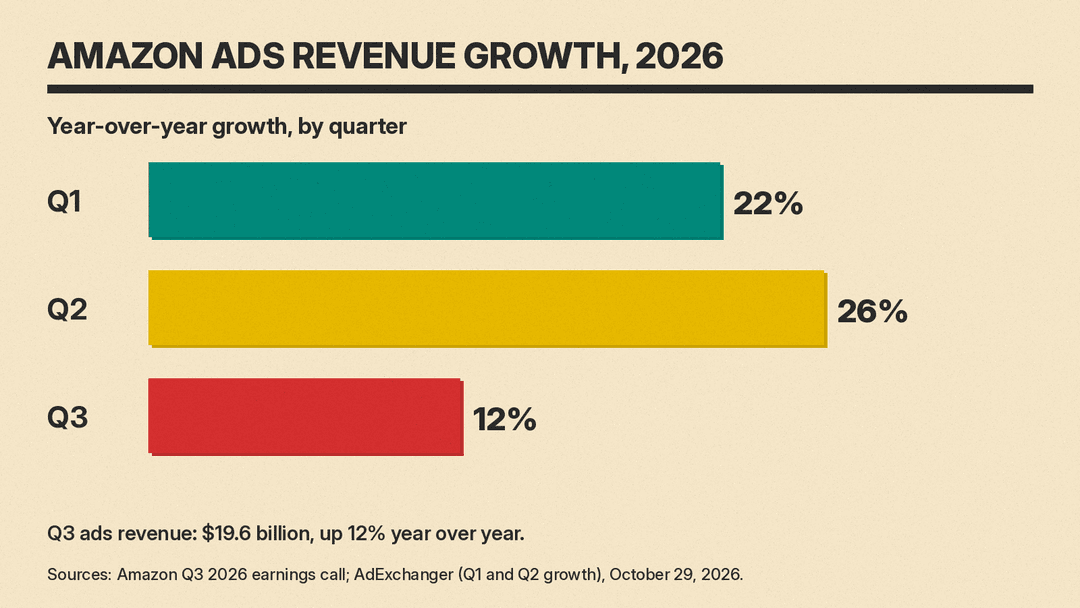
The ad numbers are the context. Amazon Ads revenue was $19.6 billion in Q3, up 12% year over year, according to the transcript. AdExchanger reports that ads grew 22% in Q1 and 26% in Q2, and that Jassy put the slower Q3 down to Prime Day moving from Q3 to Q2 and to no NBA games on Prime Video in the quarter. Jassy also said outside agents were not the cause of the weaker-than-expected ad results, Fortune reports.
The test Amazon helps decide
Here is my problem with the verdict. According to Fortune, Jassy's comments "came about a month after the e-commerce giant blocked Meta Platforms' popular new AI assistant, Muse, from accessing its online store." Fortune adds that Amazon said in September that Muse's access would violate the conditions of use its customers have agreed to. Our earlier explainer on why AI agents keep getting blocked lists Amazon among the companies that block outside automated shopping tools.
An outside agent that cannot reach Amazon's store will feel less useful for shopping. Fewer people will shop with it. Then the store can say, correctly, that few people shop that way. Jassy did not name Muse on the call, and he may well be right about the current product quality. But Amazon's own policy is one of the inputs to the low usage it describes, and the call did not account for that.
Amazon's own word choice also leaves the door open. Jassy said few customers shop this way "yet". AdExchanger read that as Jassy tacitly acknowledging that agentic shopping is likely to take root later, with "yet" being the key word.
Amazon is building the agent it wants you to use
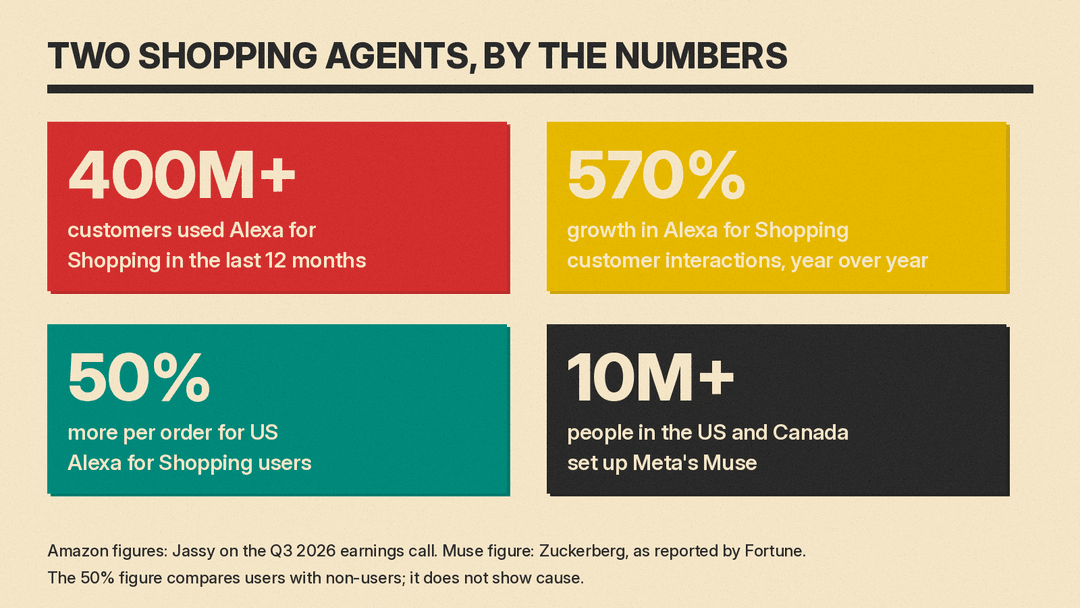
The numbers Amazon chose to share are about its own agent. Jassy said, per the transcript, that "Over 400 million customers have used Alexa for Shopping, our agentic shopping assistant, in the last 12 months, with customer interactions up 570% year-over-year." He added that "U.S. customers using Alexa for Shopping are spending 50% more per order than those who don't." Read it as a gap between users and non-users, not as proof of what the assistant itself adds to an order. We covered the assistant's latest features in Alexa for Shopping's 100+ new account actions.
The logic is easy to follow. An agent that Amazon runs keeps the shopper inside Amazon, next to Amazon's products and ads. Fortune puts the risk plainly: Muse "bypasses the usual process of humans visiting its website or app and seeing the advertisements that serve as a key profit driver for the company," per its report.
Who wins, for now
Amazon wins in the near term. It keeps the shopper, the ad slot and the checkout, and it gets to set the terms for any agent that wants in.
Meta is not standing still. Fortune reports that Meta signed up partners that welcome Muse, such as Shopify, Walmart and Best Buy, and that Mark Zuckerberg said more than 10 million people in the US and Canada had set up Muse since its release in early September. Zuckerberg also said shopping is the most common use case, with more than a quarter of people using the agent engaging in shopping and the average purchase size topping $200, per Fortune. His message to holdouts, as Fortune quotes it: "Obviously, not everyone wants to be an early adopter. That's fine," and "We'll work with folks on the terms that makes sense for them."
That reads to me like the opening of a negotiation, not a fight about quality. The retailers that let Muse in may get the most to learn from it, because they will see how agent shoppers actually behave. Shoppers lose a little in the meantime: an outside agent that cannot check Amazon cannot give a full price comparison across stores.
What Amazon should do
If Amazon believes outside agents are simply not good enough yet, it can prove it without much risk. It could publish the conditions an outside agent would need to meet to shop on Amazon: identification, rate limits, how ads are shown, and how orders are confirmed. Jassy already said Amazon anticipates "working with horizontal agents". Clear, public terms would turn that line into something agent makers can build toward, and would let Amazon's verdict on quality be tested on a level field.
Until then, "not great" is a fair description of a market Amazon is helping to keep small. For the business side of the quarter, see our report on AWS Q3 sales up 39%.
