
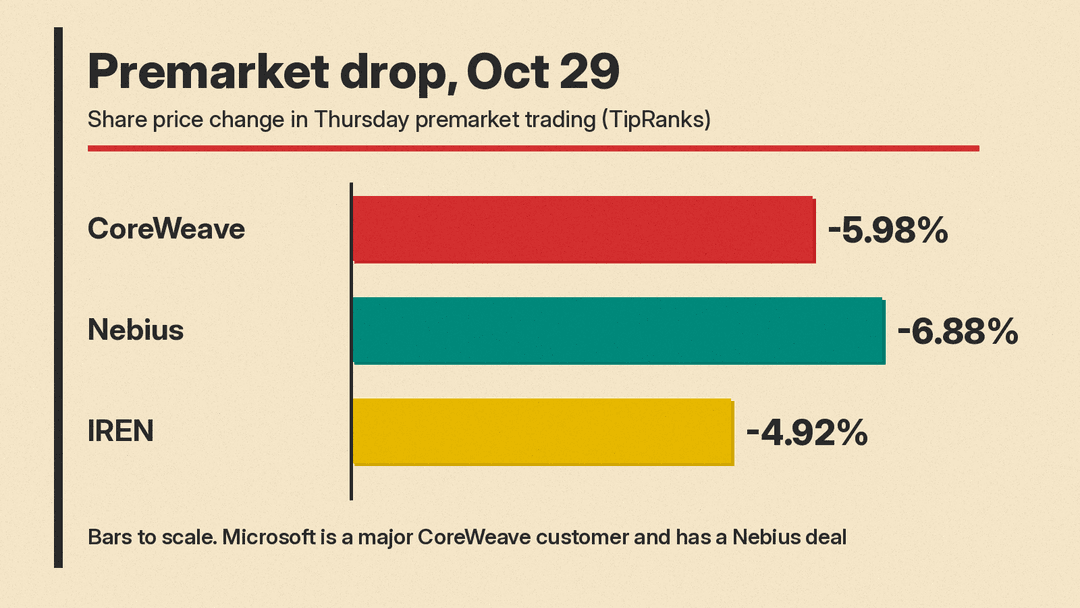
Shares of the big neocloud companies fell on Thursday after Microsoft said it spent less on data centers than planned because outside capacity arrived late. In early premarket trading on October 29, CoreWeave fell 5.98%, Nebius dropped 6.88% and IREN slid 4.92%, TipRanks reported. The slide had started after hours on Wednesday, when CoreWeave and Nebius slid almost 5% and IREN fell about 3%, according to GuruFocus on Yahoo Finance.
The losses narrowed for CoreWeave after the open. At 8:21 a.m. PT, CoreWeave was down about 1.2%, Nebius about 3.6% and IREN about 6.2% from Wednesday's close, according to Yahoo Finance quote data.
Neoclouds are newer cloud companies that rent out AI computing power. TipRanks noted that neocloud stocks depend on large tech firms to buy that computing capacity.
What Microsoft said
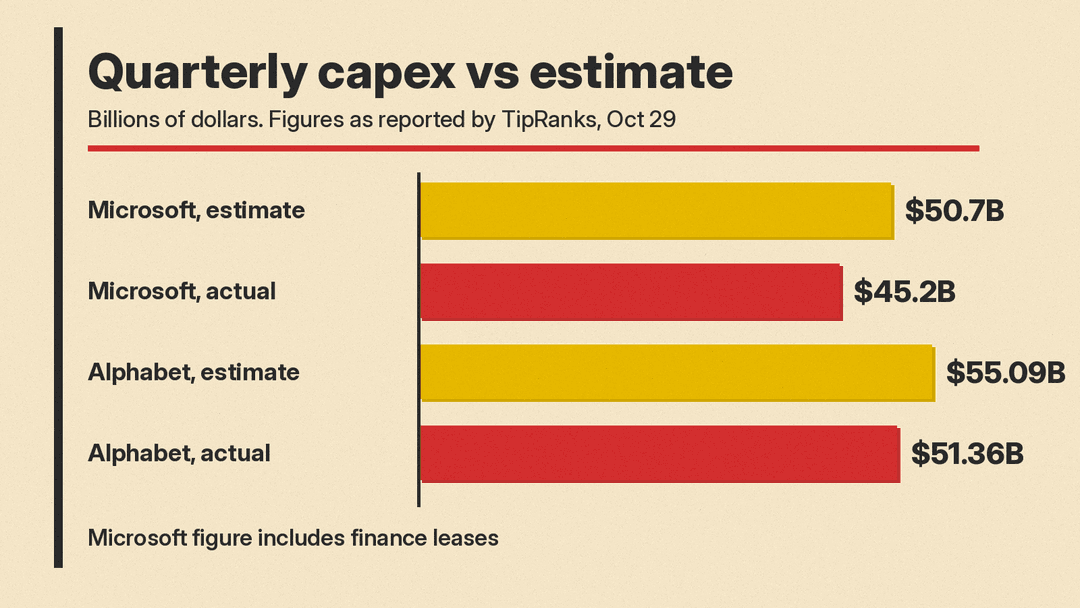
Microsoft reported $45.2 billion in capital expenditures and finance leases for its fiscal first quarter. That was up about 30% from a year earlier, but below the $50.7 billion average analyst estimate, according to StreetAccount figures cited by Invezz. TipRanks noted it also came in below Microsoft's own target of about $50 billion.
Chief Financial Officer Amy Hood gave the reason on the analyst call: "Capital expenditures were $45.2 billion as some third-party capacity deliveries we expected in Q1 were delayed," as quoted by Invezz.
"Third-party capacity" is the part that matters for this group of stocks. Microsoft is a major customer of CoreWeave and has a deal worth nearly $20 billion with Nebius for computing capacity through the 2030s, TipRanks reported. Microsoft did not say which suppliers' deliveries were late. Invezz noted that the timing of capacity deliveries matters for neocloud operators that invest heavily in infrastructure ahead of expected demand.
Microsoft expects the delayed spending to come later. It now expects calendar-year 2026 capex of about $170 billion, down from its prior view of $175 billion, and Hood said the delayed deliveries have shifted into the second half of the fiscal year, per TipRanks. Microsoft expects capex to top $50 billion next quarter. Azure revenue rose 48% year over year. Our Microsoft Q1 earnings story covers the full results.
Alphabet added to the worry
Alphabet reported third-quarter capex of $51.36 billion, below Wall Street's $55.09 billion estimate, TipRanks said. Two of the largest AI spenders coming in under forecasts in one night revived questions about the pace of the buildout and about when new data center capacity will be ready. We covered Alphabet's results in Alphabet Q3: Cloud Doubles, Free Cash Flow Negative Again.
Invezz said the results from both companies added to concerns about the financial sustainability of neocloud companies, whose expansion plans increasingly depend on debt and outside financing amid elevated borrowing costs.
Why neoclouds are the sensitive spot
Neoclouds buy chips and build data centers before those assets can earn revenue, which TipRanks said makes them sensitive to borrowing costs and to lenders' willingness to fund more growth. Yahoo Finance noted that rising interest rates have added to worries that future debt raises will cost too much.
Elon Musk added to the pressure over the weekend. He warned that more than 200 neocloud firms could fail or merge as lenders pull back from companies without substantial revenue outside AI data centers, TipRanks reported. Not everyone agrees with that view: earlier this week we covered General Compute's $100 million raise, which TechCrunch framed as countering the neocloud disaster narrative.
For now, TipRanks data still shows Moderate Buy consensus ratings for CoreWeave and Nebius and a Strong Buy for IREN.
Microsoft turns to the bond market
On the same morning, Microsoft started its first US high-grade bond sale since 2017, Bloomberg reported. It is seeking at least $25 billion, in as many as 10 tranches with maturities from two to 40 years, according to people familiar with the matter. The final size may change with demand, and Wells Fargo, JPMorgan and UBS are managing the sale, Reuters reported, citing Bloomberg, via The Globe and Mail.
Microsoft last sold high-grade debt in 2017, when it raised $17 billion, and the new deal is the first from a top-tier tech company since Alphabet sold $25 billion of debt on August 6, Bloomberg Línea reported. The preliminary prospectus lists general corporate purposes, including capital expenditures, and shows total debt of $35.481 billion as of September 30, 2026.
Why it matters
The quarter did not show Microsoft pulling back. It trimmed its calendar-year 2026 capex view only to about $170 billion from $175 billion, expects more than $50 billion next quarter, and Azure grew 48%. What it showed is that this quarter's spending was held back by late deliveries from outside partners. For a hyperscaler, a late delivery moves spending into a later quarter. For a neocloud that borrowed to build that capacity, a delay can push revenue later while its interest costs continue.
The next checks are Microsoft's second-quarter capex, which it says will top $50 billion, and whether the neoclouds confirm on their own earnings calls that the delayed capacity has been delivered.
Sources
- TipRanks: Why Are CoreWeave, Nebius, and IREN Stocks Tumbling in Pre-Market Today, Oct. 29?
- Yahoo Finance: Why CoreWeave and Nebius shares are sinking after Microsoft earnings
- Invezz: Why Nebius, CoreWeave and IREN stocks are falling after Microsoft's capex miss
- Bloomberg: Microsoft Kicks Off First US High-Grade Bond Sale Since 2017
- Bloomberg Línea: Microsoft busca recaudar al menos US$25.000 millones
- The Globe and Mail (Reuters): Microsoft plans to raise $25-billion in U.S. bond sale
- Microsoft preliminary prospectus supplement (StockTitan summary)
