
Amazon Web Services grew faster in the third quarter than at any point in nearly five years, and Amazon kept its plan to spend about $220 billion on capital projects in 2026. The two numbers tell the same story: demand for AI compute is pulling cloud revenue up, and Amazon is paying for the data centers, chips and power ahead of that revenue.
Investors focused on the cost side. CNBC reported that Amazon shares fell more than 7% in extended trading on Thursday, after earnings and revenue for the quarter came in below Wall Street expectations.
What Amazon reported
According to Amazon's third quarter release, for the quarter that ended September 30, 2026:
- AWS segment sales increased 39% year over year to $46.0 billion. Amazon puts the exact figure at 39.3% and calls it "its fastest growth in nearly five years."
- AWS now has a $184 billion annualized revenue run rate.
- AWS segment operating income was $17.8 billion, compared with $11.4 billion in the third quarter of 2025.
- Total net sales increased 12% to $201.9 billion, and operating income increased to $28.1 billion.
- Free cash flow was an outflow of $42.4 billion for the trailing twelve months, compared with an inflow of $14.8 billion a year earlier.
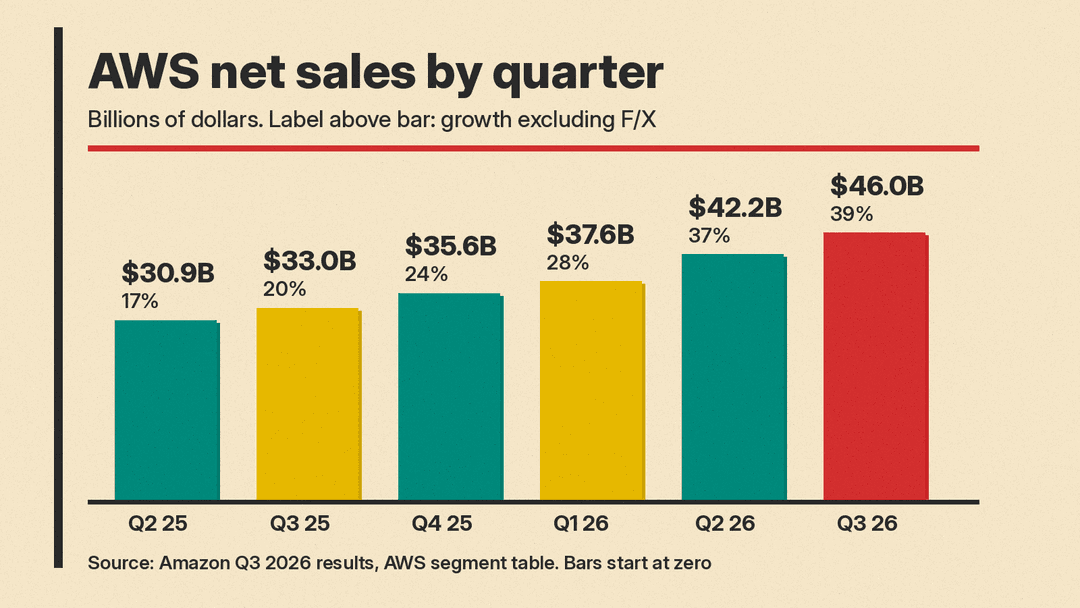
The AWS segment table in the release shows a steady climb. Growth excluding foreign exchange went from 17% in the second quarter of 2025 to 20%, 24%, 28%, 37% and now 39%. In dollars, quarterly AWS sales rose from $33.0 billion a year ago to $46.0 billion.
Andy Jassy, Amazon's president and CEO, tied the growth to spending. "Our AWS investment in functionality and infrastructure is working, with over 39% year-over-year revenue growth in Q3 ($184 billion revenue run rate) and projected revenue growth rates of over 40% both in 2027 and in 2028," he said in the release.
The spending side
The cash flow statement shows how much Amazon is putting into the ground. Purchases of property and equipment were $77.3 billion in the third quarter, compared with $35.1 billion in the same quarter of 2025. Amazon says the trailing twelve month free cash flow outflow was "driven primarily by a year-over-year increase of $94.8 billion in purchases of property and equipment, net of proceeds from sales and incentives," and that "this increase primarily reflects investments in artificial intelligence."
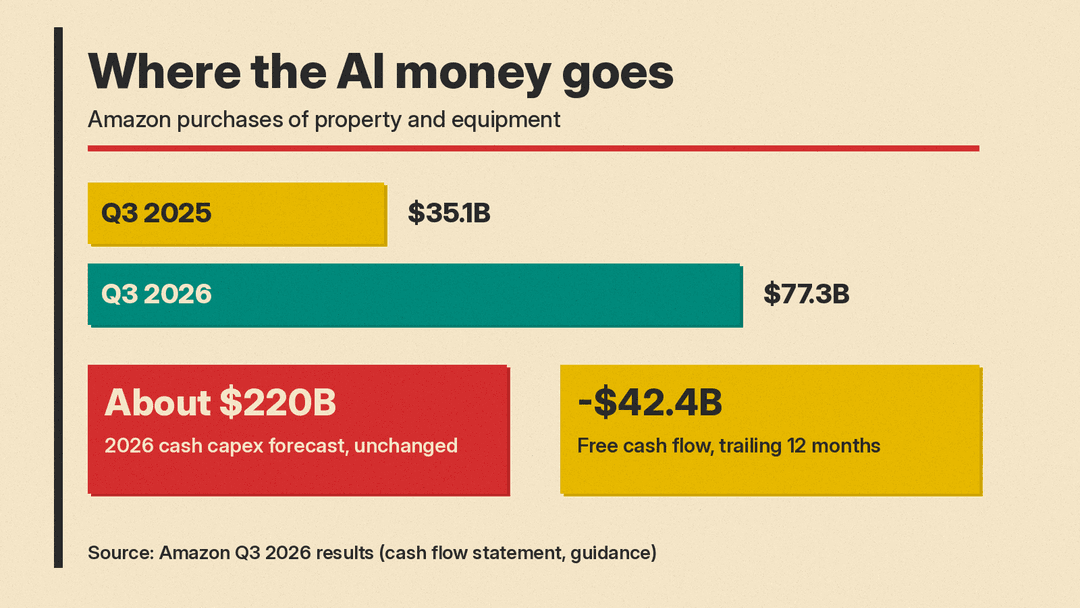
In its guidance, Amazon said: "We continue to expect 2026 cash capital expenditures to be approximately $220 billion." That is above the plan Jassy gave in February, when Amazon's fourth quarter 2025 release said the company expected "to invest about $200 billion in capital expenditures across Amazon in 2026." The first and second quarter releases gave no capex forecast, so the releases alone do not show when the plan reached $220 billion.
CNBC put the number next to its peers. Earlier this week, it reported, Microsoft lowered its capex forecast for the year to $170 billion from $175 billion, while Alphabet kept its guidance at $195 billion to $205 billion. CNBC also said signs have begun to emerge that the hyperscaler capex splurge is moderating. Amazon, at about $220 billion, is not cutting.
The release's forward-looking statements list "resource and supply volatility, including for memory chips" among the factors that could affect results. That line is not new: it also appears in Amazon's February, April and July 2026 releases. Memory is already tight. As llms.blog reported, Samsung says its high bandwidth memory supply for 2027 is already sold out.
Chips, customers and data center towns
Amazon gave fewer chip numbers this quarter than in February. The Q3 release says only that Amazon "made it even easier to adopt its custom AI accelerator, Trainium, with TorchNeuron," which "lets developers run existing PyTorch code (which most already use) on Trainium without rewriting a thing." The pitch is that teams can move existing PyTorch work to Amazon's own chip without a code rewrite, which could make it easier to try an alternative to GPUs. Our TorchNeuron explainer covers what the beta does not do yet.
For the last full chip update, the February release said Trainium and Graviton had "a combined annual revenue run rate of over $10 billion," that Trainium2 was "fully subscribed with 1.4 million chips landed," and that Trainium4 "is expected to start delivering in 2027." Amazon did not update those figures in the Q3 release.
On demand, the release says AWS signed new agreements with Meta, NVIDIA, OpenAI, Salesforce, Oracle, Qualcomm and others. It says Fortune 500 companies spent nearly 7x more on Bedrock, AWS's inference service, year over year, and total Bedrock token volume grew nearly 17x. In February, Amazon said Trainium2 "powers the majority of inference on Bedrock."
Amazon also introduced Built Together, "a new $1 billion community investment in U.S. data center communities." The release says it covers community college and trades training, energy and water efficiency upgrades, and flexible funding for local needs such as roads and fire equipment. It is aimed at the towns that host Amazon's data centers.
Why it matters
Amazon's results show both halves of the AI infrastructure trade in one report. AWS revenue is accelerating, and Jassy projects growth above 40% in 2027 and 2028. But Amazon has now posted negative trailing free cash flow, and its capex plan is larger than Microsoft's and Alphabet's latest forecasts. For chip and memory suppliers, an unchanged $220 billion plan means one of the largest buyers is not slowing down. For investors, the after-hours drop shows how much of that spending they still need to see paid back.
