
Microsoft's Azure revenue rose 48% (also 48% in constant currency) to $33.2 billion in the quarter ended Sept. 30, 2026. Total revenue rose 19% to $92.3 billion, and capital expenditures including finance leases came to $45.2 billion. On the call, CFO Amy Hood said Microsoft expects Azure growth of 49% to 50% in constant currency in the December quarter and capex of over $50 billion. The stock rose about 4% in extended trading on Oct. 28 and was still higher before the bell on Oct. 29.
Figures come from the 8-K Exhibit 99.1 release, the 10-Q and the call transcript on Microsoft Investor Relations. It was the first quarter of fiscal 2027.
The headline numbers
- Revenue: $92.3 billion, up 19% (19% in constant currency).
- Operating income: $45.9 billion, up 21% (22% in constant currency).
- Net income: $36.6 billion, up 32% on a GAAP basis. Excluding the impact from investments in OpenAI, net income was $36.4 billion, up 18%.
- Diluted earnings per share: $4.92 GAAP, up 32%, and $4.89 non-GAAP, up 18%.
- Microsoft Cloud revenue: $63.9 billion, up 30% (31% in constant currency).
- Commercial remaining performance obligation: $677 billion, up 73%.
The GAAP and non-GAAP gap comes from OpenAI accounting: per the release, net gains from investments in OpenAI added $207 million to net income this quarter, while net losses cut net income by $3.1 billion in the same quarter a year earlier. The 10-Q also shows $10.0 billion of revenue from commercial arrangements with OpenAI, covered in Microsoft Made $10B From OpenAI Last Quarter.
Azure and the new segments
The release no longer has an Intelligent Cloud line. Microsoft now reports two segments, announced in September 2026, with prior periods recast:
- Agents and Infra: revenue of $76.8 billion, up 25%, and operating income of $40.6 billion, up from $32.7 billion.
- Devices and Consumer: revenue of $15.5 billion, down 3%. Windows OEM and devices revenue fell 22%.
The release gives Azure revenue as $33.165 billion, up from $22.384 billion. Hood said Azure was "driven by Foundry and improved CPU monetization", and that Foundry revenue more than tripled from a year earlier.
A separate 8-K filed the same day says Microsoft updated its Azure growth metric "for the movement of certain components." So the 48% does not line up directly with the "Azure and other cloud services" growth in earlier releases: 39%, 40% and 43% for the December, March and June quarters.
Capex and AI capacity
Hood said capital expenditures were $45.2 billion, "as some third-party capacity deliveries we expected in Q1 were delayed." Finance leases accounted for $7.4 billion of that, and cash paid for property and equipment was $39.4 billion. She said roughly three quarters of the spending went to short-lived assets, "primarily CPUs and GPUs, including higher memory and storage costs."
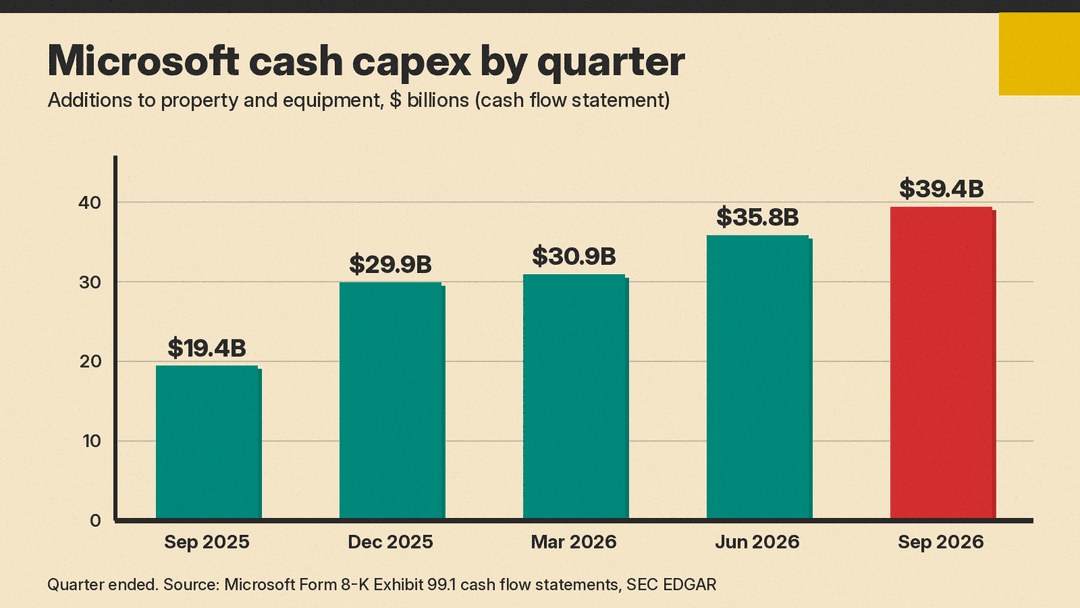
On the cash flow statement, additions to property and equipment were $39.4 billion, roughly double the $19.4 billion of a year earlier. Net cash from operations was $58.0 billion, up 29%. Hood put free cash flow at $18.6 billion, "reflecting higher capital expenditures". Net cash from operations minus additions to property and equipment gives about $25.7 billion a year earlier, so free cash flow fell about 27% and stayed positive. By contrast, Alphabet reported negative free cash flow for a second straight quarter, and Meta reported negative free cash flow of $2.1 billion for its September quarter.
CEO Satya Nadella said Microsoft added 24 new data centers across five continents in the quarter, cut dock-to-live times for new GB300s in its biggest regions by about 20% from the prior quarter, and has docked its first Nvidia Vera Rubin GPUs.
Guidance for the December quarter
On the call, Hood said Microsoft expects:
- Total revenue of $96 billion to $97.1 billion, or growth of 18% to 19%.
- Agents and Infra revenue of $80.1 billion to $80.7 billion, and Devices and Consumer revenue of $15.9 billion to $16.4 billion.
- Azure revenue growth of 49% to 50% in constant currency. She said continued efficiency gains across the CPU and GPU fleet should help offset some third-party GPU-as-a-service contracts that were delayed to the second half of the fiscal year. "Customer demand continues to exceed available supply," she said.
- Microsoft Cloud gross margin of roughly 65%, and operating margins down slightly from a year earlier.
- Capex of over $50 billion in the quarter and approximately $170 billion for calendar 2026, a figure she tied to the third-party capacity delays, with spending she currently expects to accelerate in the second half of the fiscal year.
Hood added that Microsoft expects "to continue to remain free cash flow positive in FY27."
The stock move
- After hours, Oct. 28 (after the 4:00 p.m. ET / 1:00 p.m. PT close): shares rose 4% in extended trading, CNBC reported.
- Premarket, Oct. 29, 5:50 a.m. ET / 2:50 a.m. PT: shares were up 3.47% at $549.44, Benzinga reported, citing Benzinga Pro data.
- Premarket, Oct. 29, as of 8:43 a.m. ET / 5:43 a.m. PT: Microsoft was "nearly 4% higher but pared some of those gains," CNBC reported.
Why it matters
Azure grew 48% and free cash flow stayed positive while cash capex doubled. For the December quarter, Microsoft expects faster Azure growth and capex above $50 billion. Hood described supply, including delayed third-party capacity, as the limit, with demand still above it.
The buildout also shows up in national data. On Oct. 29, the BEA reported that U.S. GDP grew at a 3.4% annual rate in the third quarter, and the AP reported that investment in information processing equipment rose 37.4%, which it tied to an AI investment boom. See our post on Q3 GDP and AI investment.
Sources
- Microsoft Form 8-K, Exhibit 99.1, earnings release (SEC EDGAR)
- Microsoft Form 10-Q for the quarter ended Sept. 30, 2026 (SEC EDGAR)
- Microsoft Form 8-K with recast segment information, Oct. 28, 2026 (SEC EDGAR)
- Microsoft Investor Relations, FY27 Q1 press release and webcast
- Microsoft Investor Relations, FY27 Q1 earnings call transcript
- Microsoft Form 8-K Exhibit 99.1, Dec. 2025 quarter (SEC EDGAR)
- Microsoft Form 8-K Exhibit 99.1, March 2026 quarter (SEC EDGAR)
- Microsoft Form 8-K Exhibit 99.1, June 2026 quarter (SEC EDGAR)
- CNBC: Microsoft stock jumps 4% as cloud growth drives earnings and revenue beat
- CNBC: Alphabet falls 11% in premarket
- Benzinga: Why Is Microsoft Stock Gaining Thursday?
