
Rokid, which sells display-equipped AI glasses, launched three wearables at its Rokid Jungle 2026 event in Hangzhou on October 27: Rokid Glasses 2, a full-color pair called Rokid Color, and a control ring called Rokid Ring. The headline for everyday users is not a new chatbot. It is that the glasses are getting more comfortable, last longer, and now act as a remote control for AI agents that do work on your phone and computer.
The launch and prices are for China. The figures below come from Chinese tech press reports from the event, mainly TMTPost, IT Home and Zhidx.
What Rokid launched
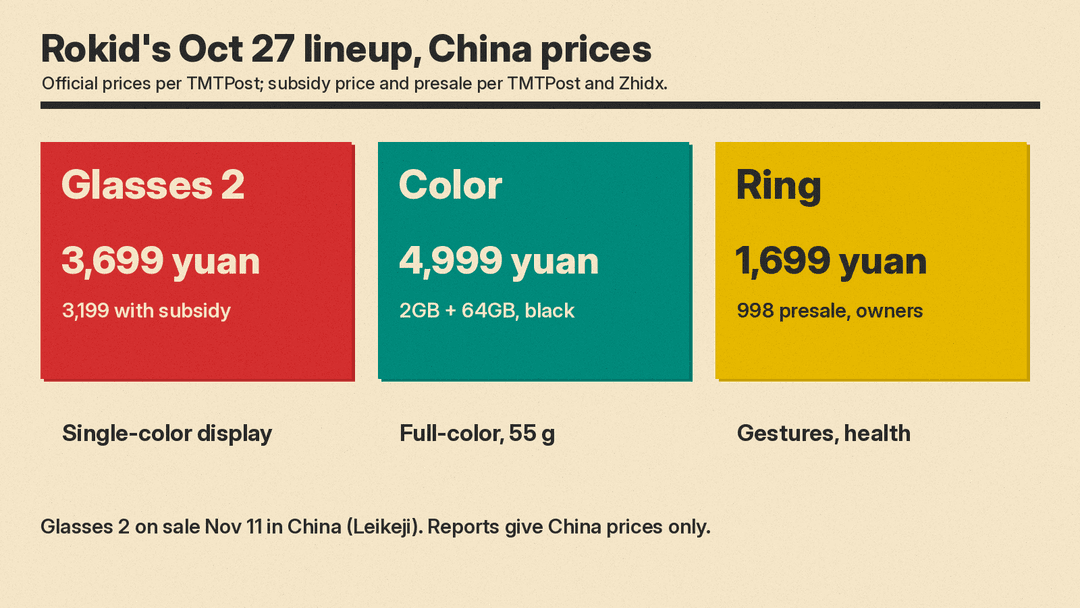
- Rokid Glasses 2. The second-generation everyday AI glasses, with a single-color display per Leikeji. Official price is 3,699 yuan for black and 3,849 yuan for tortoiseshell. With China's national device subsidy, the price drops to 3,199 yuan and 3,349 yuan, per TMTPost.
- Rokid Color. Rokid's first full-color AI glasses. TMTPost lists 4,999 yuan for a black 2GB plus 64GB model and 5,499 yuan for a tortoiseshell 4GB plus 64GB model. It weighs 55 grams without nose pads.
- Rokid Ring. A ring that controls the glasses with small finger gestures. Official price is 1,699 yuan. Zhidx reports a 998 yuan presale price for people who already bought Rokid glasses and kept them.
Tech site Leikeji reports that Rokid Glasses 2 presales are open and that the glasses go on sale November 11. None of the reports gave prices or dates outside China. All prices and dates here are as of October 27, 2026; subsidy and presale prices can change.
The AI features on Rokid Glasses 2
Rokid describes its assistant as faster to wake, better at understanding what you mean, and able to keep long-term memory and give reminders without being asked. The specific features listed at the launch are:
- AI meeting notes. The glasses record audio and use what the camera sees to produce a summary and a to-do list. It handles meetings that mix languages, according to Zhidx.
- Call translation. Real-time translation in 89 languages during WeChat calls, Feishu meetings and Teams calls, with two-way voice cloning, per TMTPost.
- Recall. An "instant recall" and an "all-day recall" mode search past conversations, events and photos, and can build an editable log of your day.
- Custom wake word and shortcuts. You can rename the assistant's wake word, set shortcut commands, and trigger a preset action by tilting your head up.
- Accessibility. For people who are hard of hearing, the glasses separate speakers, caption and summarize. For people who are blind or have low vision, Rokid is working with JD.com's research institute on obstacle alerts, object finding and spoken feedback. TMTPost describes this part as exploratory.
Not everything is ready on day one. A hands-on report summarized by AI News Feed, citing ifanr, says call translation and all-day recall arrive in later over-the-air updates.
Glasses as a remote for AI agents
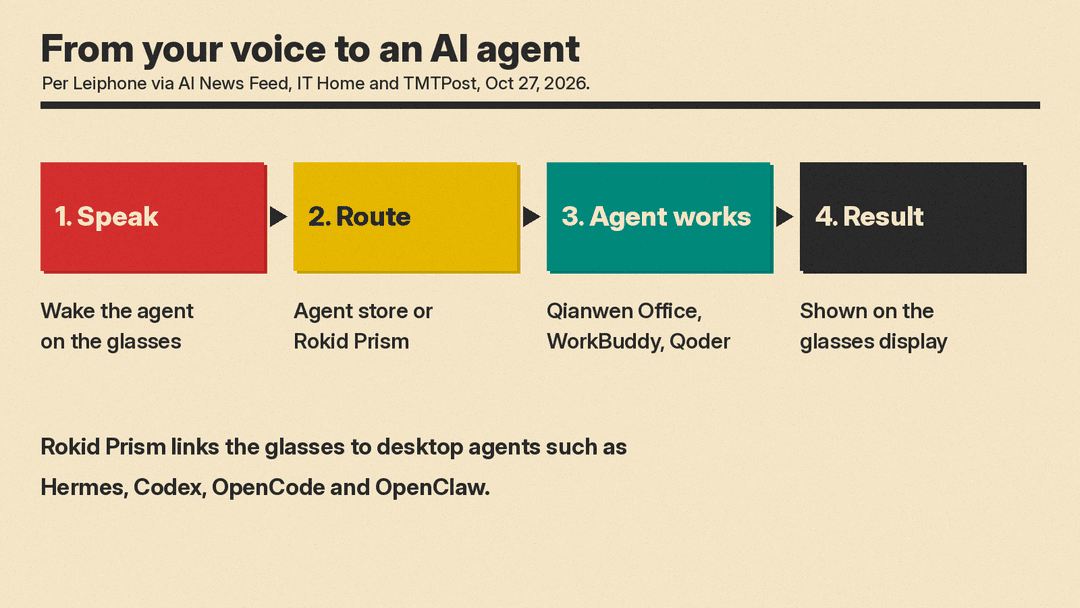
The bigger shift is what Rokid calls its agent store. Instead of one built-in assistant, you add third-party AI agents from the Rokid AI app and call them by voice.
- Qianwen Office, added from the agent store, runs research tasks and DingTalk actions such as sending messages, creating schedules and organizing documents. Results appear on the glasses, per Leiphone's report as summarized by AI News Feed.
- WorkBuddy, from Tencent, is billed as the first office agent for AI glasses. Zhidx says it can sort data, look things up and write weekly reports.
- Qoder, Alibaba's coding tool per IT Home. TMTPost says Rokid and Qoder are exploring ways to start AI coding tasks from the glasses.
- Lifestyle services include Xiaohongshu for finding shops and products, and Meituan for scanning a code to open a food delivery locker.
Rokid also announced Rokid Prism, a connector that links the glasses to desktop AI agents on your computer. IT Home lists Hermes, Codex, OpenCode, OpenClaw, Qoder and WorkBuddy as supported tools. In practice, you speak to the glasses, and an agent running on your desktop does the task.
Rokid said at the event that its platform has more than 45,000 registered developers and more than 700 agents listed in its store, per TMTPost. Zhidx reported more than 47,000 registered developers from the same event.
Hardware changes
Rokid said it focused on comfort in response to feedback on the first model. TMTPost and Zhidx report these changes:
- Battery capacity of 263mAh, 25% more than the first generation. Zhidx says the temples are also about a third thinner. Leikeji, which tested a black pair before launch, says Glasses 2 weighs more than the first generation, partly because of the bigger battery. None of the four reports gives its weight in grams.
- A second-generation charging case with two charging capsules, 2,170mAh in total per Zhidx. Rokid says a full case and capsules charge the glasses six times, and that the new capsule charges from 0 to 90% in 30 minutes. IT Home lists the charging capsule kit at 599 yuan.
- 70% less reflection and 60% less rainbow glare on the lenses than the first generation.
- Four microphones plus a bone conduction microphone, and Dolby-certified speakers.
- A 12-megapixel camera with 4K video at 30 frames per second and 2K at 60.
- A dual-chip design: Qualcomm's Snapdragon AR1+ Gen 1 and a Bestechnic chip, with Android and a real-time OS that split work by task to balance performance and power use, per TMTPost. TMTPost and IT Home name the Bestechnic chip BES2800BP; Zhidx calls it BES2900BP, a 6nm part.
- Magnetic prescription inserts and clip-on sunglasses.
Rokid Color uses a custom Micro-LED full-color projector from JBD that Rokid says is 0.16 cubic centimeters, about the size of a mung bean. Full color lets the glasses show photos, video and colored navigation signs. The Rokid Ring adds swipe and tap gestures for moments when you cannot speak out loud, and tracks heart rate, temperature, blood oxygen and sleep.
Rokid is not the only maker moving to color. Zhidx noted that RayNeo also showed new full-color AI glasses on the morning of October 27, without a price. Our earlier post covers RayNeo's iO glasses. Also on October 27, Brilliant Labs launched Halo, a pair of glasses with a full-color microOLED display, which our Halo explainer covers.
Why it matters
Rokid is betting on an app-store model where the glasses are a screen and microphone for many agents, including ones that run on your own computer. Rokid founder and CEO Misa (Zhu Mingming) called it a real "iPhone moment" for smart glasses, Zhidx reported. That is the company's view, not an independent finding.
Rokid also cited outside data on its position. It said Nielsen ranks it first in China's AI glasses market by unit share for three straight quarters through Q1 2026, and that Counterpoint Research ranks it first worldwide among AI glasses with displays in the first half of 2026, per Zhidx. Those rankings come from the launch event and we have not seen the underlying reports.
For readers outside China, the practical points are simple. These prices are in yuan, and the lower Glasses 2 prices depend on China's national subsidy. Many of the agent integrations, such as DingTalk, Meituan and Xiaohongshu, are Chinese services. Check for an international version and price before planning a purchase.
