
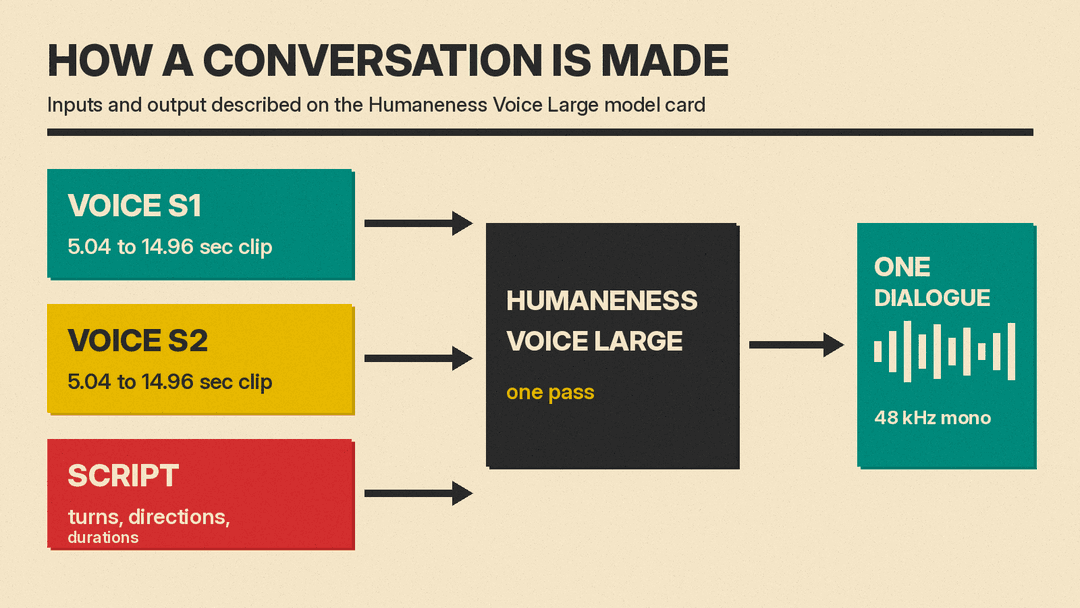
LAION has posted Humaneness Voice Large, NotebookLM Edition on Hugging Face, an open-weight text-to-speech model built for one job: turning a written two-person script into a podcast-style conversation. You give it the dialogue and two short voice recordings, and it returns the whole exchange as one audio file. The model card says it "produces the entire requested exchange as one acoustic sequence" and that "it is not a pipeline that separately synthesizes each turn and joins files."
Hugging Face lists the repository as created on November 2, 2026 (Pacific time). The weights are under CC BY 4.0, and LAION labels the release experimental.
What it does
Google's NotebookLM (renamed Gemini Notebook in July 2026) is, in the words of the dataset card behind this model, a tool "that can generate podcast-style audio discussions from source material." LAION fine-tuned this model on episodes of that kind (details below). You write a script in which speaker S1 and speaker S2 take turns, add delivery notes, and supply one clean voice sample for each speaker. If you are new to how this works, our explainer on AI voice cloning covers the basics of copying a voice from a short sample.
According to the card and its prompting guide:
- Each voice reference must be 5.04 to 14.96 seconds long, preferably 6 to 12 seconds, with "no music, clipping or competing speaker."
- The script is a JSON file. Each turn has a speaker label, the words, a target length in seconds and a delivery direction such as "warm, curious, conversational." Directions stay in English; the spoken words stay in their own language.
- You can pass up to 60 seconds of earlier conversation as context, which the guide suggests for longer sessions: keep recent output and request the next part.
- Output is 48 kHz mono audio.
The card warns that requested durations and speaker switches "are learned instructions, not hard constraints or forced waveform edits." It suggests starting with two short turns before trying longer dialogues.
How it was built
The model starts from LAION's earlier Humaneness Voice Large 1.3 Alpha. LAION then ran a three-epoch full fine-tune on filtered two-speaker podcasts, followed by a small rank-64 "quality-ladder" fine-tune that is already merged into the released weights. The card tells users not to apply the included adapter a second time.
The training notes say that quality-ladder set has 732 unique examples in English, German, French and Spanish, about 2.97 hours of target audio including repetitions, and warn against describing it as 50 to 100 hours of unique training audio.
The podcast data is listed in the release's notice file as the NotebookLM Podcasts dataset. That dataset card describes 8,223 podcast episodes totaling 2,411.5 hours, gathered from publicly available podcasts and feeds. It says the collection "contains AI-generated audio; some episodes also contain human introductions or editing," and that "not every recording has been independently listened to." It lists its license as Public Domain.
Under the hood, the card describes a 36-layer Qwen3-family transformer with a one-layer acoustic transformer, with audio decoded by the separately licensed MOSS Audio Tokenizer v2. Hugging Face's file metadata lists 4,129,990,144 parameters in BF16.
Language quality varies a lot
LAION is direct about weak spots. The card's language advice: "English and German are the strongest new-text conditions in this study. Spanish is mixed." French "should be treated as an unreliable stress condition, not reliable French support." Dutch was in the first fine-tune but "Dutch performance is not advertised."
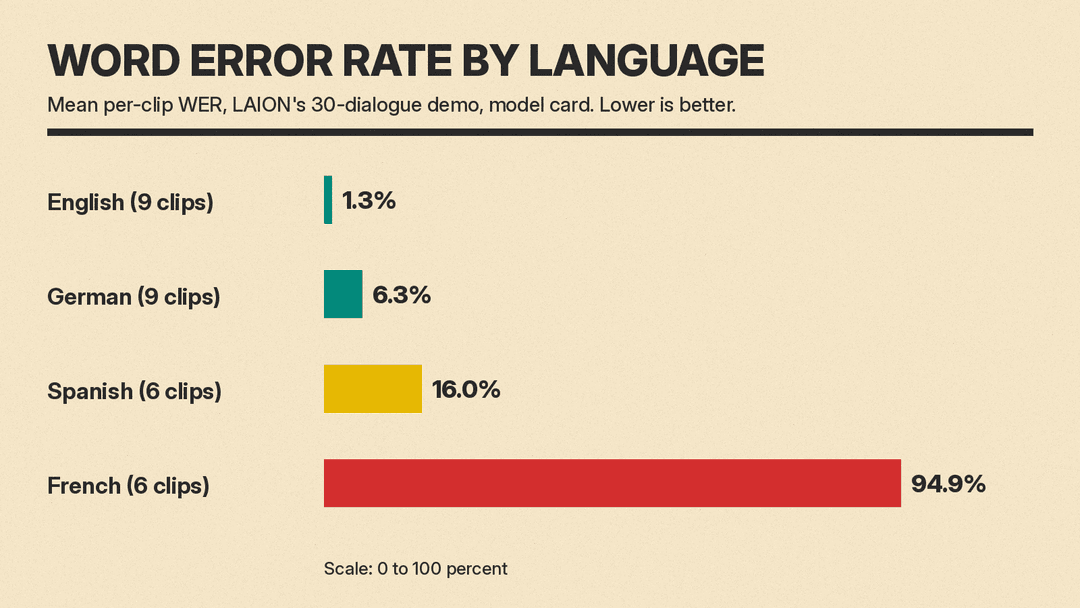
In LAION's demo set of 30 dialogues, the card reports these mean word error rates, measured by running speech recognition on the output (lower is better):
- English (9 clips): 1.3%
- German (9 clips): 6.3%
- Spanish (6 clips): 16.0%
- French (6 clips): 94.9%
The card calls these "model/ASR estimates" and says the demo uses training-domain voices, so "it is a demonstration, not a held-out-speaker benchmark." It also says the metrics "do not measure speaker-switch correctness," and tells users to listen to each transition.
A notice at the top of the card adds that the model "currently suffers from insufficient filtering of its training data, including unreliable language labels and uneven audio quality," so "output quality, pronunciation and language accuracy can therefore vary substantially."
What you need to run it
This is not a web app. The card asks for "a CUDA GPU with sufficient memory," PyTorch and Python 3.11 or newer, and says CPU-only inference is "not validated here." The pages we read do not state a minimum GPU memory figure. Setup is a download, a pip install and one Python command that points at the dialogue file and the two reference recordings. The custom code needs trust_remote_code, and the card says to "inspect the supplied code before running it."
LAION hosts a listening page with 30 generated dialogues next to their original voice references, so you can judge the output before downloading about 4 billion parameters of weights.
License and allowed use
The fine-tuned weights are CC BY 4.0, which lets you share and adapt the work "for any purpose, even commercially" as long as you give credit. The card notes that "upstream code, tokenizer assets, the external codec, and source recordings retain their own terms," so check those separately. LAION lists "research and authorized dataset augmentation" as recommended uses and says: "Use only voices for which you have appropriate permission; do not use the model for deceptive impersonation." It also asks users to test quality and speaker stability "before any production use."
Why it matters
This release puts a whole-conversation podcast model with downloadable weights and a CC BY 4.0 license in public, with detailed notes on where it fails. For creators, the practical read is narrow for now: English and German score best in LAION's own demo, other languages need care, and you need a GPU and some comfort with Python. For a different open-weight voice model, see our coverage of Fish Audio Drama 3. If you want a no-code route to the same kind of output, see our guide to turning a blog post or script into an AI podcast, and for hosted voices, our roundup of AI voice generators for text to speech.
