
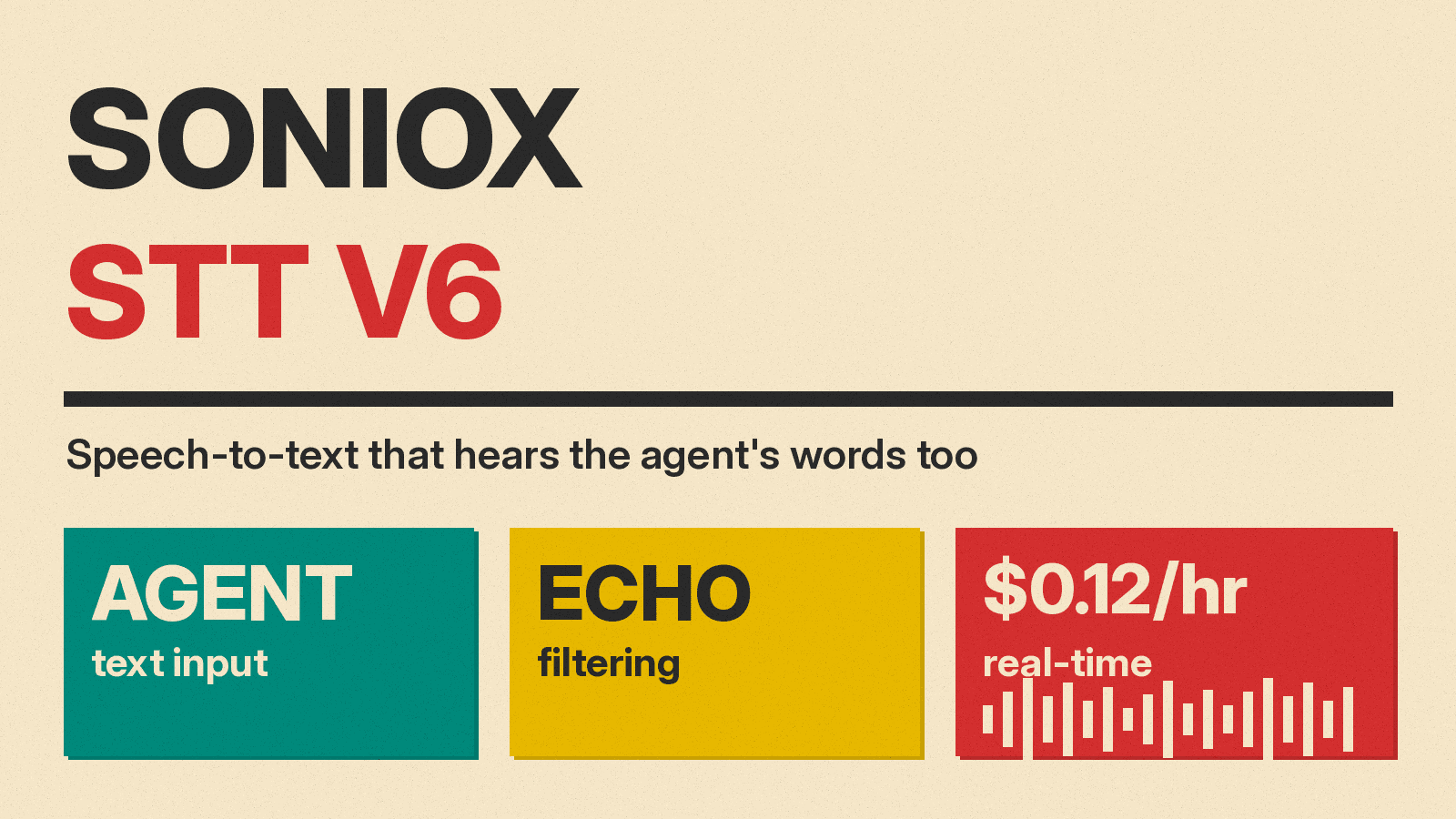
Soniox has released STT v6, the next generation of its speech-to-text API. The headline change is aimed at voice agents: the model can now be told what the agent is saying, so it can better recognize the caller's reply and ignore the agent's own voice if it leaks into the microphone. Soniox announced the release on November 3, 2026.
A voice agent is a phone or app assistant that listens, thinks and answers out loud. Speech-to-text, or STT, is the part that turns the caller's audio into text. Soniox says its new model is "the world's first speech recognition model that knows what your voice agent is saying." That is the company's own claim, and a note on it appears below.
What changed in v6
Soniox lists two connected features, both on the real-time model stt-rt-v6:
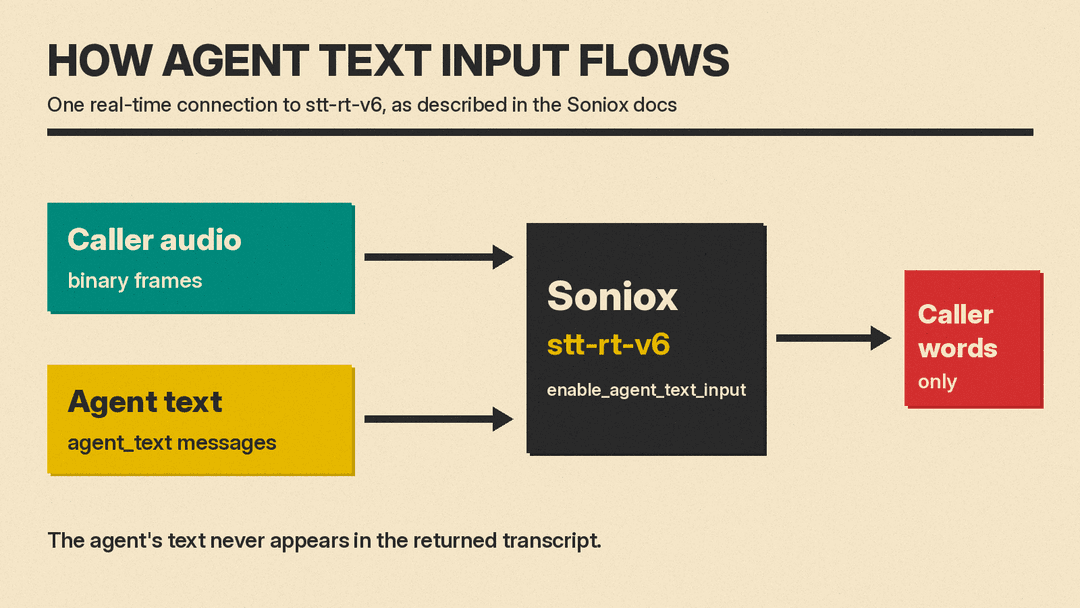
- Agent text input. Your app sends the words the agent is about to speak to Soniox on the same connection as the caller's audio, so the model hears both sides of the conversation.
- Agent voice echo cancellation. With agent text input on, the model tells the agent's voice apart from the user's and filters it out of the transcript, while it keeps listening if the user interrupts.
Soniox also says v6 is "significantly" more accurate across 60+ languages, and that it improves voice typing, meeting transcription, speaker diarization (labeling who spoke), language identification, endpoint detection (deciding when a speaker has finished) and real-time translation. The announcement page, as read on November 4, gives no accuracy numbers for v6.
Why agent text helps
According to the agent text input docs, a speech model in a voice agent normally hears only the user, so it never hears the question the user is answering. Short replies suffer most, because a word or two gives the model little to go on.
The docs give examples. Without the question, "River Roast" can become "River Road," and "a tow" can become "a tour." If the model knows the agent just asked which cafe the caller wants, or what kind of help they need, those replies are easier to get right.
Turning it on takes one flag in the start request, enable_agent_text_input, set to true. The agent's text then travels as small agent_text messages, and each agent turn ends with end_of_segment set to true. The agent's text never appears in the returned transcript.
Timing is the part developers have to get right. The messages carry no timestamps, so the model places each piece where it arrives in the audio stream. The docs say to send each piece about 500 milliseconds to 1 second before the user hears it, following playback rather than the language model or the text-to-speech engine, both of which run faster than real time. If the user interrupts, you send any text already played, mark the segment as ended and drop the rest.
The echo problem
Soniox's announcement describes the failure it wants to prevent: an agent's voice is picked up by the microphone, the recognizer mistakes it for the user, and the agent interrupts itself or answers its own words. The docs say echo cancellation is never perfect and parts of the agent's voice often leak in, especially when it starts talking.
Soniox is clear that this does not replace normal acoustic echo cancellation. Its docs say to keep that on, and that agent text input handles what it leaves behind.
Price and migration
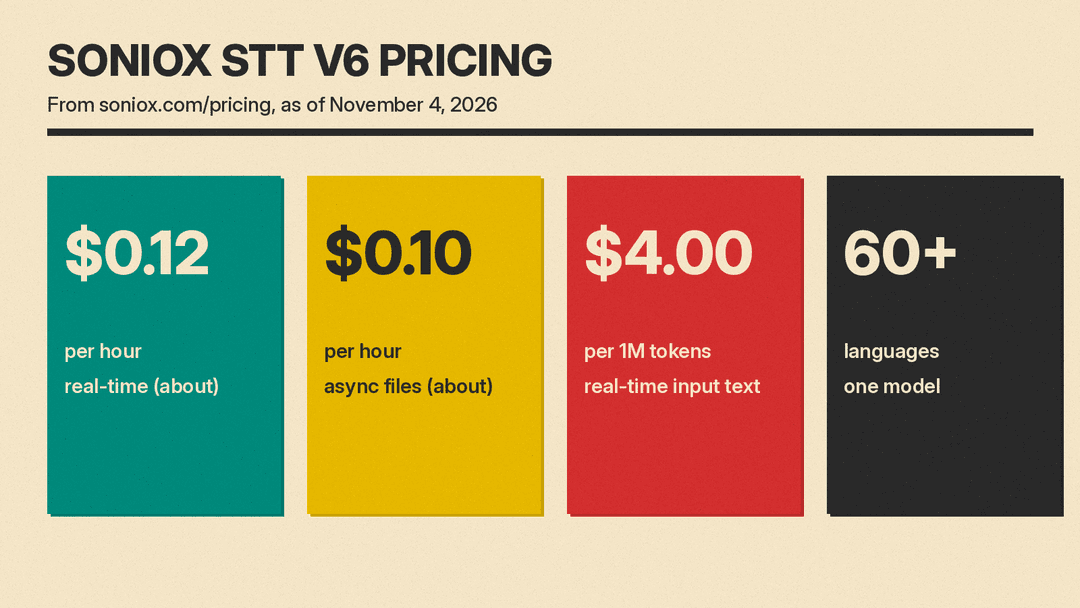
Soniox's pricing page lists speech-to-text at about $0.12 per hour for real-time streaming and about $0.10 per hour for async file transcription, as of November 4, 2026. Billing is by token: real-time input audio is $2.00 per 1M tokens, and input text, including the agent text, is $4.00 per 1M tokens. The page says diarization, language identification and smart formatting are included in the hourly rate.
The same page compares its price with rivals. It lists about $0.54 per hour for Google's gemini-3.5-transcribe-live and about $1.00 per hour for Azure Speech. Those are Soniox's own comparisons, so check each vendor's current page before you budget.
Moving from v5 is a model-name swap, according to the model docs: use stt-rt-v6 for real-time or stt-async-v6 for files. The v5 models are deprecated and will be removed on December 15, 2026. After that date, requests to v5 route to v6 automatically.
What to check before switching
The docs list one formatting change that can break downstream code. v6 writes prices closer to how they are spoken, so "15 dollars and 20 cents" is written out as words rather than "$15.20." Hyphens in codes and IDs appear only when they are spoken. If your app parses amounts or serial numbers from transcripts, test those paths first.
Agent text input is available on the real-time model, not the async one. It also gives no help to the user's first words, before the agent has said anything. For that, the docs point to the context feature, where you supply names and terms from your business.
What is still unproven
There are no v6 accuracy or latency figures from Soniox yet. MarkTechPost's write-up says Soniox's benchmarks page still reports v5 on the open-source Pipecat STT benchmark, where it lists stt-rt-v5 at 1.34% semantic word error rate and a 260 ms median time to final segment. MarkTechPost notes that v6 has not been benchmarked and found no independent v6 results.
MarkTechPost also qualifies the "first" claim. It says AssemblyAI shipped agent context in Universal-3.5 Pro Realtime in July 2026, which also feeds the agent's replies into streaming STT. In its reading, the clearer difference is the echo filtering, since AssemblyAI's context docs describe no such filtering.
For anyone building a voice agent, the clearest check is a side-by-side test on your own call audio, with agent text input on and off. The docs stress timing, so include a case where the caller interrupts. For related reading, see how Phonic-1 handles actions mid-sentence and why Deepgram bought Daily and set up a Pipecat foundation.
Sources
- Introducing Soniox STT v6, Soniox, November 3, 2026
- Soniox speech-to-text models, Soniox docs
- Agent text input, Soniox docs
- Soniox pricing
- Soniox STT v6 Adds Agent Text Input and Echo Filtering for Voice Agents, MarkTechPost, November 3, 2026
