
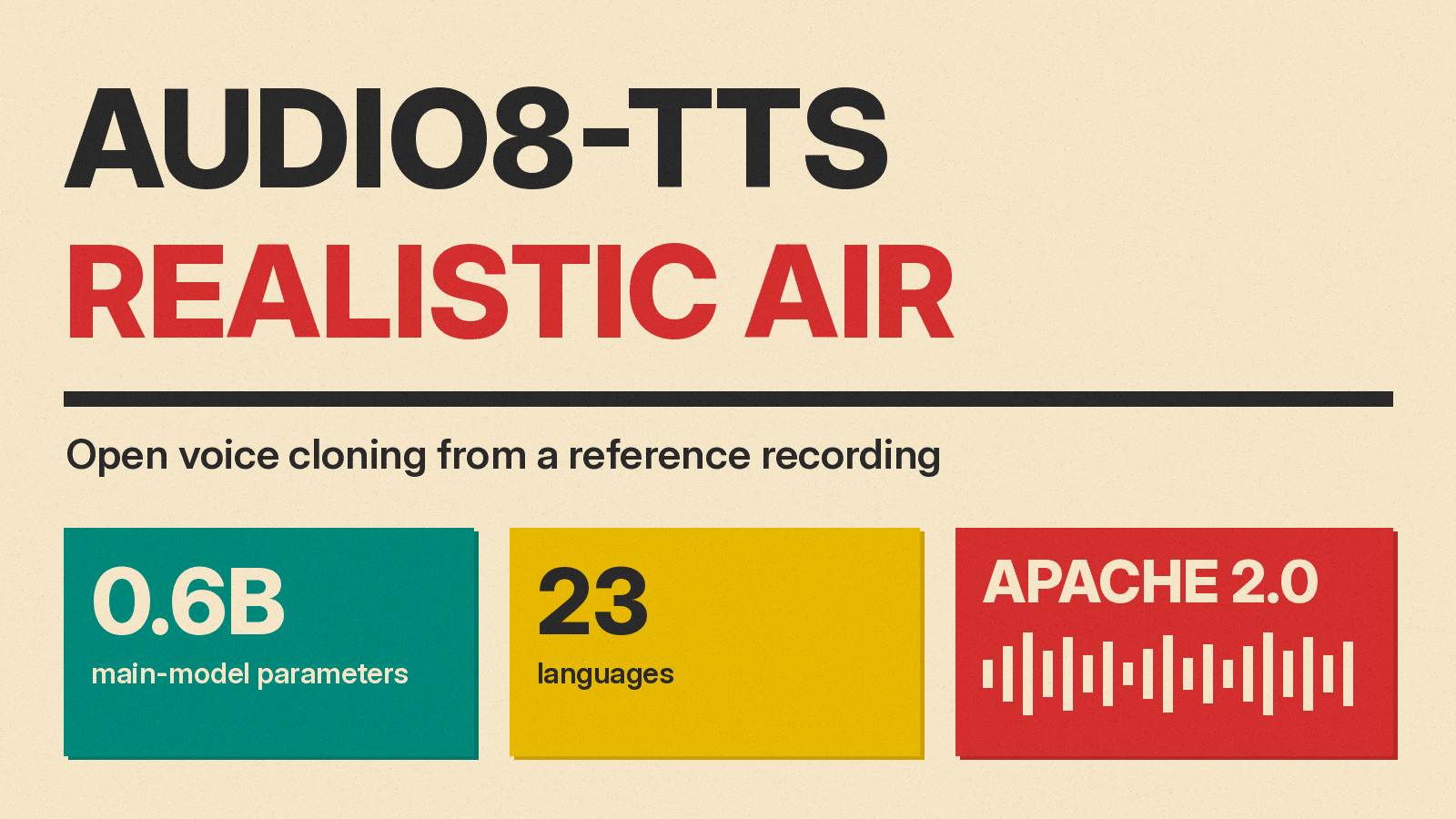
Edge0 has published Audio8-TTS-Realistic-Air, an open text-to-speech model that can copy a voice from a reference recording. According to its Hugging Face model card, the main model has 0.6 billion parameters, supports 23 languages, and ships with both its code and its weights under the Apache License 2.0.
The card and the paper behind it spell out both the training method and where the model is weak, so the numbers are worth reading before you plan to use it. All figures below come from Edge0's card and paper. The scores for other models are Edge0's own compilation, and some are its own reevaluations.
What Audio8-TTS-Realistic-Air is
Realistic Air builds on Audio8-TTS-Preview-0.6b, an earlier Edge0 model. The card says it keeps the same compact size and the same Transformers inference interface, and aims for "substantially improved speech realism."
The language list grew from 11 to 23. Preview supported Cantonese, Chinese, Dutch, English, French, German, Italian, Japanese, Korean, Polish and Spanish. Realistic Air adds Arabic, Finnish, Hindi, Indonesian, Malay, Norwegian, Portuguese, Russian, Swedish, Thai, Turkish and Vietnamese.
The repository holds the whole stack: the model checkpoint, a neural audio codec that works at 44.1 kHz, the tokenizer, the processor and custom Transformers code. The main model has 601,159,424 parameters, and the card says the "0.6B" label leaves out the codec. The repository listing shows model.safetensors at about 1.2 GB and codec.pth at about 1.35 GB, so the full download is larger than the parameter count suggests.
How voice cloning works with it
The model does zero-shot voice cloning. "Zero-shot" means you do not train anything for the new voice. You give the model a clean reference recording of the speaker, the exact transcript of what they say in that recording, and the new text you want spoken. The model then produces speech in that voice.
The card is firm on two points. The transcript must match the reference audio exactly, and noisy reference audio or a mismatched transcript can reduce stability and speaker similarity. The reference audio, its transcript and the target text also share one limited context budget, so the card advises splitting long passages into shorter utterances. The context is up to 2,048 packed text and audio positions.
You can also generate speech with no reference at all. The card shows this as a second code path. Its quick start loads the model through Hugging Face Transformers with trust_remote_code=True, which means you are running custom code from the repository, so the card tells you to review those files first. It recommends a CUDA-capable GPU and Python 3.10 or newer.
For people who want a web service instead of a script, Edge0 provides an adapter for SGLang Omni, a serving framework. The card says it offers an OpenAI-compatible /v1/audio/speech endpoint, with paged attention and dynamic batching. Its validation note is narrow: the team tested generation with and without a reference on an NVIDIA H20 GPU in BF16, using the non-streaming API. The card says throughput and streaming were not benchmarked, so it gives no speed or latency figures you could plan around.
How it was trained
The model uses what the card calls a DualAR design, which it says is inspired by Fish Audio S2 Pro. One transformer predicts a semantic token for each frame of audio, and a second, smaller one fills in the codec tokens for that frame. The card lists 24 layers for the first and 4 layers for the second, with 10 codebooks of 4,096 entries each.
The paper, Training a Compact, Strong, and Realistic Text-to-Speech Model, was submitted to arXiv on October 10, 2026 by Runyuan Cai, Yu Lin, Yiming Wang and Xiaodong Zeng. Its abstract says common TTS goals, intelligibility and speaker similarity, do not capture the fine prosody that separates human performances from synthetic speech. Prosody means the rhythm, stress and pitch movement of speech.
To go after that gap, the authors say they built a "quality ladder" from widely used open-source TTS systems and trained a realism critic to judge generated speech against human recordings of the same sentences. They then trained the model in three stages: multilingual supervised fine-tuning, a reinforcement learning step called GRPO that rewards low word error rate and high speaker similarity, and a final GRPO step guided by the realism critic. The abstract says the last stage improves perceived prosodic naturalness and speaker similarity while keeping word error rate steady.
What the benchmarks show
The card reports error rates, where lower is better, and speaker similarity on a 0 to 1 scale, where higher is better. It states plainly that these metrics "do not directly measure perceived speech realism." So the table below does not test the realism claim.
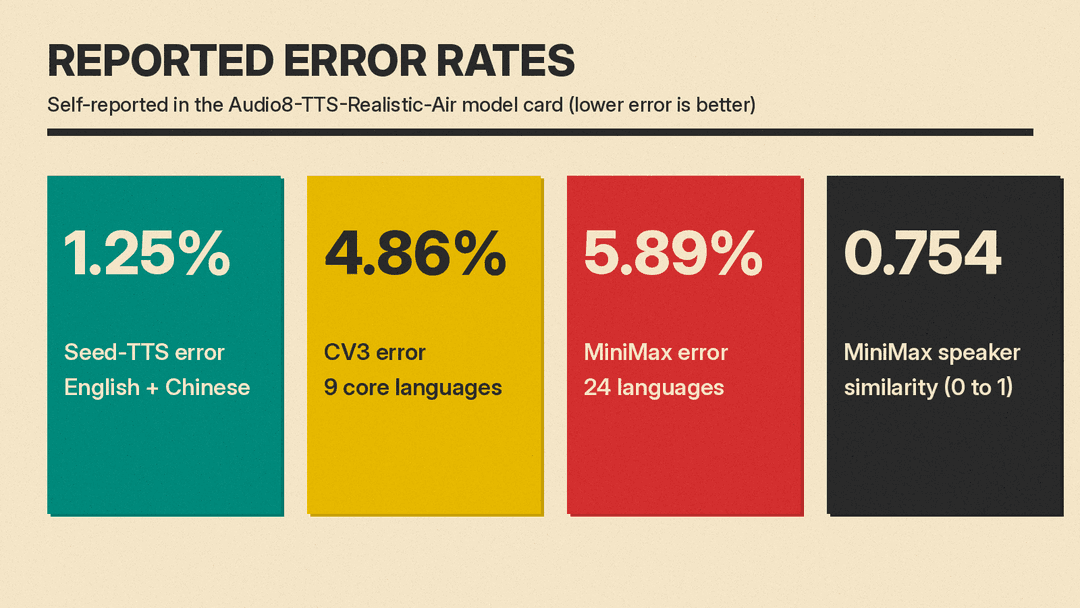
- Seed-TTS (English and Chinese): 1.25% error and 0.704 speaker similarity. Preview scored 1.23% and 0.682.
- CV3, nine core languages: 4.86% error and 0.661 speaker similarity.
- MiniMax, 24 evaluated languages: 5.89% error and 0.754 speaker similarity.
The card says these are unweighted averages across languages, and that Preview and Realistic Air were evaluated separately. On Seed-TTS the error rate is almost unchanged from Preview, while speaker similarity improves.
The card also gives a reference comparison with other open models. It warns that the sources and text normalization differ, so it is "a reference comparison rather than a strictly matched ranking." Here are four of the nine models in that table, with their error rates on Seed-TTS, CV3 and MiniMax:
- Audio8-TTS-Realistic-Air (0.6B): 1.25, 4.86, 5.89.
- Fish S2 Pro (4.6B): 1.32, 4.49, 4.40.
- Higgs Audio v3 (4B): 1.11, 4.41, 2.74.
- Qwen3-TTS-1.7B: 1.01, 7.73, 27.41.
The paper's abstract claims state-of-the-art intelligibility and speaker similarity. The card's own table shows other models with lower error rates in some columns, so read that claim with the comparison conditions in mind. Among these four models, the 0.6B model beats Qwen3-TTS-1.7B on CV3 and MiniMax and trails Fish S2 Pro and Higgs Audio v3 on both. On Seed-TTS it sits between Higgs Audio v3 and Fish S2 Pro.
Quality varies a lot by language
The card also lists results for each language. On the CV3 test, English word error is 2.907% and Spanish is 3.389%. Several of the newly added languages score much worse: Finnish is 32.279%, Vietnamese 28.111% and Thai 48.574%. On the MiniMax test, Cantonese character error is 31.349%, far above the 0.898% for German.
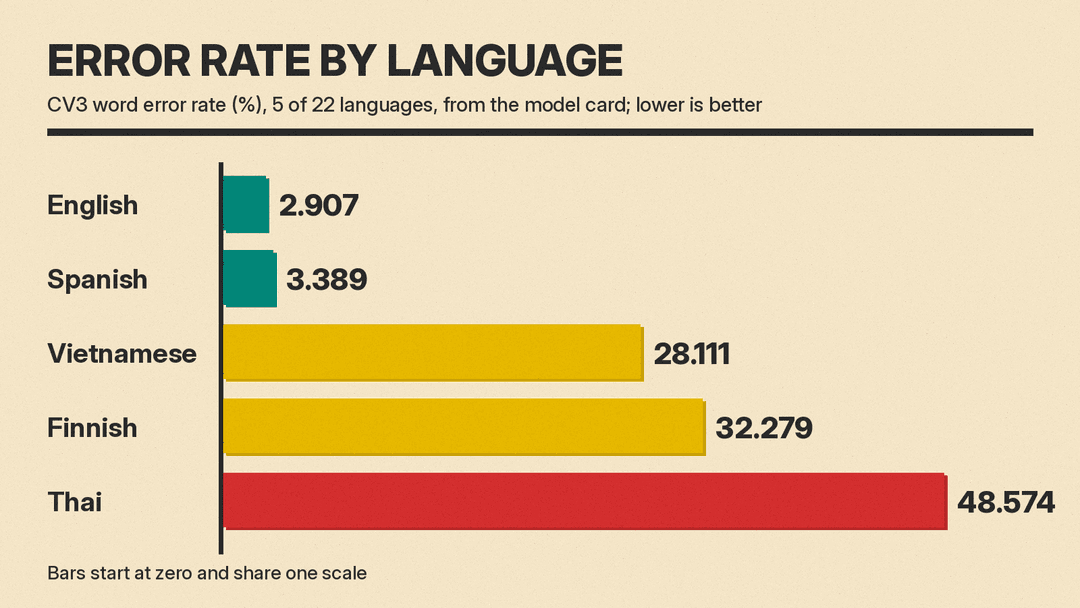
The card itself says the support list "is not a claim of equal quality across languages." If you plan to use a newly added language, run your own listening tests first.
Who should try it, and the limits
Running it yourself means a Python setup and, per the card, a CUDA-capable GPU is recommended. The card says the code and model weights are under Apache 2.0. Edge0's GitHub README says the repository code and both 0.6B releases use Apache 2.0, and that a separate 0.1B checkpoint has its own license. The card also links a hosted Playground on Hugging Face ZeroGPU, with availability depending on the queue and your daily GPU allowance.
The card lists limits you should take seriously. Speech may contain pronunciation errors, repetitions, omissions or early stopping, so listen to the audio before you use it in a finished product. It also asks users to obtain permission before cloning a voice and to disclose synthetic audio where appropriate. The card does not mention a consent check or an audio watermark in the model. For background on cloning, see our explainer on what AI voice cloning is and how it works.
If you only want a quick voice for a project and not a self-hosted model, the best AI voice generators for text to speech guide covers hosted tools. For another recent open model aimed at spoken content, see our post on Fish Audio Drama 3, and for the basics behind all of these, read what text-to-speech is and how AI voices work.
As of November 4, 2026, the Hugging Face model page shows 9,695 downloads in the last month and 296 likes. The numbers in this post come from the card and the paper; this article did not include listening tests of its own.
