
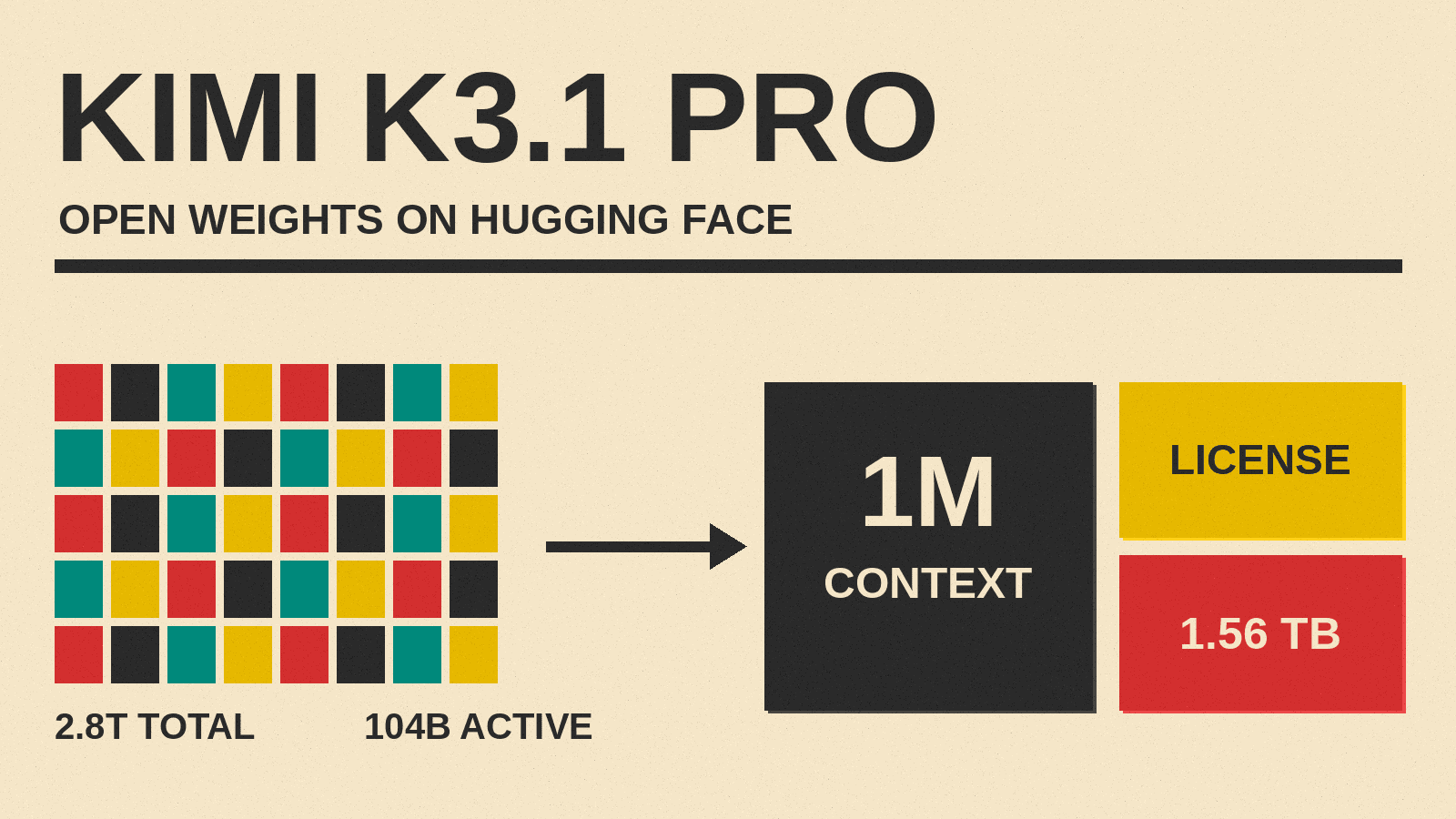
Moonshot AI has put the weights of Kimi K3.1 Pro on Hugging Face. The company said at launch that the full weights would arrive by Nov 4, 2026. The model card now lists the files, the architecture, a long benchmark table and a custom license. This post covers what the card says, what the license allows, and where the scores are strong or weak.
We covered the hosted launch earlier in our Kimi K3.1 Pro explainer. This post is about the download.
What Moonshot released
The card calls Kimi K3.1 Pro an open-weight, natively multimodal agentic model. It is post-trained from Kimi K3 with large-scale joint reinforcement learning across hundreds of downstream domains. It is the first model in the K3.1 series, and it takes text and image input.
The card gives these specifications:
- Mixture-of-Experts design with 2.8T total parameters and 104B activated parameters.
- 93 layers, one of them dense.
- 896 experts, with 16 selected per token and 2 shared experts.
- Context length of 1,048,576 tokens.
- Attention built from 69 KDA layers and 24 Gated DSA layers. The card says Gated DeepSeek Sparse Attention layers replace the full-attention Gated MLA layers used in Kimi K3, for more efficient long-context work.
- A 401M-parameter vision encoder called MoonViT-V2.
- MXFP4 weights and MXFP8 activations from quantization-aware training.
The launch post called K3.1 Pro a "3T-class" model. The card gives the exact figure of 2.8T. Both numbers come from Moonshot, and they do not conflict: 2.8T is the precise count.
The Hugging Face API lists 112 files in the repo. Summed, the file sizes come to about 1.56 TB. That is our own arithmetic from the API listing. The weights alone fill that space before any KV cache, so this is a model for multi-node servers, not for a single desktop GPU. The repo also ships custom Python files, such as the configuration and processor code, next to the safetensors shards. The Hugging Face API lists the repo as created on Nov 2, 2026 at 04:13 UTC (Nov 1, 2026, 8:13 p.m. Pacific time). Its only commit, "Initial commit", carries the same timestamp. We did not find a statement of the exact time the repo became public.
The license
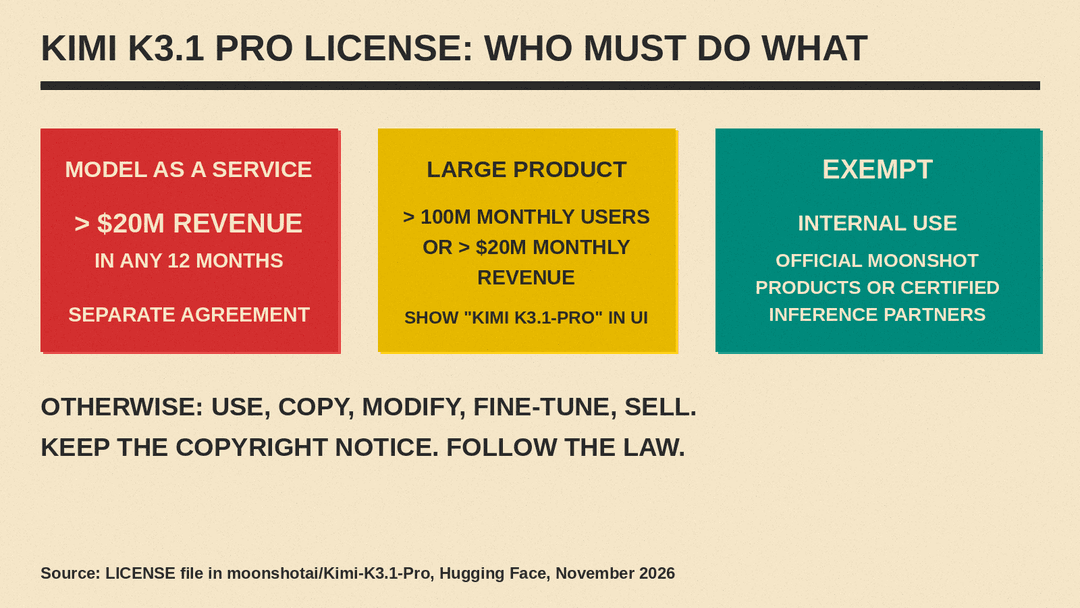
The repo tag reads "license: other" and the card says the model is released under the Kimi K3.1 Pro License. The LICENSE file itself is titled "Kimi K3.1-Pro License". We read the LICENSE file in the repo. Its main terms:
- Broad grant. Anyone may use, copy, modify, merge, publish, distribute, sublicense and sell the Software. The Software includes the weights, configuration files, inference and training code and documentation. Fine-tuning and derivative works are named.
- The copyright notice must stay in all copies, and use must comply with applicable laws.
- Model as a Service limit. The license defines this as giving a third party access to model inference or fine-tuning, for example by API, in a way that lets that party control inputs, parameters or training data. The definition leaves out end-user products that only embed model capabilities in specific features or harnesses, and the mere relaying of requests to models hosted by others. If you or an affiliate run such a business and your combined revenue passes 20 million US dollars over any 12 consecutive months, you must sign a separate agreement with Moonshot AI before any commercial use of the Software or its derivatives.
- Display rule. If a commercial product or service built on the Software has more than 100 million monthly active users, or more than 20 million US dollars in monthly revenue, "Kimi K3.1-Pro" must be shown prominently in its user interface.
- Exemptions. The Model as a Service and display rules do not apply to internal use, which the license defines as any use that does not make the Software, its outputs or its underlying capabilities available to third parties. They also do not apply to use through Moonshot AI's official products or certified inference partners.
- No warranty. The Software and its outputs are provided as is.
The card calls the model open-weight, and the revenue and user thresholds go beyond a plain permissive license. We have not seen an Open Source Initiative review of this license. For most teams that run the model inside their own company, the thresholds do not apply. A hosting company that sells API access to K3.1 Pro is the case the Model as a Service clause describes. For a plain-language view of the open versus closed difference, see our open-weight explainer.
For K3.1 Pro next to DeepSeek V4.1 Flash and MiniMax M3.1 Flash on price, speed and license, see our three-way comparison.
Update, November 5, 2026: SuperCLUE's November leaderboard lists K3.1 Pro first among its ranked models at 61.46. Our SuperCLUE November 2026 post reads that table column by column.
Benchmarks: strong on agents, weaker elsewhere
All scores below are reported by Moonshot on the model card, at "max" reasoning effort. Comparison scores for other models come from their own reports or from leaderboards, as the card footnotes state. Several benchmarks are internal to Moonshot. The card labels the closed-model columns "max, w/ fallback", and Moonshot ran K3.1 Pro through the Claude Code harness on Terminal-Bench 4.0. Treat the table as a vendor claim until outside labs repeat it.
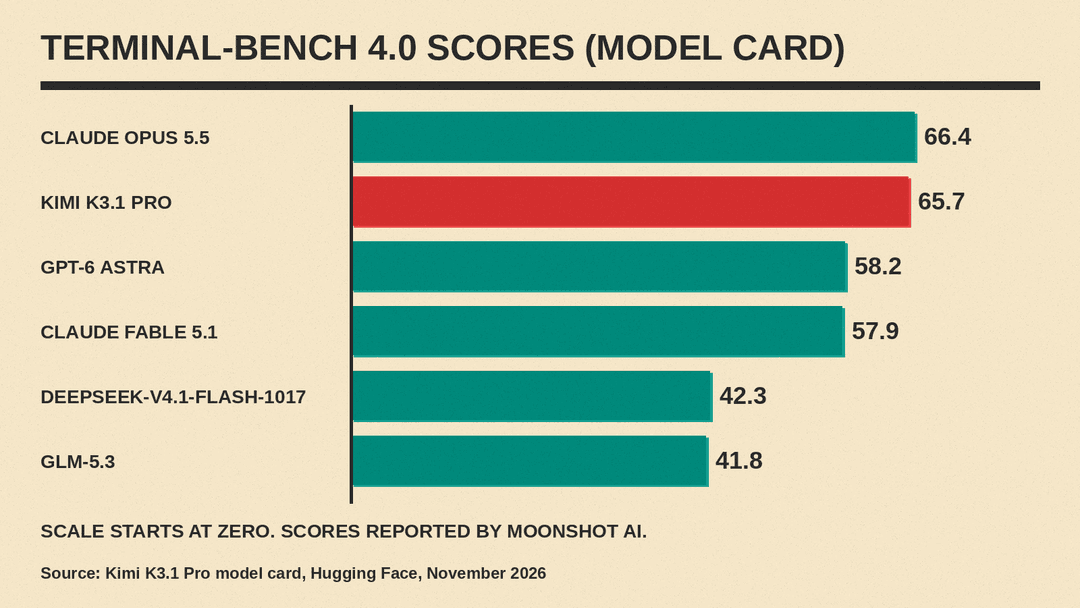
Terminal-Bench 4.0 is the headline. K3.1 Pro scores 65.7. Claude Opus 5.5 scores 66.4, GPT-6 Astra 58.2, Claude Fable 5.1 57.9, DeepSeek-V4.1-Flash-1017 42.3 and GLM-5.3 41.8. K3.1 Pro is ahead of DeepSeek-V4.1-Flash-1017 and GLM-5.3, the two other open models in the table, by more than 20 points.
Other results where the card puts K3.1 Pro first or close to first:
- BrowseComp: 92.1, against 91.5 for GPT-6 Astra and 90.8 for Claude Opus 5.5.
- HLE-Full with tools: 70.0, against 67.7 for Claude Opus 5.5.
- OfficeQA Pro v2: 64.4, against 62.2 for Claude Opus 5.5.
- SWE Marathon v1.1: 51.7, against 46.3 for Claude Opus 5.5.
- GPQA-Diamond: 94.2, against 96.1 for GPT-6 Astra.
The card also shows clear gaps:
- Terminal-Bench-Science 0.1: 38.1, against 68.1 for GPT-6 Astra and 63.3 for Claude Opus 5.5.
- ProgramBench: 31.5 (a binary score, where a task counts only if its ProgramBench score is at least 95%), against 65.0 for Claude Opus 5.5 and 53.5 for Claude Fable 5.1.
- HLE-Diamond: 39.4, against 65.8 for GPT-6 Astra.
The pattern is simple. The model does well on long agent tasks with tools, such as terminal work, browsing and office documents. It trails the best closed models on some science and hard-reasoning sets.
On factual accuracy, the launch post says the claim-level hallucination rate on Kimi Hallu Bench Hard fell from 23.4% for K3 to 8.3%. Moonshot says this is a stress test and does not describe everyday error rates. On the card, GPT-6 Astra shows 5.5 on the same internal test, where lower is better.
Cyber limits in the open release
Moonshot says it removed cyber-related data from both mid-training and the reinforcement learning stage for this release. The launch post gives one test of the effect. On its in-house xdev-bench-hard, a checkpoint without those steps solves 90.5% of tasks at pass@3, while the final model reaches 81.0%. Moonshot states that the open model's offensive cyber capability stays behind that of frontier proprietary models that have been public for at least three months. It also says it intends to raise the cyber capability available in open weights step by step.
On the card, ExploitBench shows 74.7 for K3.1 Pro, against 100 for GPT-6 Astra, 91.0 for Claude Opus 5.5 and 54.4 for GLM-5.3. ExploitGym shows 20.7, against 42.4 for GPT-6 Astra. An outside view of the same model family is in our cyber index post.
How to run it
The card names three recommended inference engines: vLLM, SGLang and TokenSpeed, with recipe links for each. A hosted API is also available on platform.kimi.ai under the name kimi-k3.1-pro, with OpenAI-compatible and Anthropic-compatible interfaces.
Two usage details matter for developers:
- Reasoning effort is set with a top-level reasoning_effort field. It accepts "low", "high" and "max", and the default is "max".
- In multi-turn chats and tool calls, you must pass the full assistant message back as returned. That includes reasoning_content and tool_calls, not only content.
If you only want to test the model on a smaller machine, see our guide to how much memory you need to run a model locally. K3.1 Pro will not fit that advice. At 1.56 TB of files, most readers will use the hosted API or a provider.
Why it matters
The license grants broad rights. Internal use is exempt from the revenue and display rules, while a company that runs a Model as a Service business and has more than 20 million US dollars in combined revenue over 12 months must sign a separate agreement with Moonshot first. The benchmark table is a vendor claim with mixed harnesses, but it puts an open model within one point of the top closed score on Terminal-Bench 4.0. Independent runs will show whether the agent scores hold up outside Moonshot's own harness setup.
For a smaller open release that ships its training code and data, see our post on Axion 1.0, whose 35B Apache 2.0 weights are a community reproduction.
Update, November 4, 2026: We collected day-one reactions from X and Hacker News in our Kimi K3.1 Pro weights reactions roundup.
