
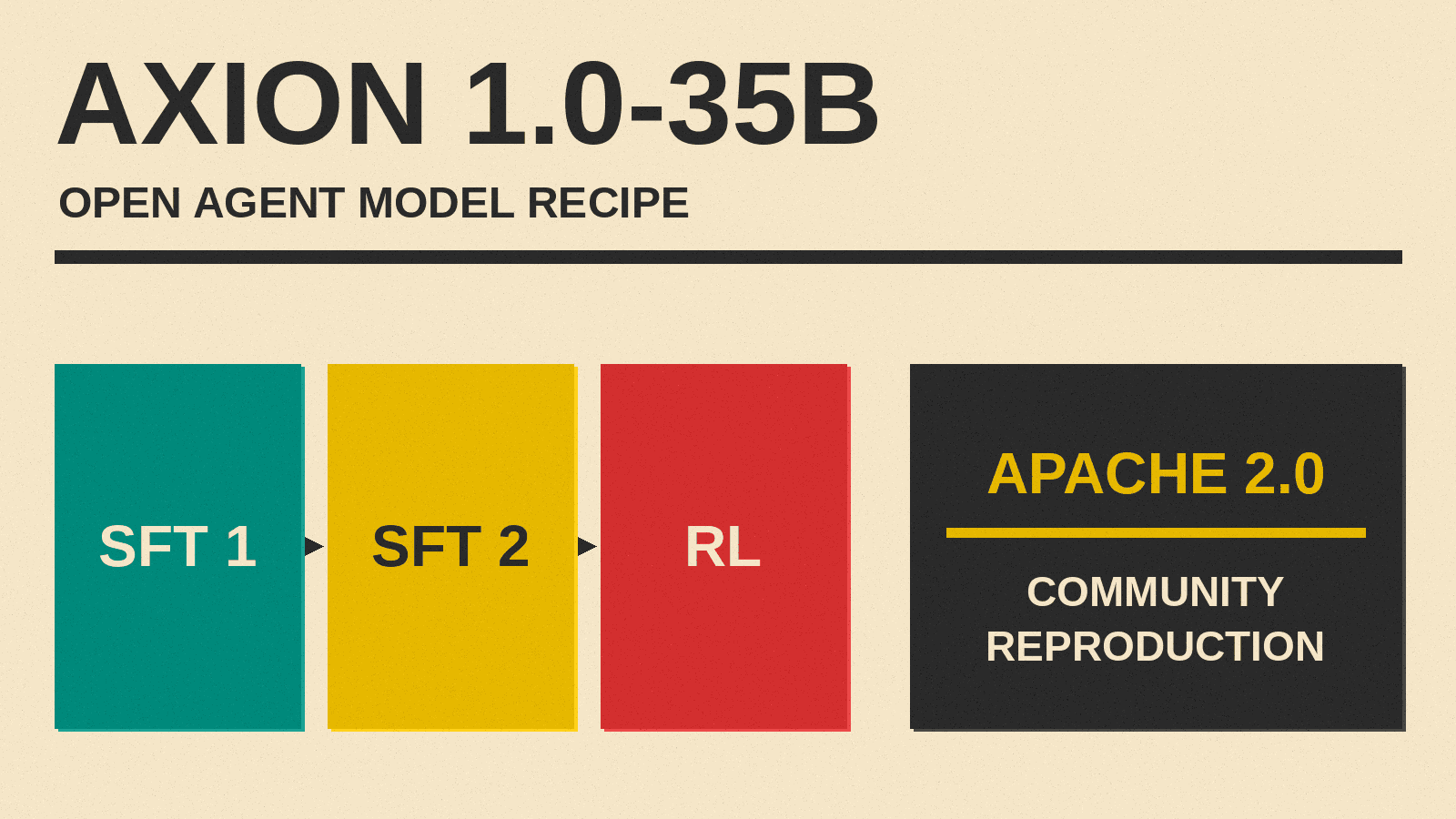
A team whose project lead is at ByteDance has published Axion 1.0, an open recipe for building an AI agent model. A matching 35B checkpoint is on Hugging Face under the Apache 2.0 license. The weights come with one important label. The Axion GitHub page says the 35B checkpoint is "a community release, not an official Axion checkpoint."
That detail shapes how to read every number below. The paper reports results for Axion 1.0-35B. The Hugging Face model card reports a second set of numbers for the reproduction checkpoint. Both are shown here, with their sources.
What Axion 1.0 is
The paper, "Axion 1.0: Open Agent Foundation Models, Simplified," describes Axion 1.0 as "a fully open agent foundation model." An agent model is built to reason, search the web and run tools, not only to answer in one reply.
The authors list affiliations at Duke University, ByteDance, the University of Maryland, College Park, and the University at Buffalo. Yunjie Tian of ByteDance is the project lead. The code lives at github.com/bytedance/axion1_0, while the Hugging Face weights sit under a separate account named Axion1-0.
The pitch is simplicity. Axion 1.0 is trained in three stages: two lightweight supervised fine-tuning (SFT) stages, then reinforcement learning. The paper says this is done "without dedicated mid-training, direct preference optimization (DPO), or on-policy distillation (OPD)." Our explainer on fine-tuning covers the basics behind SFT.
The paper reports two main sizes:
- Axion 1.0-35B, built on Qwen3.6-35B-A3B, with 35B total and 3B active parameters.
- Axion 1.0-122B, built on Qwen3.5-122B-A10B, with 122B total and 10B active parameters.
It also reports 4B and 9B variants trained with the two SFT stages only. The "active" figure matters because these are mixture of experts models, where only part of the model works on each token. Our guide to mixture of experts models explains why.
The three training stages
According to the GitHub README, Stage I uses 10,819 trajectories of scientific and mathematical reasoning. Public seed problems are rewritten into harder questions, and the base model's own successful solutions guide how each problem is made harder. Solvers may use Python but not search.
Stage II uses 7,544 trajectories, about 312M tokens. Programs filter records from public databases, pick a unique entity and compute a reference answer. Only then does an LLM write the question. The README names the NASA Exoplanet Archive, OurAirports, OpenAlex, UniProt and Ensembl among the sources. The solver must find the evidence with tools, and questions that can be answered without retrieval are removed.
Reinforcement learning with asynchronous GRPO comes last. The model interacts with search, webpage visits, scholarly retrieval and Python. A correct final answer earns full reward, and verified intermediate progress can earn partial credit.
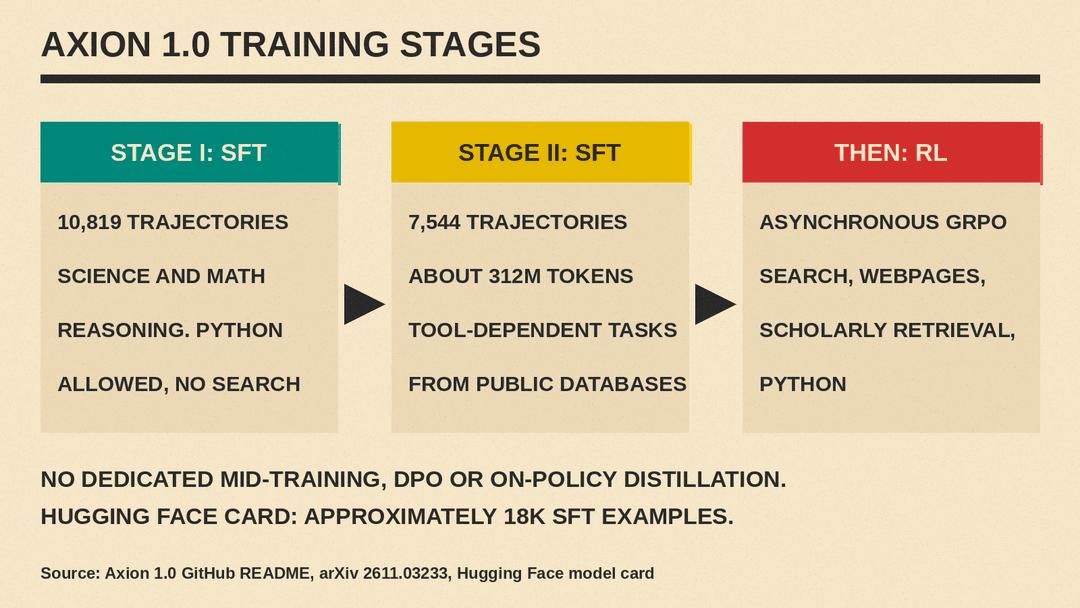
The Hugging Face card summarizes the SFT data as "approximately 18K SFT examples." That matches the two stage counts added together, 10,819 plus 7,544.
Paper numbers versus the reproduction
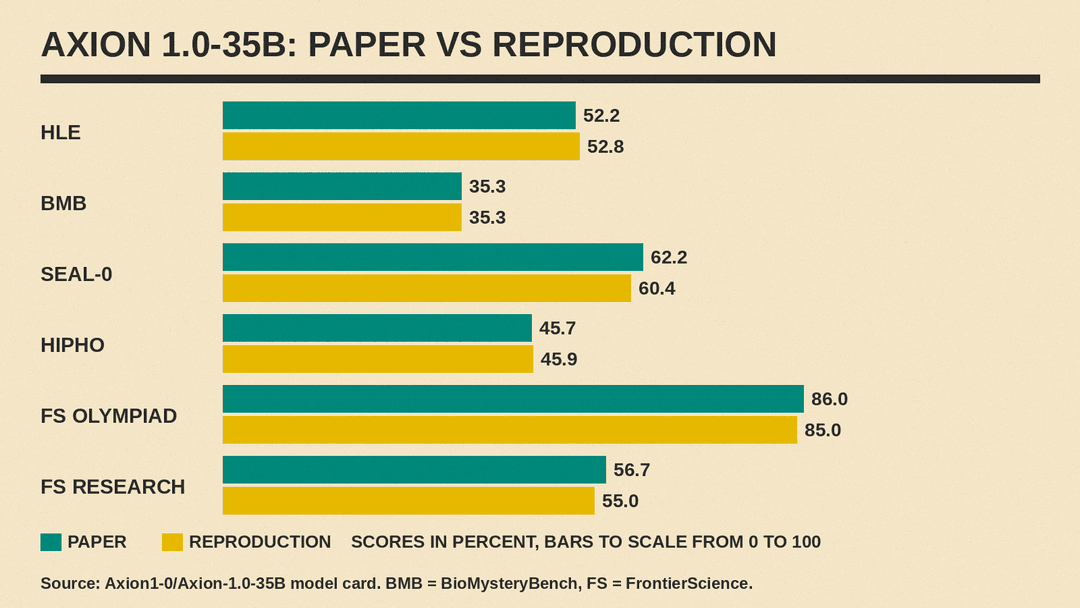
The paper says its Axion scores are "evaluated by us." The model card lists the paper figures and the reproduction figures side by side. All scores are percentages, and higher is better.
In plain terms:
- Humanity's Last Exam (HLE): paper 52.2, reproduction 52.8.
- BioMysteryBench (BMB, human-difficult subset): paper 35.3, reproduction 35.3.
- SEAL-0: paper 62.2, reproduction 60.4.
- HiPhO: paper 45.7, reproduction 45.9.
- FrontierScience Olympiad: paper 86.0, reproduction 85.0.
- FrontierScience Research: paper 56.7, reproduction 55.0.
The reproduction is close on every benchmark. It scores higher on two (HLE and HiPhO), ties on one (BMB), and scores lower on three. The biggest gap is 1.8 points, on SEAL-0.
The paper also notes that its HLE scores use restricted website access. For the 35B model, full HLE is 52.2% with sites such as Hugging Face blocked, and 59.1% without those restrictions. The 52.2 in the model card's paper column is the restricted figure. The card does not say how the reproduction run handled website access.
How it compares, according to the paper
Table 1 of the paper compares Axion with other open-weight and proprietary models. The authors warn that "cross-source comparisons are indicative rather than strictly controlled," because baselines come from official reports, other studies or their own runs.
With that caveat, the paper says Axion 1.0-35B improves on the similarly sized Agents-A1 by 4.6 points on HLE (52.2 vs 47.6), 5.8 on SEAL-0 (62.2 vs 56.4) and 7.0 on FrontierScience Olympiad (86.0 vs 79.0). On FrontierScience Research, the 35B model scores 56.7 against 40.0 for Agents-A1 and 26.7 for GPT-5.5, as listed in the table.
The picture is not uniform. On HLE, the table lists higher scores for Kimi-K2.6 (54.0), GPT-6 Astra (57.2), Claude Opus 5 (63.6) and Claude Fable 5 (63.8) than the 52.2 for Axion 1.0-35B. On FrontierScience Research, GPT-5.6 Sol is listed at 63.3, above 56.7. The larger Axion 1.0-122B scores 59.0 on full HLE with restricted website access and 66.7 on FrontierScience Research, but no weights for it appear on the Hugging Face page covered here.
The stage table in the paper shows where the 35B gains come from. On a 130-question text-only HLE subset, the Qwen3.6-35B-A3B base scores 47.7. After Stage I it scores 59.2, after Stage II 66.2, and after reinforcement learning 70.0. The paper adds that reinforcement learning slightly lowered two 35B scores: HiPhO (46.8 to 45.7) and FrontierScience Research (58.3 to 56.7). The paper says the HLE subset scores should not be compared directly with its main HLE results.
What you can download
The model card lists the checkpoint as follows:
- Architecture: mixture of experts, about 35B total and 3B active parameters.
- Weight precision: BF16.
- License: Apache License 2.0, which the repository ships as a LICENSE file.
- Release type: "Reproduction checkpoint."
The repository holds the model in 12 safetensors shards. The card's serving example uses vLLM with eight GPUs, a maximum length of 131072 tokens and a Qwen3 reasoning parser. It notes that tool-using agent evaluation also needs a harness that executes tool calls. If you plan to run a model this size at home, our guide on how much memory you need to run an AI model locally is a good place to start.
The training data is on Hugging Face as Axion1-0/axion-training-data under Apache 2.0. The GitHub repository includes data generation and filtering, prompts, two-stage SFT, asynchronous RL, and benchmark preparation and grading. The repository is under Apache 2.0 too.
What this means
The release is more about method than raw rank. A recipe that others can run end to end lets outside teams check the claims, and the community reproduction does that for the 35B size. Its numbers land within 1.8 points of the paper on all six benchmarks listed.
There are limits. The scores come from the authors' own runs and from a mix of other sources. The checkpoint on Hugging Face is not an official one. The 122B model is described in the paper, and this post did not find weights for it on the page checked. And the benchmarks, including HLE and FrontierScience, test science and research tasks, so they say little about everyday chat or coding.
Practical reading: if you work on agent models or want a documented, Apache 2.0 starting point, Axion is worth a look. Read the model card and the license before you build on it, and treat the paper's comparison table as indicative, as the authors themselves say.
