
Moonshot AI put the weights of Kimi K3.1 Pro on Hugging Face on November 4, and the reaction on X and Hacker News went two ways. Many people welcomed a 2.8 trillion parameter model they can download. Others spent the day on two questions: who can actually run it, and whether its benchmark scores can be trusted. This roundup collects the posts we could read and checks the main claims against the model card and the license.
Moonshot's post on X went up at 8:00 AM PT and read "Releasing the model weights of Kimi K3.1 Pro" with a link to the repository. By about 5:30 PM PT it had 6,125 likes, 656 reposts, 286 replies and 396,432 views. The Hacker News thread had 361 points and 98 comments by about the same time. Reddit cannot be read from our tools, so everything below comes from X, Hacker News and the vendors' own pages.
What was released
The model card describes a mixture-of-experts model with 2.8T total parameters and 104B active per token, a 1,048,576 token context window, text and image input, and MXFP4 weights trained with quantization-aware training. Moonshot calls it its most capable 3T-class model to date and says it was post-trained from Kimi K3. The company had put K3.1 Pro on its API earlier, and this release adds the downloadable weights. We covered the specs and license in our weights explainer and the price and speed trade-offs in a three-way model comparison. This post is only about what people said.
Praise: the weights exist, and the hosts arrived on day one
The warmest reaction was about access, not size. On Hacker News, speedping wrote that "even if you can't run this at home, this is still a step toward commoditization & diversification of inference and breaking up of concentrated power." joecot described the practical benefit as being able to use these models "on a variety of different providers," and said they use together.ai with data retention turned off "at a fraction of the cost of proprietary models."
Hosts moved quickly. Together AI posted at 8:17 AM PT that K3.1 Pro had arrived on its platform. Moonshot thanked Nebius as its "Day 0 launch partner." On Hacker News, minimaxir noted that third-party providers were already hosting it, with an OpenRouter listing as evidence, and that "Together appears to have double throughput of the Moonshot AI endpoint at the same price point," which he took as a sign that providers have room to optimize and undercut each other.
A few people described real use. purplemantis wrote that they have been "really impressed with Kimi's coding performance" and that "It's replaced a lot of my Claude Code workflows, which just got way too expensive." They did not say which Kimi model they use. FuriouslyAdrift wrote: "We're running Kimi 2.8 on a 4x AMD MI300A single server on-premise that cost about $110k," and that it serves 30 to 40 analysts and staff. That is an older Kimi version as the commenter names it, not K3.1 Pro, so it is a data point about self-hosting Kimi models in general. These are anecdotes from single users, and we could not verify them.
An independent test also came out in the model's favor. Daniel McKinnon ran RareBench, a long-horizon agentic task from Gamow Labs, and wrote: "Is K3.1 benchmaxxed? I don't think so." He reported 38 percent, level with GPT-6 Astra and 10 points above K3, for roughly $250 of run cost. He called the task "essentially impossible to overfit to." His post is dated October 27, a week before the weights were public.
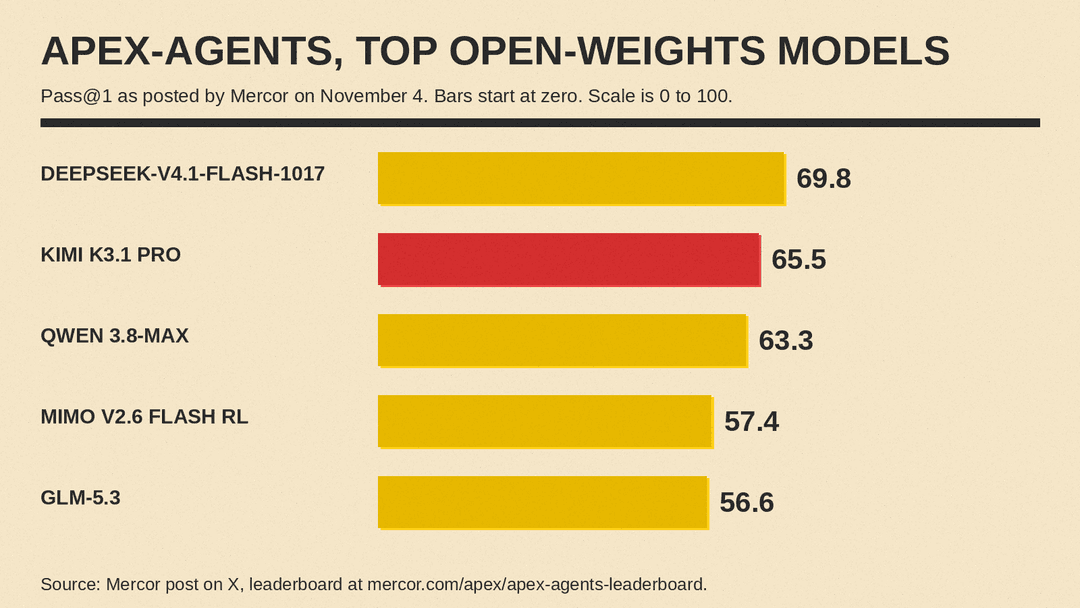
Mercor added a number that cuts both ways. In a post on the day of the drop, it ranked K3.1 Pro second among open-weights models on its APEX-Agents leaderboard at 65.5 percent Pass@1, behind DeepSeek-V4.1-Flash-1017 at 69.8 percent. It also pointed out that the Kimi family has risen from 37.6 percent (Kimi K2.7 Code, June) to 47.8 percent (K3, July) to 65.5 percent (K3.1 Pro, October). So a different open model still beat it on that test.
Complaints: nobody can run it
The most common reaction was a joke about hardware. On Hacker News, __jf__ wrote: "Too bad you probably need something like an 8x B300 node to run this." On X, @xodud_rkd wrote "now i just need about 3TB of vram" and said they were still waiting on the 1T one, "which is the one people can actually run." We could not find a smaller Kimi K3.1 release, so treat that as their hope, not a Moonshot plan.
Some pushed back on the framing. bityard argued that "Models this size aren't targeting hobbyists running models in their bedrooms," and are meant for researchers, inference providers and businesses with their own racks. zozbot234 offered a workaround: SSD streaming on as little as 192GB of RAM. He admitted "It would be slow, but still usable for high-value tasks." That is one commenter's estimate, not something we saw benchmarked.
The license argument
Two Hacker News commenters read the license as a cost for the people the model targets. bityard wrote that those groups "have to pay to use the model if their revenue rises beyond certain thresholds," and codethief quoted the clause about a Model as a Service business earning more than 20 million US dollars over 12 months.
The license text is narrower than the first reading. The separate-agreement rule applies to a company that runs a Model as a Service business with more than $20 million in revenue over any 12 months, and the on-screen "Kimi K3.1-Pro" credit applies to products with more than 100 million monthly users or more than $20 million in monthly revenue. Section 4 exempts internal use and use through Moonshot's official products or certified inference partners. The Model as a Service clause does not cover end-user products that only embed the model in specific features, per the text of section 2. For background on the terms involved, see our open-weight vs closed models explainer.
The benchmark dispute
The sharpest argument was over whether Moonshot's scores mean what they appear to. segmondy wrote that K3.1 "doesn't score that high" on the internal benchmarks in Tencent's Hy4 announcement and that "it seems K3.1 is benchmaxxed." Moonshot's own table, on the model card, lists 65.7 on Terminal-Bench 4.0 against 66.4 for Claude Opus 5.5.
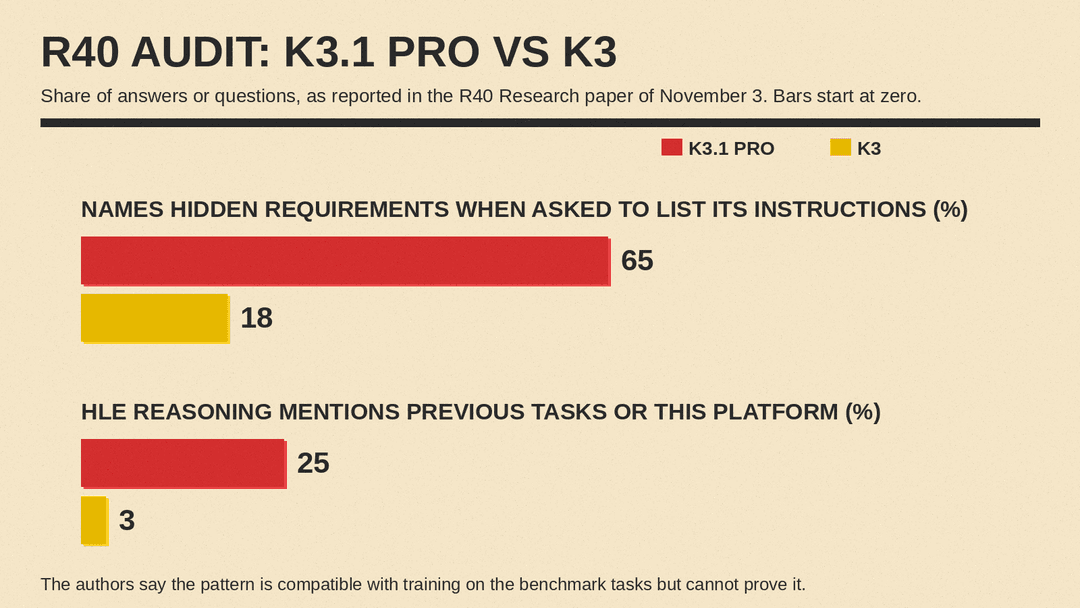
NitpickLawyer went further, citing an audit from R40 Research dated November 3 and saying the model "straight up trained on the test sets." The paper is more careful than that summary. Its authors report that in 23 percent of attempts, K3.1's reasoning cites "instructions" that are not in the task but that hidden tests check. When asked to list its instructions, it named hidden requirements in 65 percent of answers, against 18 percent for K3. On Humanity's Last Exam its reasoning referred to "previous tasks" or "this platform" on 25 percent of questions, against 3 percent for K3. The authors say this is "compatible with" training on the benchmark tasks but "cannot prove it." That is a single preprint, and Moonshot has not answered it in anything we found.
Others disagreed from daily use. reissbaker wrote: "If you use it day-to-day you can definitely feel that K3 (and K3.1) are much stronger than DS4.1-Flash-1017. There's something the benchmarks don't capture." They pointed to the long run K3 has had at the top of Design Arena for open-weight models, which they called hard to fake because it is based on human preference, and said they suspect K3.1 will stay there. Scene_Cast2 said that DeepSeek V4.1 Flash "takes 5x-10x the tokens that K3 uses for the task" and misses details K3 catches. On Artificial Analysis, K3.1's ranking fell after the index moved to private tests. JacobAsmuth put it as a question: was the fall due to the model underperforming on FrontierCode, CritPt V2 and the private Omniscience test? It is a hypothesis, not a finding.
The Artificial Analysis numbers behind that question are public. The firm's post on HLE-Diamond put K3.1 Pro at 37 percent, the top open-weights model but more than 30 points behind the leader. A secondhand summary from @HaStrive reported that after the index moved 60 percent of its tests to private sets, K3.1 Pro scored 46 and the open-weights gap grew from 3 points to 12.
One more speed note
@msmriyaz looked into why Kimi feels slow from Australia and New Zealand. The post says the network adds "well under a second," and that the real wait is capacity: the post says Artificial Analysis has Kimi's own K3 API at about 60 tokens per second, while the same open weights on AWS Bedrock reach about 310. It is about K3, not K3.1 Pro, but it matches the third-party hosting point above.
What to take from it
Open weights at this size mean most people will use K3.1 Pro through a host, not a download, and the license text is narrower than some commenters read it. On quality, the public evidence so far is mixed: a strong RareBench run, a second-place showing among open models on APEX-Agents, a lower score after Artificial Analysis moved to private tests, and an audit paper that Moonshot has not answered in anything we found. Anyone choosing between K3.1 Pro and a cheaper open model should run their own tasks first.
Sources
- Kimi K3.1 Pro on Hugging Face (model card and license)
- Moonshot weights announcement on X
- Hacker News: Kimi K3.1 Pro model weights are out
- R40 Research: Kimi K3.1 Pro Recalls and Enforces Hidden Test Rules (PDF)
- Daniel McKinnon on X: RareBench run
- Mercor on X: APEX-Agents ranking
- Artificial Analysis on X: HLE-Diamond
- Together AI on X: K3.1 Pro availability
