
Intel's third quarter showed two different companies inside one. Its data center business grew 78% from a year earlier, which Intel called its strongest data center revenue growth in 15 years. Its PC business shrank, and Intel now expects the PC market to get worse before it gets better. Investors weighed the second part more heavily: CNBC reported that Intel shares fell more than 20% in extended trading on Thursday after the company issued a weak fourth-quarter forecast.
The quarter in numbers
According to Intel's Q3 2026 results:
- Revenue was $16.5 billion, up 21% from $13.7 billion a year earlier.
- Non-GAAP earnings per share were $0.52, up from $0.23. GAAP EPS was $0.60, down from $0.90.
- Non-GAAP gross margin was 44.1%, up 4.1 points from a year earlier.
- Cash from operations was $5.1 billion.
CNBC said analysts polled by LSEG expected 40 cents of adjusted EPS on $16.5 billion of revenue, so Intel beat on profit and matched on sales. CFO David Zinsner said in the release that revenue, gross margin and EPS all exceeded guidance.
Data center: demand above supply
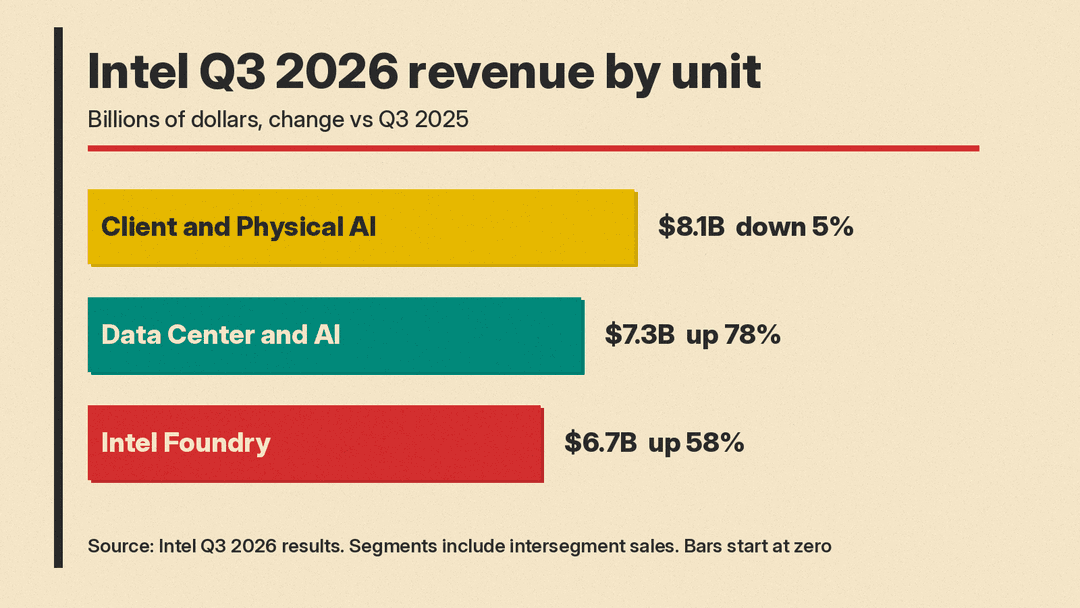
The Data Center and AI group (DCAI) brought in $7.3 billion, up 78% year over year. On the earnings call, Zinsner said DCAI revenue rose 17% from the prior quarter, that DCAI operating profit was $3 billion, or 42% of revenue, and that growth was broad across hyperscale, enterprise and neocloud customers. He also said "demand for DCAI products continues to meaningfully exceed available supply."
Intel's explanation for the demand is agentic AI. Zinsner said on the call that AI workloads are "moving beyond prompt-based responses toward multi-step reasoning, orchestration, and autonomous persistent action," and that CPUs play a central role in that work. Intel now expects industry server CPU units to grow more than 30% in both 2026 and 2027, and said growth would be higher in both years if more supply were available. He also said Intel expects the industry to stay supply constrained through 2027 and into 2028.
CEO Lip-Bu Tan went further on the call. He said that by Intel's estimates, the server CPU market, "largely driven by agentic workloads, could increase as much as five times from where it is today, from $40 billion to more than $200 billion over five years." That is Intel's own projection, not an independent forecast.
Tan also said Intel is mindful of "the fierce competition underway" for that demand. Nvidia is one rival: Modal, a cloud company that runs agent sandboxes, plans to add Nvidia's Vera CPU alongside its Intel and AMD machines.
Two other data center details stand out:
- Purpose-built silicon, Intel's custom chip business, grew more than 50% from the prior quarter and more than doubled year over year, Zinsner said. He also said its margins are below the corporate average.
- Supply is limited by more than wafers. Tan said an industry-wide shortage of advanced organic substrates for Intel's EMIB packaging is limiting how fast output can scale.
PCs: memory shortages bite
The Client Computing and Physical AI group (CCPG) brought in $8.1 billion, down 5% year over year and down 9% from the prior quarter. Zinsner said on the call that memory shortages pressured PC demand, and that the pressure intensified late in the quarter as customers changed purchasing patterns. AI PC revenue still grew 35% year over year.
Memory makers sit on the other side of that shortage. SK hynix reported record third-quarter revenue on demand for AI memory, and Samsung said its HBM supply for next year is already sold out.
Intel's PC outlook is weak. Zinsner said Intel expects industry PC units to fall about 12% in 2026, with second-half units down more than 20%, and it plans for a roughly 10% industry decline in 2027. "We do not expect a sustained recovery until memory availability improves and pricing begins to normalize," he said.
The Q4 forecast
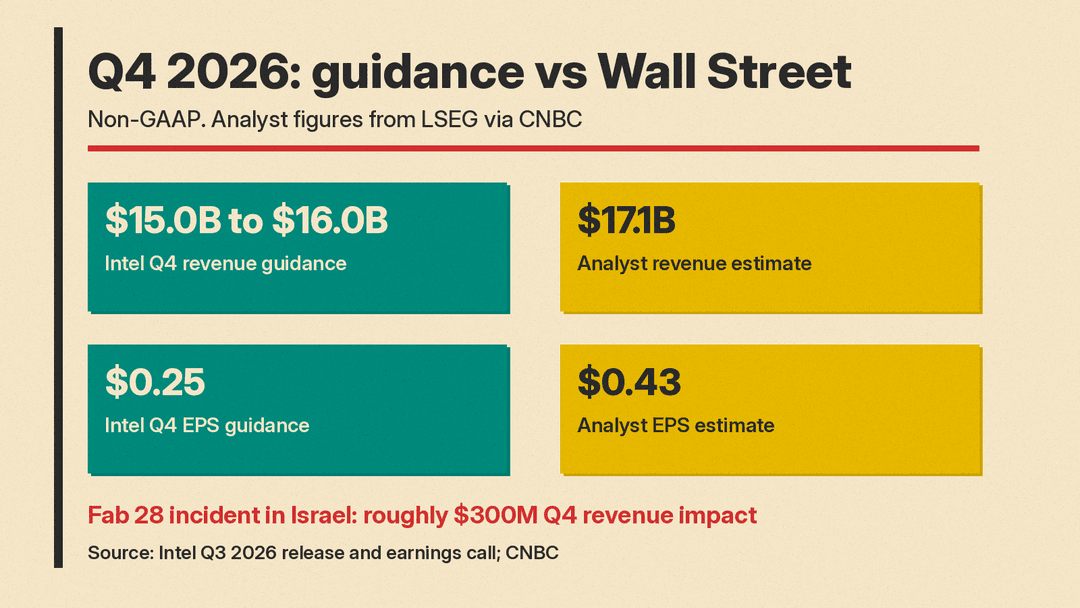
Intel guided fourth-quarter revenue to $15.0 billion to $16.0 billion, with non-GAAP EPS of $0.25 and non-GAAP gross margin of 38.0%. CNBC reported that analysts expected $17.1 billion of revenue and 43 cents of EPS, according to LSEG.
Three things pull the forecast down, per the call:
- PC inventory. Intel expects CCPG revenue to fall more than 20% from Q3 as customers cut inventory.
- Fab 28 in Israel. Tan called it "an unfortunate and tragic accident" that led to an extended shutdown. Zinsner said guidance includes roughly $300 million of revenue and 200 basis points of gross margin impact, almost all tied to 10-nanometer server products, and that the first-quarter revenue impact is likely to be similar. CNBC reported the incident was an explosion that killed two workers and seriously injured a third.
- Mix. Fast growth in lower-margin custom silicon makes quarter-to-quarter comparisons harder.
Data center growth continues in the forecast: Intel expects DCAI revenue to grow by a mid-teens percentage from Q3.
Foundry and capital spending
Intel Foundry revenue was $6.7 billion, up 58% year over year. That figure includes sales to Intel's own product groups. Tan said Intel 18A yields improved at a double-digit rate and that the Intel 14A 0.9 process design kit went to select customers in October. Intel did not name external foundry customers. Tan said Intel will not disclose customer details.
Zinsner said 2026 gross capital spending remains on track at $20 billion and that 2027 spending will be "up strongly." Intel completed a $23 billion equity offering in early August, Zinsner said.
Why it matters
Intel's results add a CPU data point to the AI infrastructure story, which mostly focuses on GPUs. If Intel's view is right, agent workloads create a second wave of demand for general-purpose server chips, and that demand is limited by substrates and factory capacity, not by customer interest. At the same time, memory shortages are hurting PC sales. Intel is exposed to both trends, and this quarter the PC side set the forecast. AMD reports next week and Nvidia in mid-November, according to CNBC.
