
Iluvatar CoreX, a Shanghai GPU designer listed in Hong Kong, says its Tiangai 300 chip has matched Nvidia's H200 in measured performance. The company showed the GPU running on live hardware for the first time at a media open day in Shanghai on October 28, 2026, and called it the first Chinese general-purpose GPU to reach H200 level in measured tests, according to TokenHeart's translation of Chinese reports.
The comparison matters because of where the H200 sits. The South China Morning Post describes it as the most advanced Nvidia AI processor approved for export to China under current US trade rules. A domestic chip that really performs at that level would give Chinese cloud providers and model labs a local option at the top of what they can legally buy from Nvidia. The open question is how much of the claim holds outside the test setups Iluvatar chose.
What Iluvatar says the chip did
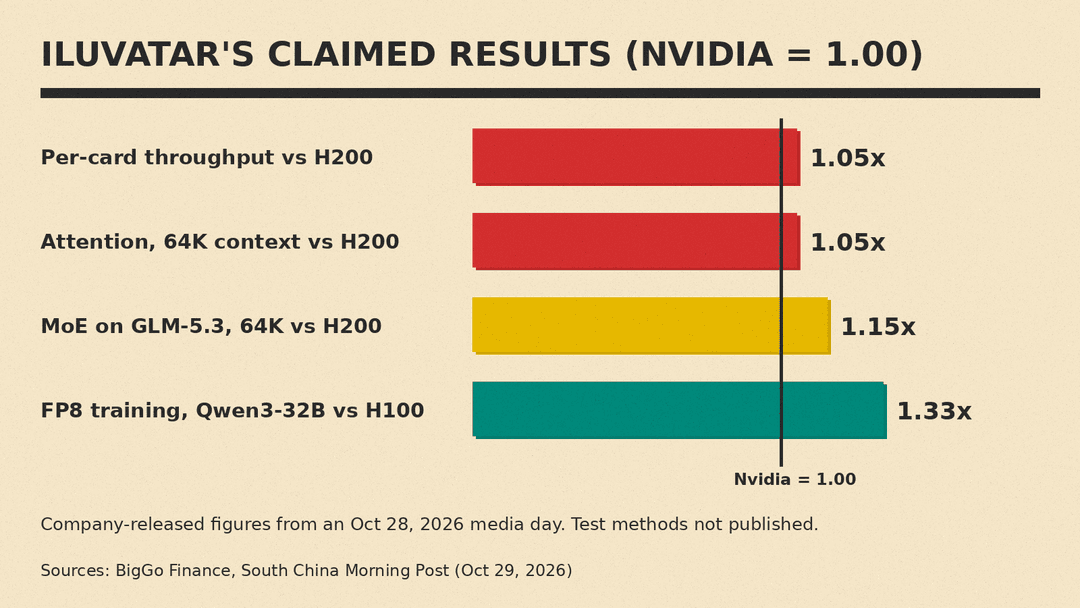
The headline number is 1.05. In a prefill-decode (PD) disaggregated deployment, where the step that reads a prompt and the step that writes the answer run on separate hardware, the Tiangai 300 reached 1.05 times the H200's end-to-end throughput after the result was normalized to a per-card figure, BigGo Finance reported on October 29. Per-card normalization means a multi-card result divided down to one card. It is not a single-chip peak figure.
The company released more results with the same caveat. All are Iluvatar's figures, as reported by BigGo Finance:
- Attention at 64K context: 1.05 times the H200.
- Mixture-of-experts throughput on Z.ai's GLM-5.3 at 64K context: 1.15 times the H200.
- Agent first-token latency across 8K to 128K context: 10% to 30% shorter than the H200.
- Search, advertising and recommendation: 21% higher recommendation inference throughput and 26% lower latency for lightweight compute.
- Training: in an 8-card FP8 demo on Alibaba's Qwen3-32B, 1.33 times the per-card effective throughput of the H100, Nvidia's previous generation. This one is not an H200 comparison.
- Stability under long full load: step-time variance of 0.43%, against 0.76% for the Hopper-based system it was compared with.
The live demo also covered image and video generation. The SCMP, citing Chinese tech outlet Xinzhixun, reported that the demo showed the Tiangai 300 outperforming the H200 on multimodal tasks including text-to-image and text-to-video. In one text-to-image test, according to a summary of that report, the Tiangai 300 completed 100% of the task at 0.101 images per second, against 87.5% and 0.086 images per second for the H200, but it took 0.64 seconds longer.
Who ran the test is not clear
Iluvatar calls the 1.05 result third-party. Reports disagree on the tester. BigGo Finance names Shanghai Yidian, the state-backed group also known as INESA. Asia Daily names Shanghai Electric Group and says the test finished in July. EastFrontier, citing IT Home, says the company did not name the tester at all.
Asia Daily reports that Iluvatar has not published the test method, the model list, or the workload conditions behind the headline figure, and EastFrontier says the workload conditions are unpublished. Without them, no outside lab can reproduce the result. Future Systems Review notes that, as reported, the parity claim comes with no named buyer and no shipment figure.
The IXL144 rack and the cost claim
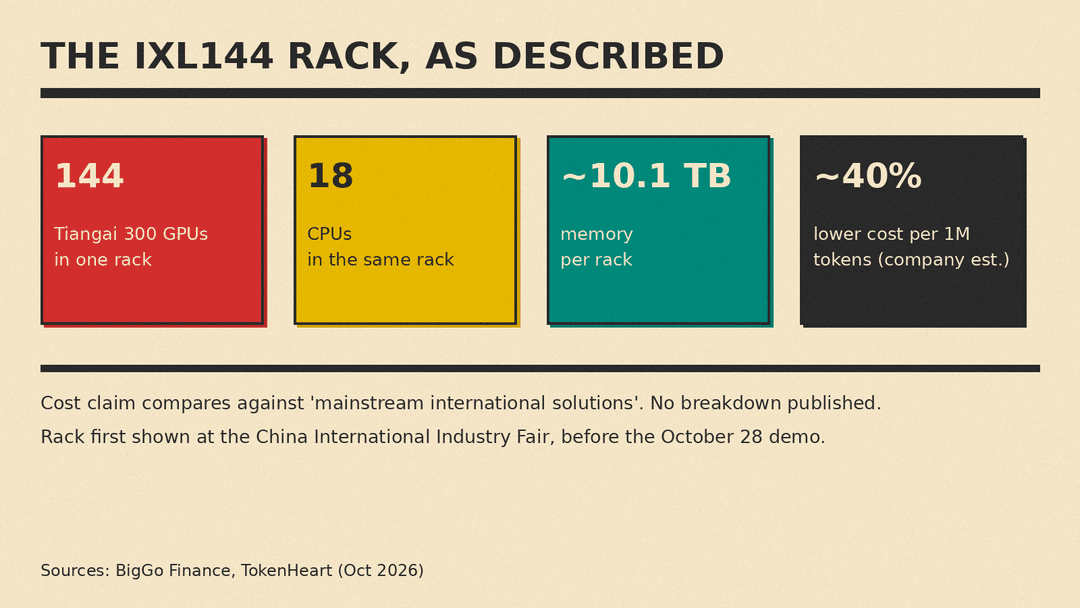
Iluvatar also showed a rack-scale system. The IXL144 puts 144 Tiangai 300 GPUs and 18 CPUs in one rack with about 10.1 TB of memory, according to TokenHeart, which says the rack was first shown at the China International Industry Fair before the October demo. Iluvatar calls it the industry's highest-density single-rack GPU supernode.
The company estimates that the IXL144 cuts the cost per 1 million effective tokens by about 40% compared with "mainstream international solutions," BigGo Finance reported. It did not publish a breakdown. Real token cost depends on the purchase price, power, interconnect, utilization and operations, so this number is an estimate until customers run the rack at scale.
Two other claims from the event point at how Iluvatar plans to close gaps. It says it ran China's first "GPU+XPU" heterogeneous setup that splits attention and the feed-forward expert network across its own GPUs and a partner's chip, which it says cut decode latency by 60%. It also says a next-generation interconnect aims to cut in-domain transfer latency from 3 to 5 microseconds to 1 microsecond. Both are company figures.
The edge chip
Iluvatar also showed the Tongyang TY1200, an edge device it rates at 300 TOPS of dense compute. The company says it delivered 1.2 times the performance of Nvidia's Thor T5000 in tests with Qwen3.8-27B and Qwen3.6-35B-A3B, per BigGo Finance. The next edge product, TY2000, targets 600 TOPS of dense compute.
Why it matters
Chinese chipmakers keep moving the comparison point up Nvidia's lineup. On the same day, October 28, Huawei switched on its first 1,024-card Ascend 950DT SuperPoD in Wuhan. Huawei did not frame that cluster as an H200 match. Iluvatar did, and its use of GLM-5.3 and Qwen models in the demos suggests it is tuning for the open models Chinese labs actually deploy.
The company has money to scale. It completed a Hong Kong placing of new H shares on July 13, 2026, raising about HK$7.07 billion gross, according to its exchange filing. The filing says 60% of the net proceeds will go to supply-chain resilience and procurement of key materials and components, which is the part of the business that decides whether a chip can ship in volume. Reuters put the raise at about $902 million when it was announced.
What would settle the question is simple to list: a published test method, an independent benchmark on a stated workload, a named customer, and a count of units shipped. Until one of those appears, the Tiangai 300's H200 parity is Iluvatar's claim, not a measured fact.
Sources
- South China Morning Post: Iluvatar CoreX says new GPU matches Nvidia's H200
- BigGo Finance: Chinese GPU takes aim at Nvidia H200
- TokenHeart: Iluvatar CoreX shows Tiangai 300 running live
- Pandaily: Tiangai 300 first live demo
- Asia Daily: Iluvatar CoreX claims Tiangai 300 tops H200
- EastFrontier: Iluvatar CoreX says Tiangai 300 matches H200
- Where's the AI: summary of the Xinzhixun demo report
- Iluvatar CoreX placing completion filing, July 2026
- Future Systems Review: who has checked the H200 claim
