
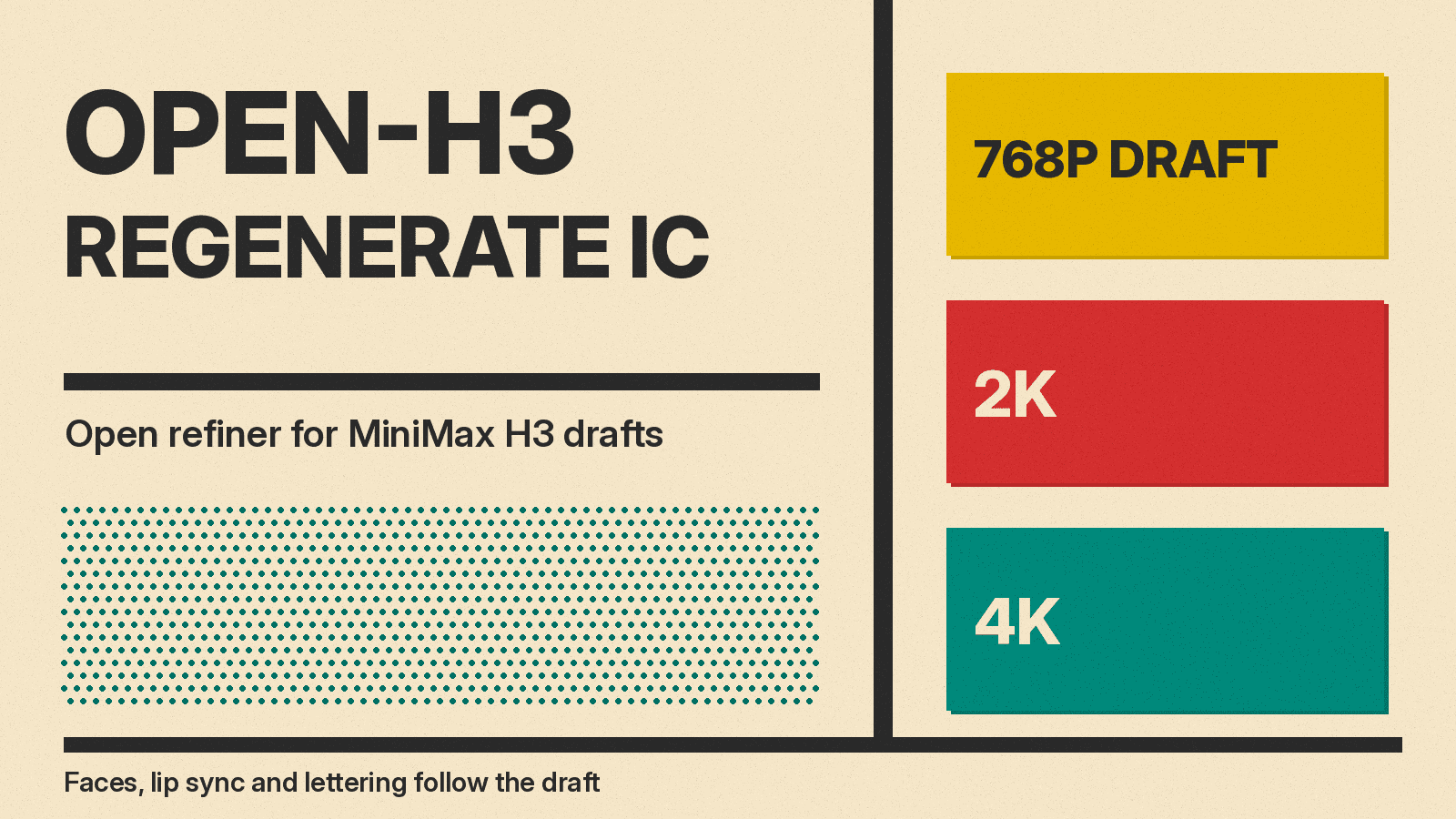
A research team working in the NVlabs Sana project has published Open-H3-Regenerate-2K-IC, a new version of its open refiner for MiniMax H3 video drafts. According to the model card, the system takes a low-resolution MiniMax H3 draft and regenerates it at 1080P, 2K or 4K "while keeping the draft's faces, lip sync, lettering and layout." The card also states that this is "not an official MiniMax product." Weights are hosted on Hugging Face under the Efficient-Large-Model account, code sits in the NVlabs/Sana repository on the sol-engine branch, and the project page carries a section on the release.
What NVIDIA's Sana team released
The Hugging Face repository was created late on November 8, 2026 Pacific time. Listed authors are Sensen Gao, Haozhe Liu, Yitong Li, Haopeng Li, Tian Ye, Jia-Wang Bian, Song Han and Enze Xie.
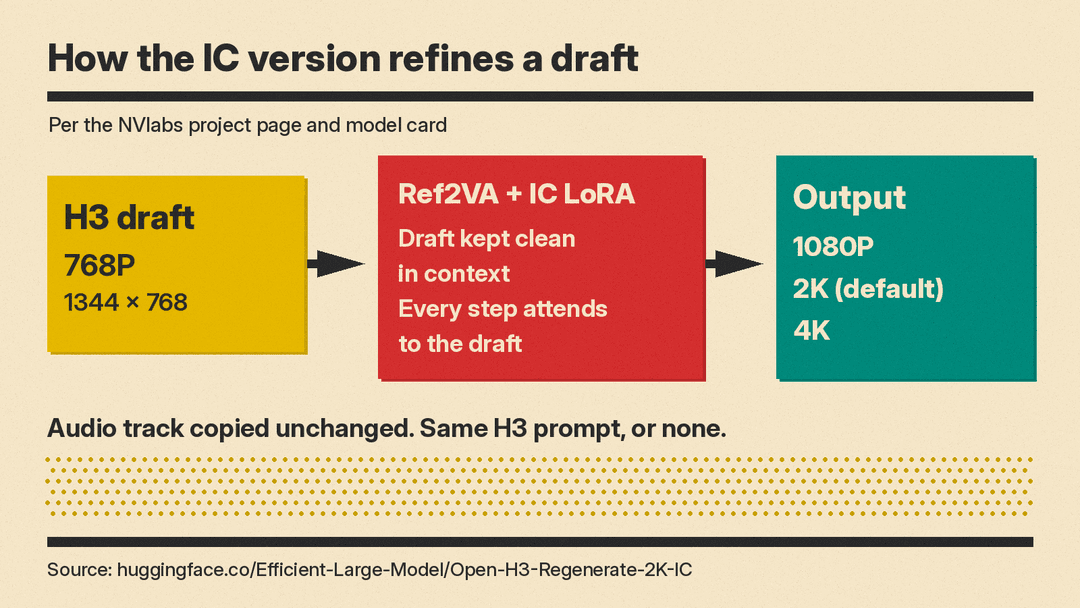
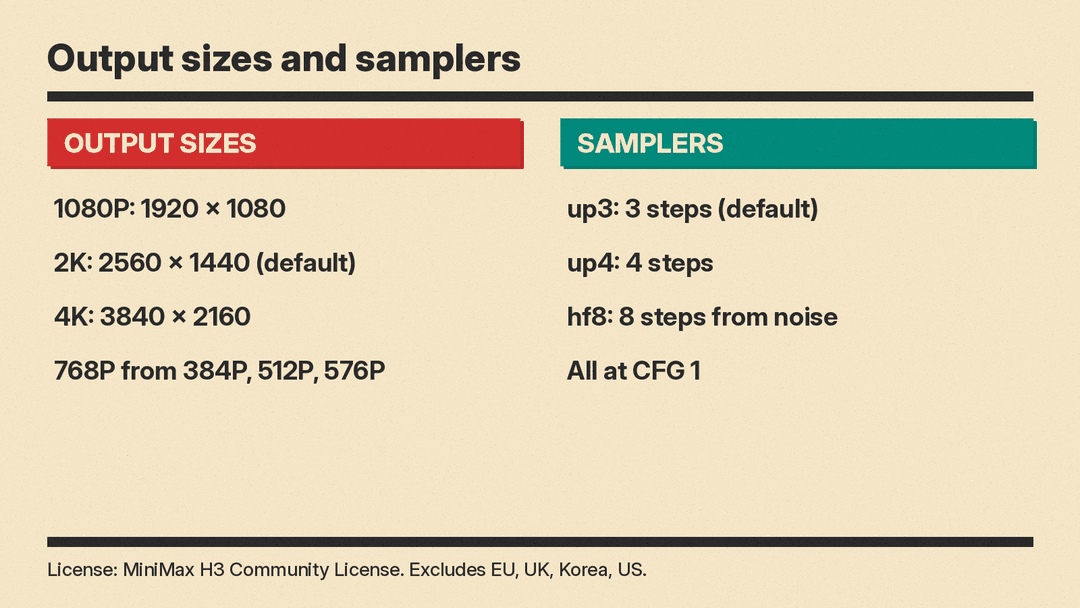
In this pipeline, a "draft" means the low-resolution first pass that MiniMax H3 produces. The IC model reads a 768P draft at 1344x768 and outputs 1920x1080, 2560x1440 (the default) or 3840x2160. It also accepts smaller 384P, 512P or 576P drafts up to 768P. The published config reads drafts at 24 fps and 124 frames, about five seconds of video. The draft's audio track is copied to the output unchanged.
How the IC version works
The project page explains that H3 ships a reference-to-video transformer called Ref2VA, which reads reference videos as extra tokens. The team keeps Ref2VA frozen and trains a LoRA on it at rank 384. A LoRA is a small add-on file that adjusts a big model without retraining it.
The draft stays clean in the transformer's context as a reference, the high-resolution video is generated next to it, and every step attends to the draft. As the project page puts it, "faces, lip sync, text and layout follow the draft while the detail is drawn at 2K or 4K." Training used real clips ranging from 768P up to 4K, with lower-resolution and sometimes blurred copies serving as the reference.
Three samplers are included: up3 (three steps, the default), up4 (four steps) and hf8 (eight steps from pure noise). All run at CFG 1, so each step costs one transformer call. The release bundles a HyperFlow 8-step LoRA and the community LMS Sharp v1.0 LoRA by Alissonerdx, merged at load time, plus a community 3D-convolution latent upscaler and a fast H3 VAE decoder with 24 layers. Users pass the original H3 prompt unchanged as the caption, or leave it empty.
What changed from the first Open-H3-Regenerate-2K
MiniMax H3 builds a video in two steps. The base model sets content and motion at low resolution, then MiniMax's H3-Regenerate-2K redraws it at 2K. Only the first step is open. The refiner is a hosted API with no released weights. The NVlabs team published an open replacement, Open-H3-Regenerate-2K, in late October, with its Hugging Face repository created on October 26. That first version re-noises the draft and redraws it in three steps, and the project page says it "adds detail but can drift on faces, mouths and lettering." The IC version instead keeps the draft intact as a reference.
On its own selected examples, the team reports that "the previous model draws more texture but moves eyes, wrinkles and mouth shapes away from the draft; the IC version keeps them." In a car park clip compared against the official H3-Regenerate-2K API, the official output turns a sign into unreadable marks while the IC version keeps "PRIVATE CAR PARK." These are examples chosen by the team. No benchmark numbers are published for the IC version.
Numbers do exist for the earlier, non-IC release. According to the project page, on one B200 GPU, a five-second 2K clip took 22.45 seconds with the team's SoL-Engine optimizations versus 87.26 seconds without them. On the RefinerBench-150 test set it scored higher than the official API on aesthetic quality, imaging quality and subject consistency, and in a blinded study it was preferred in 87% of 200 judgments. Those figures describe the first version, not IC.
Hardware and setup
The model card shows running the model with torchrun, and its example uses 8 GPUs. The transformer can be sharded over 1, 2, 4, 7 or 8 GPUs. The repository bundles an unmodified copy of the MiniMax H3 components it needs. A merge script produces one combined LoRA for tools that load a single LoRA per model. No minimum VRAM figure is published for the IC version.
License: who can use it
The release is under the MiniMax H3 Community License. Its "Excluded Territories" are the European Union, the United Kingdom, the Republic of Korea and the United States of America, and use of the works or their outputs outside the allowed territory is not authorized. The license says people in excluded territories can contact MiniMax about a license. Commercial products with more than 20 million US dollars in yearly revenue need separate written authorization from MiniMax, and commercial products must display "MiniMax H3" in the interface. Third-party parts keep their own licenses; the latent upscaler ships Apache-2.0 weights with MIT code.
Why it matters
In our view, the final high-resolution pass is where a good draft can be lost. Holding identity and on-screen text steady across that pass matters for talking heads, product shots and ads, where a shifted mouth or a garbled sign ruins the take. Readers comparing approaches may also want our rundown of other AI video upscalers for old low-res clips, which work on finished footage rather than on a model's draft.
Open H3 add-ons are also accumulating. We covered Pika H3 Flex and TaoMate-HD, both built on the same base family. The limit here is legal rather than technical. The license blocks users in the United States, the United Kingdom, the European Union and Korea, so many readers cannot use it today.
What we don't know yet
No benchmarks are published for the IC version, and there is no speed figure for it, so the 22.45 second number from the earlier release should not be read across. No minimum VRAM requirement is stated. It is also unclear whether MiniMax will change the excluded territory list.
Sources
- Hugging Face: Efficient-Large-Model/Open-H3-Regenerate-2K-IC model card
- NVlabs project page: Open-H3-Regenerate-2K and the IC version
- GitHub: NVlabs/Sana, Open-H3-Regenerate-2K/IC code (sol-engine branch)
- MiniMax H3 Community License (copy in the repo)
- Hugging Face: Efficient-Large-Model/Open-H3-Regenerate-2K (first version)
