

OpenAI said on Monday that its internal models produced three new results in mathematics, computer science and physics. The one that will draw the most attention is in computer science: OpenAI says its system proved that the Exponential Time Hypothesis (ETH), a conjecture that hundreds of papers rely on, is false.
None of the three results has been independently confirmed yet. OpenAI has handed each one to a group of outside experts, and the computer science group says plainly that its role is to check the claim, not to vouch for it.
What OpenAI announced
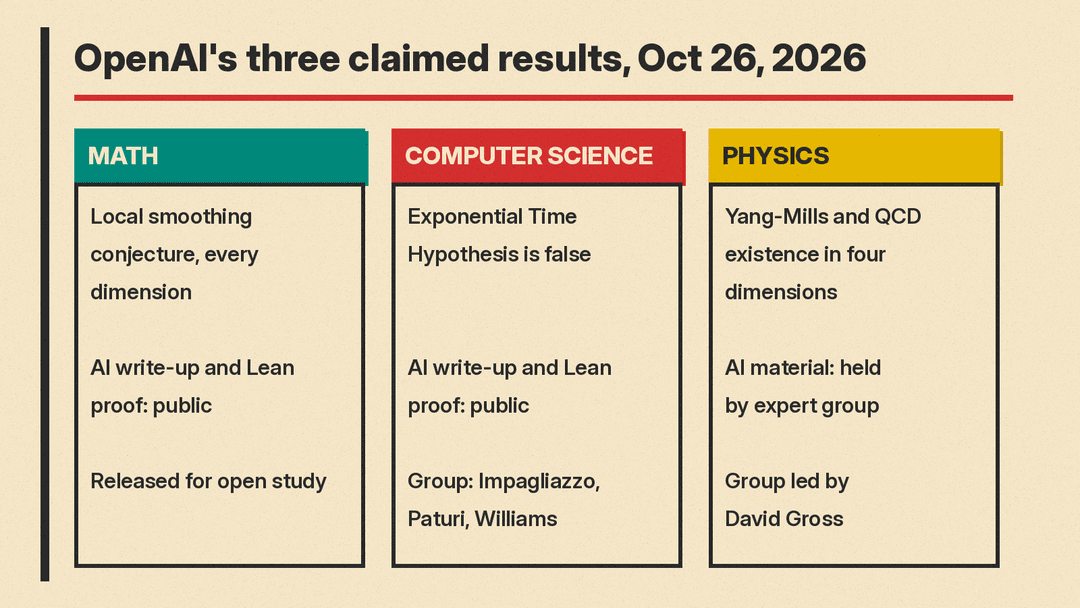
In its announcement, OpenAI lists three results:
- Math: a proof of the local smoothing conjecture, proposed by Sogge in 1991, in every dimension. OpenAI says this "therefore also resolve[s] the Kakeya conjecture and Stein's restriction conjecture in all dimensions." Earlier work had proved local smoothing in two dimensions in 2019 and the Kakeya conjecture in three dimensions in 2025.
- Computer science: a disproof of the ETH, which OpenAI describes as "a longstanding conjecture about the computational complexity of Boolean formula satisfiability, a problem deeply related to the P vs. NP problem."
- Physics: "a mathematically rigorous existence proof of certain interacting quantum field theories containing gauge fields and fermions in four dimensions, including Quantum Chromodynamics (QCD) and a unified completion of the Standard Model of particle physics." OpenAI says the work includes a proof of the existence of pure Yang-Mills theory, "which is part of the Quantum Yang-Mills Theory Clay Mathematics Institute Millennium Prize problem."
What the ETH is, and what OpenAI claims
The Exponential Time Hypothesis, proposed by Impagliazzo and Paturi, says that 3-SAT, a basic version of the Boolean satisfiability problem, cannot be solved in subexponential time in the worst case. Researchers use it as a starting assumption to show that other problems are hard. OpenAI says the ETH "has been used in hundreds of papers to derive conditional computational hardness results across a wide variety of fields including graph theory, computational biology, databases, computational geometry, and more."
OpenAI says its AI found the natural language disproof on October 16, 2026, and that the result was formalized in Lean, a language that checks proofs by machine, on October 17. The scope note in OpenAI's public math repository says the Lean proof shows that, for fixed k, a deterministic machine exactly counts the satisfying assignments of a k-CNF formula on n variables in subexponential time, using polynomial space.
OpenAI does not claim this makes everyday software faster. "The refutation of the ETH reopens questions about how much faster these tasks could become, and may help guide the search for better algorithms," the company wrote. OpenAI added that finding such algorithms, and turning theoretical advances into practical improvements, "will require significant further research."
Who is checking it
OpenAI says the ETH result "will be verified and shepherded by a group led by Russell Impagliazzo (UC San Diego), Ramamohan Paturi (UC San Diego), and Ryan Williams (MIT)." Impagliazzo and Paturi, with Francis Zane, originally proposed the ETH. OpenAI says Williams has refuted strong versions of it.
According to The Next Web, the three researchers wrote in an open letter: "Our involvement should not be taken as certification of the claim. A result of this significance requires careful, independent scrutiny." They also wrote: "If the claim is correct, it will change an important part of theoretical computer science."
The group asked OpenAI to make all raw data on the result public and to fund a conference on its implications. OpenAI says it agreed to both. The Next Web reports that, according to Williams, the group signed no nondisclosure agreements and will not be paid.
The physics result will be shepherded by a group led by Nobel laureate David Gross, with Michael Douglas, Arthur Jaffe, Igor Klebanov and Nikita Nekrasov. That group decided "to hold off on releasing the AI-produced artifacts and instead work on writing it up themselves," OpenAI says. For the math result, OpenAI released the AI write-up and a Lean proof and left researchers free to organize their own efforts, as it did with its October 6 release.
Three ways to release a result
OpenAI frames the announcement as a test of how to publish AI-made results. It calls the manuscripts "a form of raw research data" and says it tried three release strategies, one per result. OpenAI says it does not know yet which approach will work best.
The company set four principles for the outside groups: transparency, no academic credit for OpenAI, recognition for the people who explain the results, and independence. "We do not seek academic credit for the discoveries produced by our internal models," OpenAI wrote. It also says inviting a researcher to steward a collaboration "does not imply that they or their working group made the original discovery."
OpenAI also points to the tradeoffs. "Choosing initial shepherds necessarily shapes who gets involved first and creates asymmetry of information," the company wrote, and it asked for feedback on how to broaden participation.
The Next Web reports that the three computer scientists raise the same issue of credit in their letter. They warn that recognition may go to those who publish first or have the most powerful tools, while checking and explaining the work gets less credit.
What to watch
A Lean check is strong evidence that each step follows, but reviewers still need to confirm that the formal statement matches the conjecture people mean. A guide from Cairn Commons on OpenAI's October 6 release makes that point. It lists "Is the formal statement the conjecture?" as the first question a Lean proof leaves open.
The next signals to watch are written reports from the Impagliazzo, Paturi and Williams group, the conference OpenAI agreed to fund, and the physics group's own write-up. OpenAI also points to its recent $5 million contribution to the Simons Foundation, which it says will support workshops, conferences and programs to help researchers understand and build on results produced by AI.
Sources
- OpenAI: Working with academic communities to build scientific understanding
- OpenAI math repository: Lean scope note for "The Exponential Time Hypothesis is False"
- The Next Web: OpenAI says its AI model has disproved the Exponential Time Hypothesis
- Cairn Commons: OpenAI's October 2026 math proofs, what is claimed, what is checked
- Wikipedia: Exponential time hypothesis
