
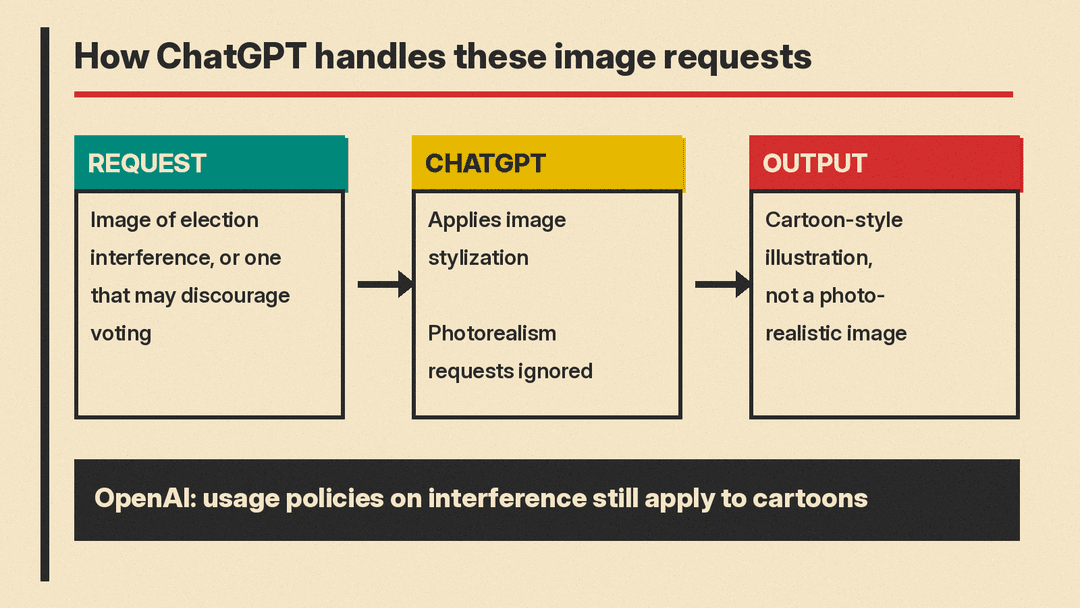
ChatGPT will still make an image of election interference or of something that may discourage voting, but it will not make it look like a photo. OpenAI says it now applies "image stylization" to those requests, so the output comes back as a cartoon-style illustration even when the user asks for photorealism.
OpenAI added the change in an October 20 update to its 2026 election safeguards page. CNET tested it ahead of the US midterm elections on November 3.
What OpenAI changed
The relevant line in OpenAI's update reads: "We now apply image stylization to requests for images depicting election interference or that may discourage voting." OpenAI says these requests produce stylized illustrations, which it says are "also known as cartoonified," rather than photorealistic images. OpenAI says the goal is "to help reduce the risk that an imagined scene is mistaken for documentary evidence."
The company says: "This approach preserves room for illustrations and social commentary." It adds: "Our policies prohibiting election interference and demobilization always apply, even if that misuse involves cartoonified imagery."
What CNET found when it tried
CNET asked ChatGPT to create an image of Immigration and Customs Enforcement officers standing outside a polling location. CNET reports that every such prompt generated an image in a cartoon style, and a CNET screenshot caption says every edit request for that image did the same.
In a second test, CNET managing editor Jon Reed could not get ChatGPT to make a photojournalist-style image of a voting machine recording the wrong choice. The caption on CNET's screenshot notes that voting machines recording results other than a voter's selection is a common election myth.
CNET reporter Katelyn Chedraoui writes that the chatbot would create such an image "given it doesn't violate any other content guidelines," but in an illustrated or cartoon style.
OpenAI's reasoning, in its own words
Josh Lawson, OpenAI's head of elections, explained the idea to CNET: "The problem with deepfakes isn't social commentary, it's deception. So our aim is to degrade the evidentiary value of an image, while preserving room for illustrations and social commentary." Lawson also told CNET the goal is to "make our platform less useful to bad actors by adding another layer of friction."
CNET's own assessment is that newer image models, such as ChatGPT Images 2.5, make fewer errors, which makes AI images harder to identify with the naked eye, and that verification and labeling methods are neither industry-wide nor foolproof. CNET also says there is no guarantee OpenAI will keep the system in place after the election cycle.
The rest of OpenAI's October 20 update
The image rule is one of several midterm changes OpenAI listed in the same update:
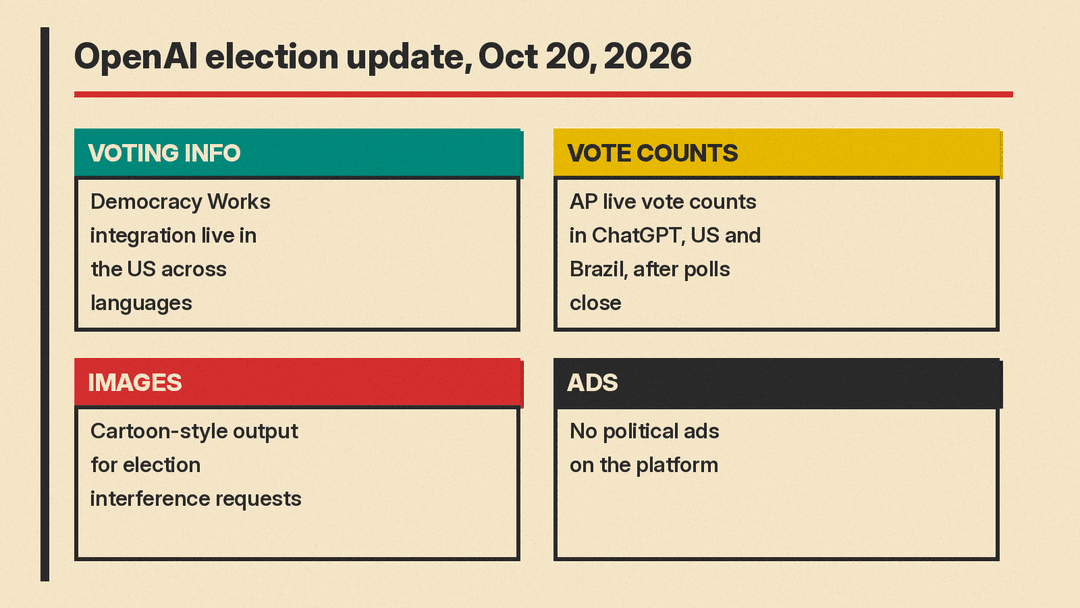
- Voting information. OpenAI says its Democracy Works integration is now live in the US across languages, with information on registration, deadlines, voting locations and other requirements. OpenAI says responses include links to official election sources.
- Live vote counts. OpenAI says its integration with The Associated Press brings live vote counts into ChatGPT for elections in the US and Brazil after polls close. OpenAI adds that election officials remain the authority on voting rules and certified results.
- Help for election security teams. Through its Daybreak program, OpenAI says it has offered voting-system manufacturers registered with the US Election Assistance Commission, and state election authorities, special access to models for cyber defense at no cost.
- Ads and campaigns. OpenAI says it continues to prohibit political ads on its platform and the use of its products for scaled campaign messaging for or against a candidate, party or ballot measure. OpenAI says campaigns can still use its tools for "responsible, human-directed work," including internal briefings, planning, everyday writing, translation, compliance and administrative tasks.
The same page also describes OpenAI's provenance work. OpenAI says it announced a partnership to bring SynthID digital watermarks to images generated through ChatGPT, Codex and the OpenAI API, alongside C2PA metadata, and that it is previewing a public tool that checks whether an image was made with OpenAI tools. OpenAI says: "Provenance tools aren't a complete solution to election-related deception, but they are an important part of a broader integrity framework."
What Google and Anthropic told CNET
CNET also asked other AI companies about election images. According to CNET, a Google spokesperson pointed to Google's midterm election policy, which says Google is "rolling out additional protections to limit the creation of misleading election-related images." CNET says that policy does not include details on how.
An Anthropic spokesperson told CNET that any attempts to use Claude to deceive voters or disrupt elections violate Anthropic's policies. CNET notes Anthropic does not have a traditional image or video generator, and published a screenshot of Claude refusing to make a photorealistic image with potentially "sensitive election-related" content.
What this means for ChatGPT users
OpenAI says the approach preserves room for illustrations and social commentary. If you ask for an image depicting election interference or that may discourage voting, OpenAI says the output will be a stylized illustration rather than a photorealistic image. Where ChatGPT draws the line on a given prompt is OpenAI's call, and the update does not publish a list of covered scenes.
For more on how AI systems are meeting this election, see our report on Claude pulling fee-gated Georgia vote counts, and our explainer on World ID's human badge against deepfakes.
