
SpaceX will lease, not buy, a batch of Nvidia chips due to arrive next year. On October 26, 2026, the company said it has a binding commitment for an approximately $40 billion master finance lease with an entity managed by Apollo Global Management. The lease "will deliver the next generation of NVIDIA Vera Rubin chips for SpaceX's terrestrial compute buildout," the release says, and SpaceX calls it "the largest committed GPU financing."
It is one of two very large chip financings announced on October 26. The same day, banks and Blackstone lined up $63 billion to buy Broadcom chips for Anthropic. The two deals use different structures, and the SpaceX filing gives more detail on how the money is paid back.
How the lease works
The details are in a Form 8-K that SpaceX filed with the SEC. It says that on October 24, 2026, SpaceX signed a binding commitment letter with the Apollo-managed lessor.
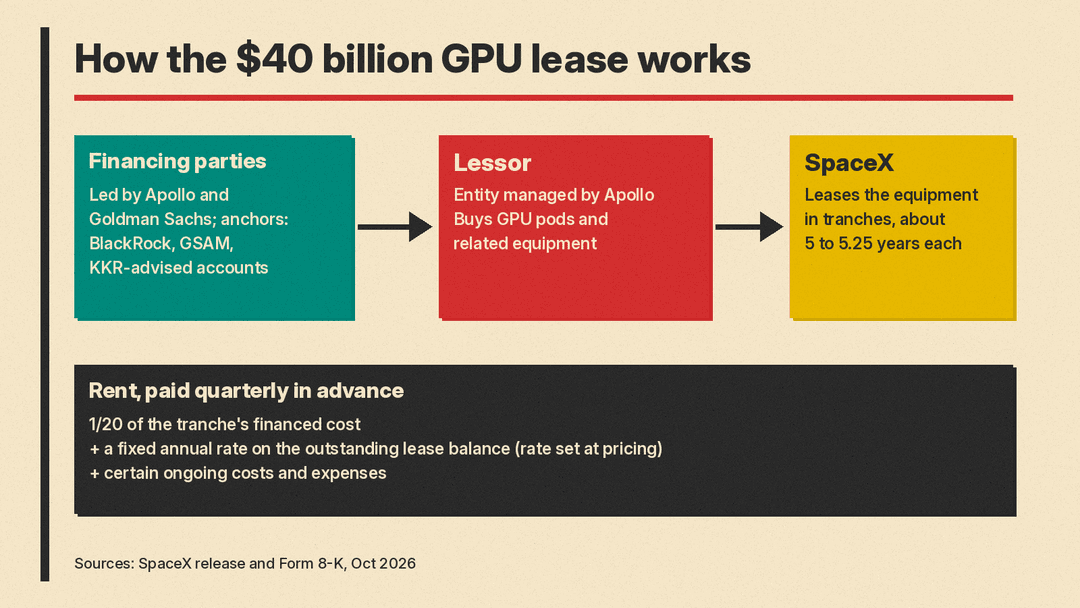
- The lessor buys the hardware. It "will acquire and lease to the Company certain graphics processing unit pods and related equipment," per the 8-K, for use at data centers that SpaceX selects.
- Delivery comes in tranches. Each tranche has its own lease schedule, with a term of "approximately five to five and one-quarter years" from its start date.
- Rent is paid quarterly, in advance. It generally equals "one-twentieth of the financed cost of the applicable tranche," plus an amount at a fixed annual rate on the outstanding lease balance, plus "certain ongoing costs and expenses."
- The rate is not set yet. The fixed rate "will be determined at pricing," which happens before SpaceX enters the master lease.
- About $40 billion in principal. SpaceX "expects aggregate principal payments under the lease schedules over their respective terms to total approximately $40 billion."
One-twentieth per quarter means 20 quarterly payments repay the financed cost of a tranche, which is five years. That matches the stated lease term. In plain terms, SpaceX pays off the chips over roughly the lease term, plus interest.
Who is putting up the money
The SpaceX release, also posted by Apollo, names the backers:
- Apollo and Goldman Sachs lead the financing parties. Goldman Sachs "served as sole structuring agent."
- Anchor commitments came from funds and accounts managed by BlackRock, Goldman Sachs Asset Management, and capital accounts advised by KKR.
The release does not say how much each party committed.
Timeline
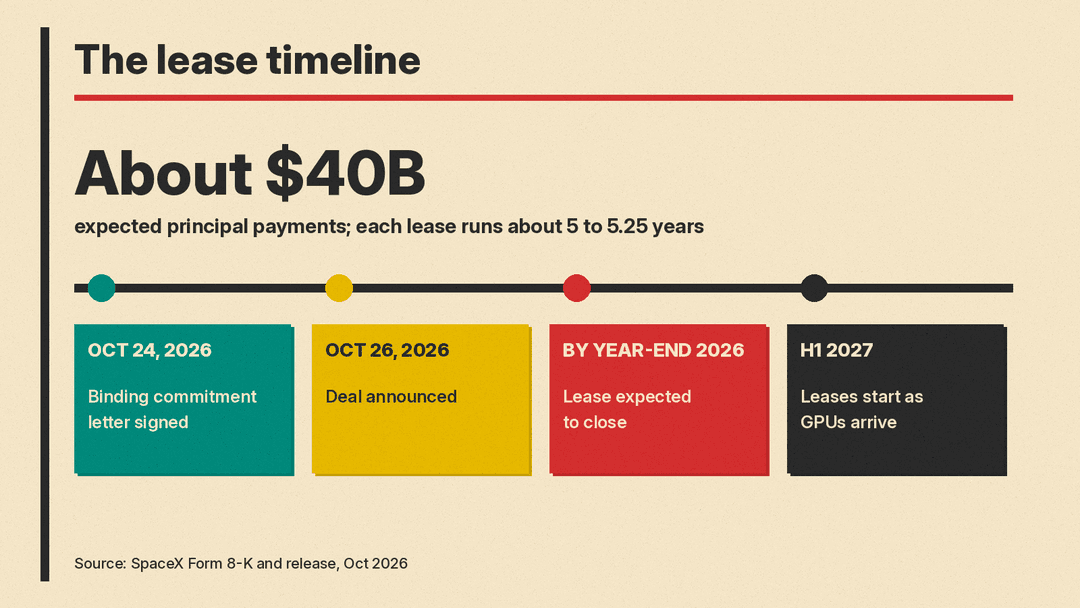
- October 24, 2026: binding commitment letter signed (8-K).
- Before year-end 2026: the lease is expected to close, subject to "certain specified closing conditions."
- First half of 2027: lease schedules are expected to start "upon delivery of GPUs and related equipment."
Reuters reports that Elon Musk said on X on Sunday that SpaceX had "closed" $40 billion in debt financing for GPUs. The filing is more careful: the deal is a commitment, and closing is still expected later. Per Reuters, Musk said the funding mainly targeted chips arriving in the first and second quarters and would not be "a major factor this quarter."
What SpaceX says the compute is for
CFO Bret Johnsen said in the release: "SpaceX aims to deploy the largest compute infrastructure in the world. As demand for compute continues to accelerate, we're seeing less than one year payback periods on our SI infrastructure investments." He said the lease "diversifies our funding sources and addresses a notable portion of the funding required to deliver on our growth plans," to power Grok "for enterprises and consumers, as well as serve existing and future cloud services customers."
The payback claim is SpaceX's own figure. The release gives no data behind it. Reuters adds that Johnsen had said SpaceX still expects fourth-quarter capital expenditure of $35 billion to $40 billion.
How it compares with the Broadcom and Anthropic deal
In both deals, a lender-funded entity buys the chips and leases them to the company that uses them. The structures differ:
- SpaceX: a master finance lease directly between SpaceX and an Apollo-managed lessor, with rent that repays the cost over about five years. The SpaceX release and 8-K do not mention any guarantee from Nvidia.
- Anthropic: a new special purpose vehicle buys Broadcom XPUs and networking gear and leases them to Anthropic. Broadcom provides "residual value support" equal to the first lien portion of the financing.
Why it matters
Chip leases move the cost of AI hardware off a single up-front bill and onto a schedule of payments. For SpaceX, the 8-K sets quarterly rent for about five years per tranche, at a fixed rate that is not yet priced. The Vera Rubin chips in this lease are not expected to arrive until 2027.
What we do not know yet
- The fixed interest rate. It is set at pricing, before the master lease is signed.
- How many GPUs or pods $40 billion buys, and which data centers will host them.
- How much each financing party committed.
Sources
- SpaceX Secures $40 Billion in the Largest GPU Financing Ever (SpaceX, Oct 26, 2026)
- SpaceX Form 8-K, binding commitment letter dated Oct 24, 2026 (SEC)
- SpaceX Secures $40 Billion in the Largest GPU Financing Ever (Apollo, Oct 26, 2026)
- SpaceX enters $40 billion deal with Apollo for AI chip financing (Reuters via Investing.com, Oct 26, 2026)
- SpaceX locks in $40B GPU financing deal with Apollo (TechCrunch, Oct 26, 2026)
- Broadcom $63 billion financing structure announcement (Broadcom, Oct 26, 2026)
