
Google says AI math tutoring built on Gemini gave UK students support comparable to human tutors on classwork. But on an independent standardized test, neither AI nor human tutoring did better than static hints, and a human expert checked every AI reply before a student saw it.
Google published the results on October 29, 2026, in a blog post by Kevin McKee, Evaluations Lead for AI for Edu at Google DeepMind, and Amanda Rosenburg, Staff Researcher at Google for Education. The post covers two studies: a math tutoring trial in the UK and a yearlong classroom study in Italy. This is Google's own research on its own product. All figures below come from Google and its partners.
The UK trial: what Google tested
Google ran a 10-week randomized controlled trial (RCT) with the math platform Eedi. Google says it involved over 1,100 students ages 12 to 15. The full technical report, from the LearnLM Team at Google and Eedi, puts the number at 1,179 students across 10 state secondary schools.
When a student got a question wrong, they received one of three types of support:
- a static hint
- help from a human tutor
- interactive AI tutoring that combined Eedi's teaching resources with Gemini
The technical report splits AI tutoring into two versions, one with added context about each student's learning history, for four groups in all. Teachers monitored progress in class, and tutors guided students one-on-one through the platform. Google tracked results on regular Eedi assignments, on intermediate quizzes, and on independent STAR standardized tests.
What Google says it found
Google says: "Across in-platform tasks and intermediate quizzes, students receiving AI tutoring performed similarly to those paired with human tutors."
Google also reports that the AI pushed students to think instead of handing out answers. Following a teaching prompt Google provided, Gemini guided students instead of giving answers in nearly 99% of sessions. Students worked through the math themselves in more than 85% of their chats.
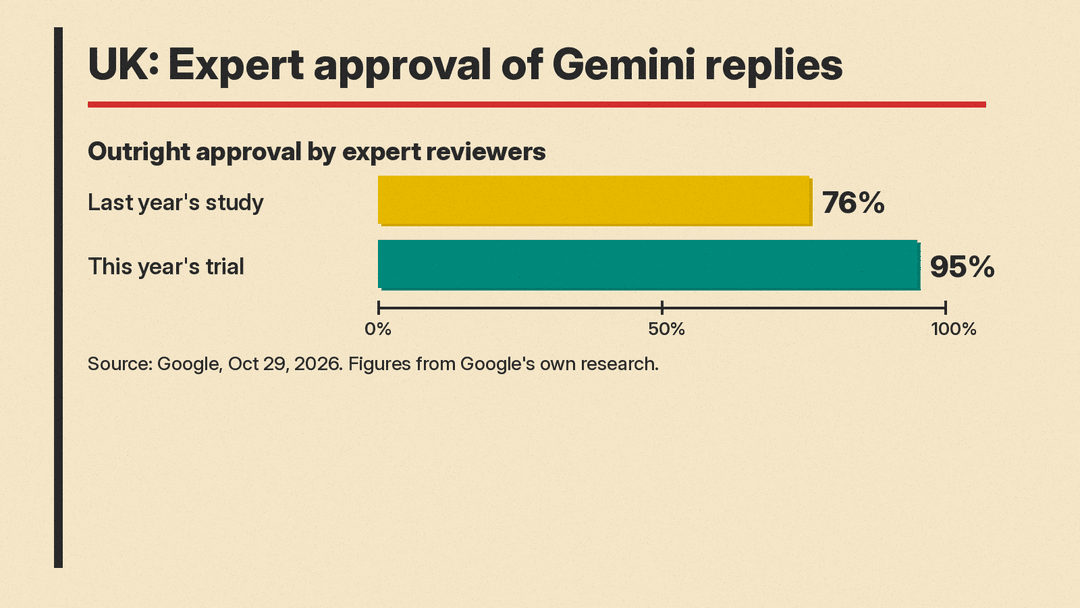
Model quality also went up compared with last year's exploratory study. Google says expert reviewers' outright approval rate rose from 76% to 95%, which it describes as a quality improvement of nearly 25%. The technical report says supervising tutors approved 94.7% of 94,385 drafts without any changes. It also says retrospective audits found math errors in fewer than three in every 1,000 AI messages.
The caveats: tests and human review
Two limits matter before reading this as proof that AI can replace tutors.
First, the gains did not show up on STAR standardized test scores over the trial period. The technical report says neither form of AI tutoring beat standard remediation on Star Maths, and students with expert human tutors did slightly worse than the other three groups, a result the report calls surprising. Google's explanation is time. Step-by-step tutoring takes longer per question than a simple hint, so students solved fewer problems per session: about 14 with AI tutoring versus 19 with static hints. Over 10 weeks, Google says, that meant students covered less of the curriculum, and the trial was not long enough to cover the broad range of topics on the STAR test. The technical report calls its explanations tentative. It also says exploratory analyses found tutoring effects on Star Maths were more favorable for girls than for boys.
Second, this was not unsupervised AI. Google says: "To ensure teaching quality, human experts reviewed every AI response in real time before it reached a student." The technical report says tutors could approve, regenerate or rewrite each message before delivery.
The Italy study: lesson planning with Gemini
In Italy, Google worked with the Salesians of Don Bosco school network and the Pontifical Salesian University in Rome on a yearlong study across 31 schools. It involved 1,600 teachers, who Google says represent over 24,500 students ages 13 to 18. Researchers compared lessons planned with and without Gemini for Education.
Google reports these results for lessons teachers co-designed with Gemini:
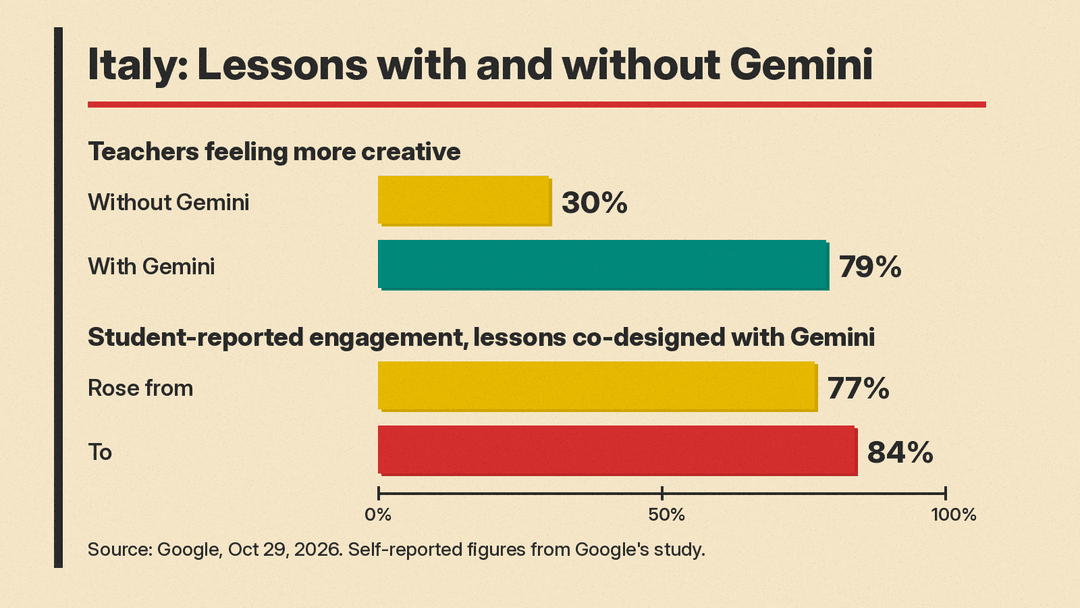
- Teachers said they felt more creative than usual in teaching and planning: 79% with Gemini versus 30% without.
- Traditional front-of-class lectures dropped by 38%.
- Student-led collaborative learning nearly tripled, through workshops, group activities and peer discussions.
- Student-reported engagement rose from 77% to 84%.
- Teachers' reliance on their own energy to keep a room engaged dropped by 66%.
- Lessons where the activity design itself drove engagement went from 23.2% to 52.2%.
Several of these numbers are self-reports. Google points to the Don Bosco CNOS-FAP Foundation for more on the implementation. The foundation's page describes a published volume that collects results from the project, which it calls Go Beyond Traditional Education. That page gives wider project totals than Google's study: over 1,600 educators, 29,000 students and more than 50 Salesian institutions.
Why it matters
The technical report notes that classroom RCTs of AI are rare, and that most experiments look at brief exposures or narrow tasks.
For parents and teachers, the UK result is mixed. AI help matched human tutors on the work students did in the platform. It did not move a broad standardized test in 10 weeks. And every reply had a human reviewer behind it.
The Italy study points to a different use: AI as a planning partner for teachers, not a stand-in for them. Google's own summary says: "These findings show that AI works best when it supports teachers and encourages active learning in the classroom."
For more on Gemini in school, see our explainer on Gemini Immersive Explorations. For other options, see our guides to the best AI tools for teachers and AI tutors for students.
The next test is a full-year trial. Google says it is exploring follow-up trials across a full academic year and expanding its metrics.
