DeepSeek launches Harness, an open agent framework, and raises V4-Pro API prices
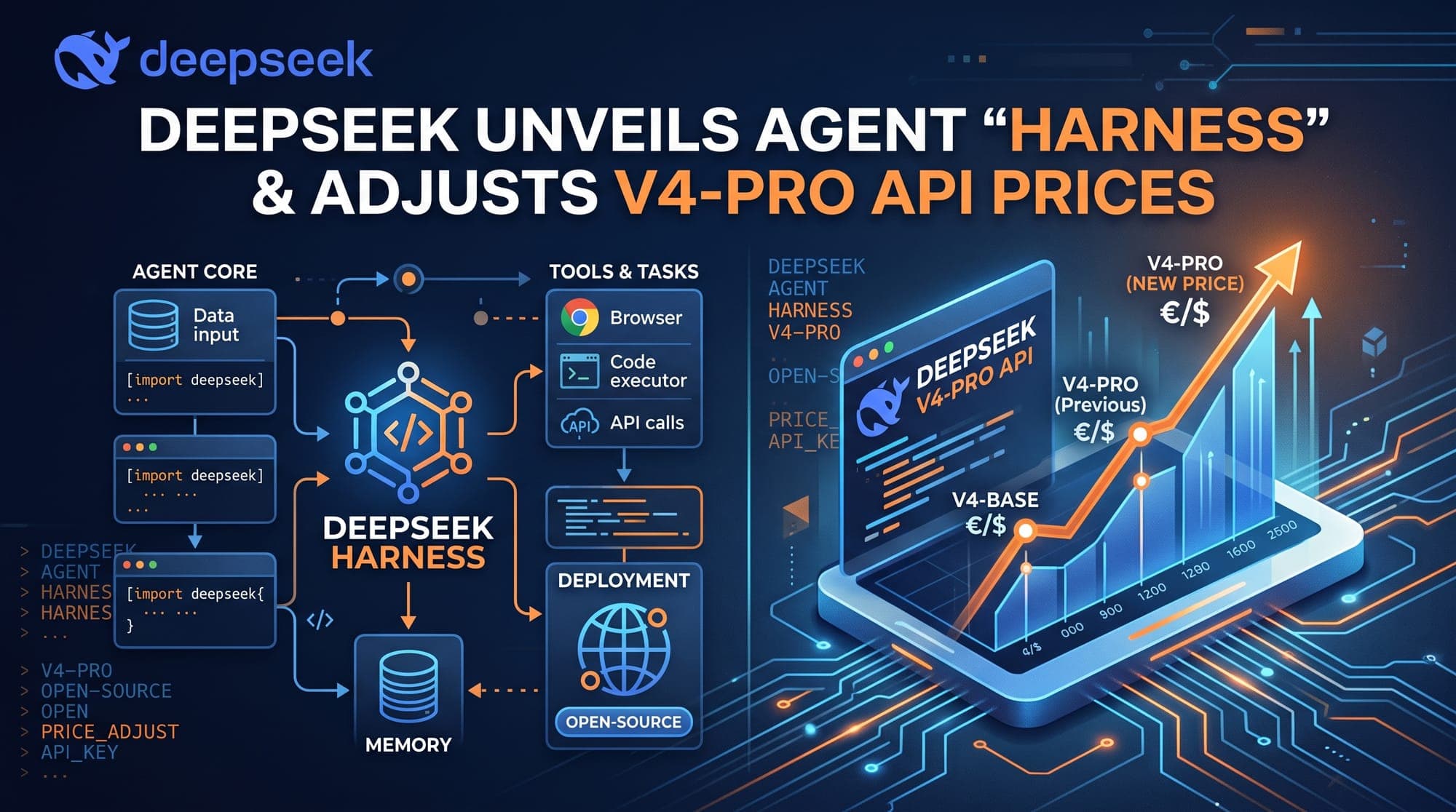
DeepSeek released DeepSeek Harness v0.1, an MIT-licensed open-source agent harness that gives developers a modular alternative to vertically integrated coding agents like Anthropic's Claude Code and OpenAI's Codex. At the same time, the company moved DeepSeek-V4-Pro to general availability with "significantly enhanced agent capabilities" and introduced peak/off-peak API pricing that roughly doubles costs for many workloads starting August 16.
Harness: everything is a plugin
DeepSeek Harness (`dsh`) is built on Cordis, a plugin-oriented framework. The project's guiding principle is "everything is a plugin" — models, tools, skills, sessions, sandboxes, filesystems, orchestration loops, and user interfaces can all be swapped or extended.
The harness can already inspect repositories, edit files, execute shell commands, search files and the web, maintain plans, invoke skills, delegate to subagents, and enforce approval policies. It launches via `npx @deepseek-ai/dsh web` and includes a local web UI for workspace selection and operation approval.
DeepSeek positions Harness as a model-agnostic alternative to the agent infrastructure underpinning Claude Code and Codex, not a full drop-in replacement for their broader developer experiences. Key differences: Harness is in developer preview with breaking changes expected; it lacks hosted background agents and GitHub-native PR workflows; its primary interfaces are a local web UI, headless CLI, and Python SDK. Its extensibility is exceptional — virtually every component is replaceable — and it supports DeepSeek, Anthropic, OpenAI, and custom-compatible endpoints.
On launch day the repository showed roughly 27,500 GitHub stars and 2,000 forks, though those figures are a snapshot rather than an adoption metric.
V4-Pro: agent-focused update, new pricing
The general-availability DeepSeek-V4-Pro-0813 adds "significantly enhanced agent capabilities" and native support for the OpenAI Responses API and Codex integration. The model identifier `deepseek-v4-pro` now resolves to this version across the web, mobile app, and API.
DeepSeek also introduced three reasoning-effort levels — Non-think, Think High, Think Max — as a deployment knob for agent systems to balance latency and token spend against problem difficulty.
Company-reported benchmarks show V4-Pro-0813 scoring 87.9 on Terminal Bench 2.1, 74.1 on Toolathlon-Verified, 71.1 on DSBench-FullStack, and 67.2 on DSBench-Hard. Some agent results were measured using DeepSeek Harness in "minimal mode," meaning they reflect the model-harness combination rather than the model alone.
Pricing pivot: peak and off-peak rates from August 16
Beginning 16:00 UTC on August 16, DeepSeek replaces its flat API pricing with time-based rates. Peak hours are 01:00–04:00 UTC and 06:00–10:00 UTC; all other hours are off-peak (half the peak price).
For V4-Pro, off-peak cache-miss input rises from $0.435 to $0.66 per million tokens and output from $0.87 to $1.98. Peak rates reach $1.32 input and $3.96 output. Cached input costs also increase substantially: V4-Pro cache hits move from $0.003625 to $0.022 off-peak and $0.044 peak.
V4-Flash off-peak moves from $0.14/$0.28 to $0.22/$0.66; peak reaches $0.44/$1.32.
A simple 1M-in/1M-out workload on V4-Pro currently costs $1.305. The same workload will cost $2.64 off-peak (2x) or $5.28 peak (4x). V4-Flash moves from $0.42 to $0.88 off-peak and $1.76 peak.
Reuters reported the changes represent increases of 50% to over 1,100% depending on model, token category, and time of use. DeepSeek's "50% lower" off-peak framing compares against its own new peak rate, not against current prices developers pay today.
The shift creates a strategic tension: DeepSeek is opening its agent stack while making its hosted API considerably more expensive. For organizations evaluating the platform, workload scheduling, caching behavior, and the option to run open weights on their own infrastructure become more important cost factors.
Sources:
- VentureBeat: "DeepSeek Harness launches as open source rival to Claude Code, alongside V4-Pro on API with higher prices" (Aug 13, 2026) https://venturebeat.com/technology/deepseek-harness-launches-as-open-source-rival-to-claude-code-alongside-v4-pro-on-api-with-higher-prices
- DeepSeek API pricing announcement (X): https://x.com/deepseek_ai/status/2087864589895798968
- Reuters: "DeepSeek releases official V4-Pro model as it steps up expansion" (Aug 13, 2026) https://www.reuters.com/world/china/deepseek-releases-official-v4-pro-model-it-steps-up-expansion-2026-08-13/
- DeepSeek Harness repository: https://github.com/deepseek-ai/deepseek-harness