
DeepSeek and Moonshot AI relied heavily on outputs from OpenAI's GPT-6 Astra when they trained their newest models, The Information reported on Wednesday, October 28, 2026. The report, by Jing Yang, Juro Osawa and Qianer Liu, cites people with direct knowledge of the matter, according to Reuters.
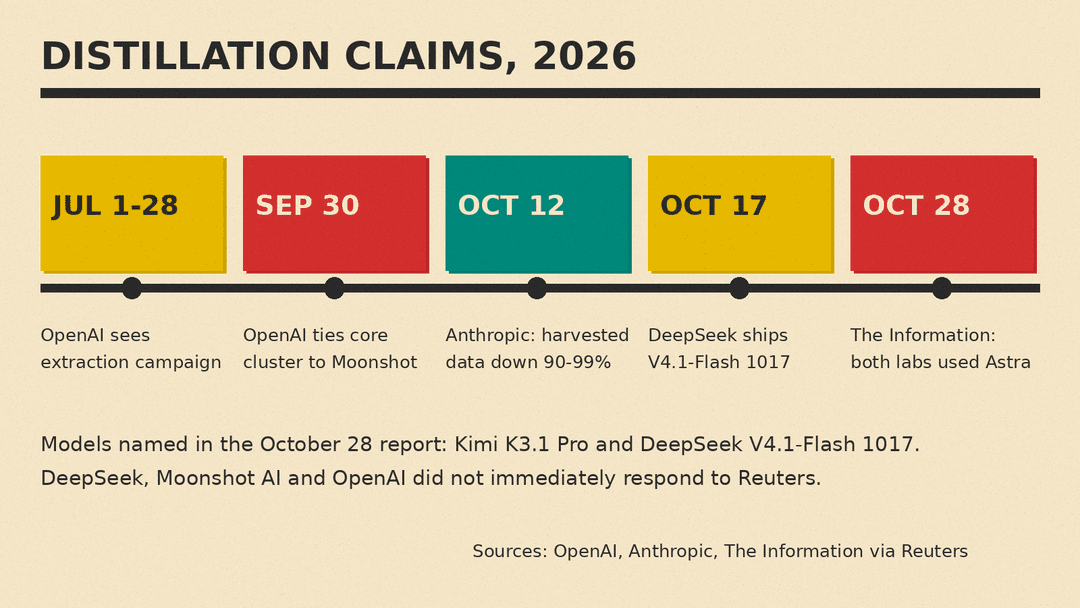
The two models named are Moonshot's Kimi K3.1 Pro, which Reuters said was released last week, and DeepSeek's upgraded V4.1-Flash 1017, which launched on October 17. Both "benefited from distilling Astra, The Information said," in Reuters' summary.
OpenAI, DeepSeek and Moonshot AI did not immediately respond to Reuters requests for comment.
What the report says
The Information describes GPT-6 Astra as the most powerful model OpenAI has released. It says demand for the model has been strong since its release in early September, and that one growing group of users is Chinese AI labs that want to extract its capabilities. The headline calls Astra the "top distillation target" for China's AI labs.
The full article is behind a paywall. The claims above come from its public preview and the Reuters summary. Those public parts do not say how much Astra output each lab used or how it was collected.
What distillation means here
Distillation is a training method in which one model learns from the outputs of another, stronger model. The dispute is about using a rival's model this way without permission.
OpenAI calls the unauthorized version "adversarial distillation." In a September 30 post, it defined this as "the systematic and unauthorized use of one model's outputs or reasoning to help train, reproduce, or improve another model." Reuters notes that the practice "has become a flashpoint for leading AI companies as US-China technology competition intensifies."
The earlier OpenAI case against Moonshot
This is not the first time Moonshot's name has come up. In the September 30 post, OpenAI said it found and stopped a campaign that tried to extract the hidden reasoning of its models. OpenAI said:
- The activity began on July 1 at low volume.
- On July 24 and 25 it saw 16,000 requests using an extraction pattern from over 4,000 users. OpenAI says these were attempted, not necessarily successful, extractions.
- Related activity spanned a cluster of more than 15,000 users, which it "fully disrupted by July 28."
- Operators copied encrypted reasoning from one conversation and asked a model in another conversation to decrypt and transcribe it.
- The operators did not break its encryption, compromise a database or reach stored user conversations.
On attribution, OpenAI was careful. It said it is unclear whether all operators came from a single actor, but "we attribute a core cluster of the activity to individuals associated with Moonshot AI, the developer of Kimi." It said it banned or restricted accounts and shared what it learned with other labs through the Frontier Model Forum. CNBC reported that OpenAI also shared findings through government information-sharing channels.
The new report goes further than that post in two ways. It names DeepSeek as well as Moonshot, and it links the practice to specific released models rather than to a cluster of accounts.
Anthropic says its defenses cut harvesting
The report lands 16 days after Anthropic published its own update. In an October 12 post, Anthropic said early evidence suggests its new methods "have reduced the amount of data harvested by distillers by around 90 to 99%." It said the number of Claude reasoning tokens that distillers extracted on its own platform is "consistently 10 to 100 times lower than it was before," and that it has banned tens of thousands of accounts associated with distillation.
Those figures are Anthropic's own estimates. Anthropic also wrote that it does not yet know how long the gains will last, and that it expects distillation to "remain a cat-and-mouse game." Reuters reported that Anthropic cited Z.ai, also known as Zhipu, as an example of a company that tried to distill Claude while it developed GLM-5.3. CNBC reported that a few weeks before OpenAI's post, Anthropic had accused several Chinese developers, including Moonshot AI and Alibaba, of using Claude to help train their own models.
Why it matters
For users, the report raises a question about two recent Chinese releases. We covered Kimi K3.1 Pro and safety tests of DeepSeek V4.1 Flash-1017. If the report is accurate, part of their quality may trace back to a US model, which would change how people read the gap between US and Chinese labs.
Three DeepSeek V5 model names sit in a test file in its Harness repository, though DeepSeek has announced no V5 model. Our look at the DeepSeek V5 names in Harness code explains why they are placeholders, not specs.
The debate over how much distillation explains is not new. On October 18, OpenAI's Dean Ball gave a personal estimate that distillation explains about 50% of how close Chinese models are to US ones, which we covered in our report on his estimate.
For the labs, it adds pressure. Reuters notes that Anthropic, OpenAI and Google have argued distillation lets rivals reproduce advanced capabilities "more quickly and cheaply." OpenAI's September post also said extracted reasoning could be used to train a model "without preserving the safeguards" applied to the original. That argument links distillation to safety and national security, not only to business.
What to watch next:
- Whether OpenAI comments on the Astra report, or publishes new findings like its September 30 post.
- Whether DeepSeek or Moonshot responds. Neither had replied to Reuters when the story ran.
- Whether OpenAI tightens Astra access in ways that also affect ordinary developers. Anthropic said its own defenses came with trade-offs.
Until the companies respond or more evidence appears, this remains a report based on unnamed sources, and it should be read that way.
Sources
- The Information: OpenAI's Astra Model Becomes Top Distillation Target for China's AI Labs (October 28, 2026)
- Reuters via U.S. News: DeepSeek, Moonshot Used OpenAI's GPT-6 Astra to Train Latest Models, the Information Reports
- OpenAI: Disrupting a coordinated model-distillation campaign (September 30, 2026)
- CNBC: OpenAI links China's Moonshot AI to extraction attempt
- Anthropic: Strengthening our defenses against distillation attacks (October 12, 2026)
- Reuters via Yahoo: Anthropic says new safeguards sharply reduce AI distillation attacks
